6-K
UNITED STATES
SECURITIES AND EXCHANGE COMMISSION
Washington, D.C. 20549
FORM 6-K
REPORT OF FOREIGN PRIVATE ISSUER
PURSUANT TO RULE 13a-16 OR 15d-16
OF THE SECURITIES EXCHANGE ACT OF 1934
For the month of October 2026
Commission File Number 001-42254
Rezolve AI plc
(Translation of registrant’s name into English)
21 Sackville Street,
London, W1S 3DN
United Kingdom
(Address of principal executive offices)
Indicate by check mark whether the registrant files or will file annual reports under cover of Form 20-F or Form 40-F.
Form 20-F ☒ Form 40-F ☐
INFORMATION CONTAINED IN THIS REPORT ON FORM 6-K
On October 6, 2026, Rezolve AI plc (the "Company") held an investor day (“Investor Day”). During Investor Day, members of the Company’s management team presented regarding certain business developments and the Company’s strategic plans. A copy of the Investor Day transcript and a copy of the Investor Day presentation are furnished as Exhibits 99.1 and 99.2, respectively, to this Report on Form 6-K and are incorporated herein by reference.
The information included in this report on Form 6-K, including Exhibit 99.1 and Exhibit 99.2, is being furnished and shall not be deemed "filed" for purposes of Section 18 of the Securities Exchange Act of 1934, as amended (the "Exchange Act"), or otherwise subject to the liabilities of that section, nor shall it be deemed incorporated by reference in any filing under the Securities Act of 1933, as amended, or the Exchange Act, except as otherwise set forth herein or as shall be expressly set forth by specific reference in such filing.
DISCLAIMERS
Forward-Looking Statements. This report on Form 6-K and the exhibits hereto include “forward-looking statements” within the meaning of the “safe harbor” provisions of the Private Securities Litigation Reform Act of 1995. The actual results of Rezolve AI plc (“Rezolve,” the “Company,” “we,” “us” or “our”) may differ from its expectations, estimates and projections and consequently, you should not rely on these forward-looking statements as predictions of future events. Words such as “expect”, “estimate”, “project”, “budget”, “forecast”, “anticipate”, “intend”, “plan”, “target”, “aim”, “may”, “will”, “could”, “should”, “believes”, “predicts”, “potential”, “continue”, “design” and similar expressions as they relate to us, our performance and/or our technology are intended to identify such forward-looking statements. Forward-looking statements include, without limitation, statements regarding our full-year 2026 revenue guidance of approximately $360 million; our targeted annual recurring revenue (“ARR”) exit rate of at least $500 million for 2026; our expected gross margin improvement and revenue mix shift toward software, recurring platform and infrastructure licensing revenue; our expected operating cash outflows in the second half of 2026 and the second half of 2027; the expected approximately $60 million of annualized benefit from our operating efficiency program; our strategic framework and five strategic priorities and our path to profitability; the integration and consolidation of acquired businesses and future acquisitions; any exercise of our share repurchase authority; the anticipated growth of AI-driven and agentic commerce, estimates of the value of agent-orchestrated commerce and total addressable market estimates; the development, launch, timing, performance, capabilities and adoption of RezolveCommerce, RezolvePay, RezolveReward, RezolveInsight and our brainpowa model, including its accuracy and ability to limit hallucinations; the expected economic benefits of RezolvePay to merchants; the commercialization of our infrastructure as standalone enterprise infrastructure; expected enterprise adoption, expansion within our installed base and customer and partner deployments; our relationships with Microsoft, Google, Tata Consultancy Services, Tech Mahindra and other partners, the transition of professional services delivery to partners and future partner announcements; and our future growth, results of operations, financial condition and liquidity. These statements reflect management’s current beliefs, assumptions and expectations and are subject to a number of factors that may cause actual results to differ materially.
Such factors include but are not limited to our ability to achieve our revenue, ARR, margin, adjusted EBITDA and cash flow targets; our limited operating history and history of financial losses; our liquidity and our ability to raise additional capital when needed or on acceptable terms; our ability to integrate acquired businesses, manage our growth effectively and realize anticipated cost savings and synergies; our dependence on strategic relationships with third parties, including our distribution partners, and the non-performance, termination, non-renewal or material modification of agreements with them; customer demand, deployment timing and contract terms, including termination rights; whether the markets for our AI-powered commerce solutions, including agentic commerce, develop more slowly or differently than we expect; competition and rapid technological change; the risk that our AI technologies, including brainpowa, produce inaccurate, misleading, biased or otherwise flawed outputs, and our dependence on the quality and availability of training data; regulatory requirements applicable to payment transactions on our platform, including in connection with RezolvePay; our ability to protect our intellectual property; data privacy, cybersecurity and evolving AI, payments and consumer protection regulation; risks associated with our international operations and expansion, exchange rate fluctuations and trade barriers; seasonal fluctuations in our operating results; price fluctuations and impairment risk relating to our digital asset holdings; dilution from issuances of additional Ordinary Shares; volatility in the trading price of our Ordinary Shares; and legal proceedings and commercial or contractual disputes. You should also carefully consider the risks and
uncertainties described in the “Risk Factors” section of Rezolve’s Annual Report on Form 20-F for the fiscal year ended December 31, 2025, as filed with the U.S. Securities and Exchange Commission (the “SEC”) on March 30, 2026 (the “Rezolve 20-F”), and its subsequent filings made with the SEC. These filings identify and address other important risks and uncertainties that could cause actual events and results to differ materially from those contained in the forward-looking statements. Most of these factors are outside Rezolve’s control and are difficult to predict. Factors that may cause such differences include but are not limited to: (1) competition, the ability of Rezolve to grow and manage growth profitably, and retain its management and key employees; (2) changes in applicable laws or regulations; and (3) weakness in the economy, market trends, uncertainty and other conditions in the markets in which Rezolve operates, and other factors beyond its control, such as inflation or rising interest rates. Rezolve cautions that the foregoing list of factors is not exclusive and not to place undue reliance upon any forward-looking statements, including projections, which speak only as of the date made. Oral forward-looking statements made during the Investor Day are qualified in their entirety by these cautionary statements. Except as required by applicable law, Rezolve does not plan to publicly update or revise any forward-looking statements contained herein, whether as a result of any new information, future events, changed circumstances, or otherwise.
Non-GAAP Financial Measures. This report on Form 6-K and the exhibits hereto include adjusted EBITDA, which is a non-GAAP financial measure that Rezolve uses to assess underlying operating performance. It represents EBITDA adjusted for certain non-cash, non-recurring and other items, including share-based compensation, foreign exchange effects, certain fair-value and financing-related items, and specified acquisition, restructuring and other one-time costs. Net income (loss) is the most directly comparable GAAP financial measure to forward-looking Adjusted EBITDA. The Company is unable to provide a quantitative reconciliation of Adjusted EBITDA to net income (loss) without unreasonable efforts because it cannot predict with sufficient certainty the type and extent of specific reconciling items that would be needed to provide such a reconciliation.
Industry and Market Data. This report on Form 6-K and the exhibits hereto include market, industry and survey data and forecasts from third-party sources, as well as internal estimates. We have not independently verified this third-party information, and these estimates involve assumptions and risks similar to those described above.
No Offer. This report on Form 6-K and the exhibits hereto does not constitute an offer to buy or sell, or the solicitation of an offer to buy or sell, any securities, nor shall there be any sale of securities in any jurisdiction in which such offer, solicitation or sale would be unlawful prior to registration or qualification under the securities laws of any such jurisdiction.
SIGNATURE
Pursuant to the requirements of the Securities Exchange Act of 1934, the registrant has duly caused this report to be signed on its behalf by the undersigned hereunto duly authorized.
Dated: October 6, 2026
|
|
|
|
|
|
By: |
|
/s/ Daniel Wagner |
Name: |
|
Daniel Wagner |
Title: |
|
Chief Executive Officer and Chairman |
EX-99.1
Rezolve AI PLC – Investor Day 2026 Transcript
Call Participants
Howe Gu
Group SVP of Customers and Partners, Rezolve AI
Kimberly McKinley
Senior Director, Microsoft
Saurabh Acharya
Head of Retail and Consumer Goods East Region, TCS
Arthur Yao
CFO and COO, Rezolve AI
Kate Goossen
Deputy CFO, Rezolve AI
Dan Wagner
Founder, Chairman, and CEO, Rezolve AI
Michele Fisher
CMO, Rezolve AI
Laurence O'Toole
VP of SEO, AEO, and Discovery, Rezolve AI
David Ingram
Chief Experience Officer, Rezolve AI
Naga Samineni
CEO of Rezolve Pay, Rezolve AI
James House
CEO of Rezolve Reward, Rezolve AI
Sauvik Banerjjee
Group CTO, Rezolve AI
Elizabeth Lachhar
EVP of the Americas, Rezolve AI
Steve Perry
Non-Executive Director, Rezolve AI
Presentation
Dan Wagner
Founder, Chairman, and CEO
Most retailers can see this coming and need an immediate solution that can support their end-to-end commerce journey needs. We at Rezolve AI have spent 10 years, 10 years building that solution. Michele will talk you through exactly what that opportunity is worth right after me. Let me start with the numbers because they make the argument better than I can. In the first half of this year, we delivered $130.8 million of revenue. That was more than twentyfold what we delivered in H1 2025, and nearly three times our revenue in the whole of 2025. We are targeting at least $500 million of annual recurring revenue as we exit 2026 and we go into 2027, and our strongest trading period is still ahead of us. Our next job is profitability, and we have a strategy to get there faster, built on growth we can sustain.
We are operating from a position of strength. We have the team, the technology, and the partners in place to succeed at scale. From here, we are growing what we have already built, and that costs us a fraction of what it took us to build it in the first place. That must be my mother calling me. It is obviously very serious. Our strategy starts with our mission. Rezolve AI is the infrastructure backbone powering AI-driven commerce for merchants, financial institutions, hyperscalers, and technology companies. We start with merchants, and the same infrastructure we build for them can be sold to every other part of the chain, from banks and payment networks to the largest technology platforms in the world. brainpowa is our own proprietary language model, trained from first principles for commerce and protected by more than 30 patents. We all know AI can talk.
The problem is it can make things up. In a live store, one invented price costs a merchant the sale and the customer. Hallucination is the reason most retailers will still not let AI sell on their behalf. brainpowa was built to solve that problem, and we will show you exactly how later this morning. With the technology built, the job is now distribution, and we are running three growth engines at the same time. The first is organic growth, driven by our own go-to-market sales team selling directly to enterprises around the world. The second is distribution through partners whose marketplaces and sales forces put us in front of customers we would take years to reach on our own. The third is licensing that infrastructure itself so that platforms, banks, and payment networks can run on the data, intelligence, transaction, and payment rails we have built.
Together, they deliver against five priorities, every one of which you will see proved today. The first priority is win the enterprise. We have built one suite of products that carries a merchant from the moment a shopper starts looking to the moment the money lands. Discovery, conversation, recommendation, merchandising, loyalty, checkout, and payment all run on one shared layer. A merchant integrates once. We ended June with well over 1,000 merchants, and our job now is to move every one of them from first deployment into full production across the whole suite.
Today, we will show you all of it running on live enterprise sites. The second priority is own the payment. Influencing a purchase is worth something. Completing it is worth far more, because that final step is where the economics of commerce sit. We are building Rezolve Pay to lift conversion at the moment of payment.
It will put more of every sale back into the merchant's pocket by removing 2%- 3% transaction fee that they've paid on every single purchase for decades. Beneath every product sits infrastructure which we own outright, from our commerce-tuned language model and data pipelines to the verification layers that prove why an agent did what it did. Platforms, financial institutions, and enterprises can license those rails from us and save themselves years of expensive building. The fourth priority is scale through giants. Microsoft, Google, Tata Consultancy Services, Tech Mahindra, and most recently, Mastercard give us marketplaces, enterprise sales forces, and delivery capacity that would take a decade to assemble on our own.
They already sit in the room with the enterprises we want to reach, and they hold the budgets and the relationships. The fifth priority is compound the margin. Our acquired businesses are being consolidated into one operating platform. Our revenue mix is shifting towards software and recurring revenue, and every new deployment costs less to serve than the last. Everything you hear today comes back to one of those five priorities, and you can track our progress against every one of them. Here's how the day runs. I think I've run through a couple more slides.
There's our priorities. Here's how the day runs. Nine of us are presenting today alongside two panel sessions, and that is deliberate because this company runs far deeper than one founder with a story to tell. Michele Fisher, our Chief Marketing Officer, follows me to define agentic commerce and set out the size and shape of the market. We then open up the platform layer by layer, in the order a shopper moves through it, from getting a merchant found, to turning into a visit, from turning a visit into a sale, to turning that sale into a customer who comes back, to completing the checkout.
Laurence O'Toole, our VP of SEO, AEO, and discovery, David Ingram, our Chief Experience Officer, and James House, CEO of Rezolve Reward, will then put the live product in front of you running against real deployments. Naga Samineni, CEO of Rezolve Pay, will give you a glimpse into the future of payments with a preview of Rezolve Pay. Sauvik Banerjjee, our Group CTO, closes that section with a look at our intellectual property and the technology we built to hold it all together. Steve Perry, one of our non-executive directors, and Elizabeth Lachhar, our EVP of the Americas, will then explain why this moment is different from every earlier wave of retail technology and what it looks like from the inside of the payments industry.
After the break, you will hear from two of our partners, Kimberly McKinley from Microsoft and Saurabh Acharya from Tata Consultancy Services, about the agentic commerce landscape and why they chose to work with Rezolve AI. Arthur Yao, our Group CFO, and Kate Goossen, our Deputy CFO, will close with the financial picture and our path to profitability. Today's Rezolve AI presenters will then take questions from all of our investors. We are taking these through the web platform, so if anyone sitting in the room or online would like to ask a question, as Ermi said, please submit it there.
We'll do our very best to get through as many as we can in the time available. The product is live in the reception area outside. Throughout the break, for those of you who are with us in person, I encourage you to go and experience the products firsthand. I'll leave you with one thought before I hand over. I started my first company, MAID, in 1984, I know you can't tell because I look so youthful, and put business information online before most people had even heard of the web. In 1998, I founded Venda to run e-commerce as a hosted service, years before anyone called it SaaS, and Oracle went on to buy that company.
Alongside it, I founded Attraqt, which built the search and merchandising tools that decide what shoppers see, and I took it to the London stock market. Each time I saw a new way of buying before the market did. Agentic commerce is the next change in how people buy, and it's already here. Rezolve AI is the only provider that gives merchants everything they need to meet this new paradigm, everything from discovery through to payment in one place. I was right about the previous changes to e-commerce. I'm right about this one. The only difference is this time, the prize is much, much bigger.
This is the most exciting company I've ever been involved in, and this is the most exciting time that I've ever experienced in my life in technology. The transformation of what we're seeing with agentic technologies and artificial intelligence is breathtaking and transformative, not just for business, but for our lives. I'm very, very happy to be here running this business in this market that has such infinite potential. Michelle's going to show you just how big.
Please welcome Michele Fisher.
Michele Fisher
CMO
Thank you, Dan, for setting the stage. Hi, everybody. I am so honored to be here today to get to talk to you about what it is that we are building for and who we're building it for. My name is Michele Fisher. I'm the Chief Marketing Officer here at Rezolve AI, and I am absolutely thrilled to be a part of Rezolve AI. I joined about four months ago. It's been about two decades for me in retail, starting all the way when I was selling bridal gowns to being able to be at the intersection of infrastructure and emerging technologies and storytelling with storied companies like Disney and Amazon. To get started, I don't think anybody is going to be surprised in this room that commerce is going through a monumental shift.
It's a total redesign, and someone is going to build that infrastructure, and every single thing that we're building is ensuring that we are the company that is going to be building it and transacting with it. The very nature of shopping has gone through a fundamental change. Merchants spent years developing strategies, and many of you may have even experienced this, where they put millions and billions of dollars into strategies to improve their search to be the first thing that people see when they go to Google. Now all of that is shifting to if you don't get chosen in the first three to four AI recommendations, you're practically invisible as a brand. 42% of shoppers consult with LLMs, according to an Adobe traffic report.
Actually from the same report, shoppers referred to retail sites through AI convert 61% more often than customers who come through other channels. That's not a trend. That is an unbelievable change. We'll go through a little bit of this big shift in the next slide here. Agentic commerce is going through a multi-trillion dollar shift in a $30 trillion industry. Retail is the demand signal for the global economy. It's impressive how in just such a short period of time, we've seen retail shift from the old way that we used to go shopping, which I will go into in just a minute, to now 3 trillion- 5 trillion predicted to be going through agentic commerce and through agents. Bain has actually predicted that 15%- 25% of commerce, or 15%- 25% of all e-commerce by 2030 will actually be going through e-commerce as well.
Just to restate, 3 trillion- 5 trillion in 2030 will be going through agents as well. Merchants need to be ready. They need to ready their catalogs with machine-readable data or face being invisible at the moment that a customer comes and has their query. If you are missed at this point in the three to four AI recommendations that people get when they're doing their shopping, at best, you can consider that a lost opportunity. At worst, you consider that a missed sale. That's what we're trying to solve. The sales funnel has essentially collapsed. I'll give you an example of how that changes. Many of you have probably experienced this before yourselves, where you've gone and for example, with me, I'm going to be in New York City again. I'm based in Seattle at NRF, and I'm going to need a winter coat.
When I go and I go shopping and go to Google, this is the old experience. I've got all of these different recommendations, and there'll be sponsored products at the top, and I'll probably scroll past those and keep scrolling and scrolling and scrolling endlessly. I might have to go to page two, page three, and I'll give up altogether. I'll go to a site that I already know, to a brand that I already know, where I'll be met with thousands of different categories, different filters, different colors. I'll have to pick my size. Am I petite or standard? Don't answer that. We know that. It is such a frustrating experience. It's not just a frustrating experience for me as a customer.
It's a really frustrating experience when I actually get to the product that I want, and it's out of stock, and I give up entirely and go to a different brand because that merchant actually knew who I was. I went to that brand specifically because I returned an item three weeks ago. I had been in their store. I have a credit card on file, and yet they can't actually track me and talk to me like their own customer. Why they can't do that is because there's data that is located in silos across an entire organization, whether or not it's the customer behavior in the CRM or it's the catalog data that's in the PIM or the where my order is data that's going to be with supply chain. It's all in different areas.
The infrastructure that we're talking about is connecting the dots between that moment of discovery within AI and LLM recommendations all the way to capturing that moment once you enter the site, which I'll go through in that new experience, which we are calling Rezolve Commerce. Now let's fast forward to the happy future. This will be the experience that I will experience as a customer when I'm working with Rezolve technology and a retailer. Now let's go back. I need that coat again. Needs to be a warm winter coat for NRF in January. What I'm going to do is I'm actually just going to go to my favorite LLM. This is the flywheel that we're talking about. I go to my favorite LLM. I type in all of the context that I need because it's actually not just NRF.
I'm also going to need it prior for the ski season. It also has to be business casual, and how do you do business casual when you look like a marshmallow in these winter coats? I go to my favorite LLM. Three to four recommendations later, I click through, and I go directly to a site. Then I'm captured by this wonderful concierge that greets me at the storefront, on the digital storefront and says, "Welcome back." Already knows who I am, already knows what I've bought, already knows what colors I tend to like, what kind of things I may have sent back, for example, and even gives me recommendations of things that I may want next based on my purchasing behavior.
That's the kind of personalization we're talking about.
Not only have I skipped all of these massive, frustrating steps, I have also been able to find exactly what I want in a very short period of time, and they've upsold me to all of the hat, glove accessories. Now that's the experience of Rezolve Commerce. Let's move on to the actual transaction, which is Rezolve Pay. They already have my credit card information. When Rezolve Pay is live, there will be an elegant handoff where essentially I transact through the exact same platform. There will be a balance that's live on my site or that's live within my account that I'll be able to go and spend again. It will incentivize me to actually come back because who doesn't love a balance?
Rezolve Reward through loyalty will reengage me with offers that are available within my own bank payment apps. That has scrolled through and seen all of the different things that I have purchased, and given me an offer that is personalized just for me, for that store, that I can go back and redeem whenever I choose to go back, and the merchant will have offered that up and they will pay for it once I actually get there. Finally, there is Rezolve Insights. This is the part that actually really excites me, and I am excited to have James up here to talk about it a little bit.
Because as somebody who has been in retail for a really long time, both in consumer goods especially, and in retailers as well, insights are super valuable in the era of AI.
It is something that is monetizable in hundreds of different ways. I can say that also having been in that business for a long time. So being able to take those insights and eventually turn them into something that will drive your discovery and your visibility. Taking data that comes through conversation and being able to enrich it in your PIM so that you have machine-readable data like we talked about, you are able to discover it, or use it for discoverability and LLMs. That is all driving the sale. Instead of missed sales, what you are seeing is that flywheel getting stronger and stronger every single time that it is getting used. We are trusted by well over 1,000 customers, and I know you see a lot of these logos. They are familiar to everybody. This is what we are doing today.
We are helping retailers to get chosen, get paid, get real incentives that drive a loyalty base with AI, and drive higher and higher likelihood of being chosen the next time that a customer comes and does a query, and being chosen in those three to four recommendations. The longer that this flywheel runs, like I said, the more valuable it becomes.
We are the only company building the entire sequence of discovery all the way to checkout, all the way to insights, all the way back to being chosen again. This is the new conversion loop that we are talking about. Essentially, like I said, sales funnel has collapsed, and now we think of it as more of a flywheel.
We are doing it with one layer that is no rip and replace for a retailer that, as we know, has a lot of legacy technology. Our customers today are mid to large enterprises, $200 million GMV, in both the hospitality and in the enterprise merchant space. However, we are actually aiming up the curve to over $500 million. This is not a pilot. This is a full transformation. This is a board decision. So it is with my honor to be able to present to you the first person who is going to go a lot deeper into all of these aspects of getting chosen, which is Laurence O'Toole. Thank you so much.
Laurence O'Toole
VP of SEO, AEO, and Discovery
Thank you, Michele. I must confess, I can relate to that shopper, and I brought the evidence. This is everything I have purchased so far this year, sorted into three columns by how I chose it, or should I say by how AI chose it for me. On the left, AI researched, evaluated, shortlisted, and recommended everything on that list. From a sensible German electric car for the family to a secondhand car for my daughter after she drove the first one into our house. Yes, really. To a wood logger, chopper, something else for shifting logs. I do not even know what it is called. An electric chainsaw. My point is this: 80% of my expenditure was here, was fully researched and evaluated and recommended and shortlisted by AI. Two years ago, that would have been zero. In the middle, this is where the volume is.
Low-value commodities, over 150 items that I wasted my time researching manually, comparing potato peelers and waste bins and extension leads and car shampoo. My car does not care what car shampoo I use, and nor do I. I would happily hand all these over to an agent. I will, as long as it buys reputable products from reputable retailers with a good returns policy. Finally, still manual for now, the stuff I care enough about to read the reviews and actually watch the YouTube videos. But for me, that list is getting shorter every single year. I am Laurence O'Toole. I spent my career optimizing websites for search engines and more traditionally now, recently, for AI search engines. What my purchase habits tell me is if you are missing from the AI shortlist, you are going to miss out on the sale.
There are two factors driving this that I want to cover. First is machines are reading more data than humans these days. The humans are telling the machines much greater context about what they want. I want to look at each of those in turn, and then look at what that means for merchants and how we can help them. According to Cloudflare, 62% of traffic on the web now is bot traffic, and it is growing. It is almost two to one. That gap is widening. Why? You make a query to an AI engine, as Dan mentioned earlier, and it does multiple queries behind the scenes, reads dozens of web pages. You hand that to an autonomous agent that is running 24/7, and that multiplies and multiplies again.
I think what is really interesting is Human Security did their research last year and it said, well, where are these AI agents going? 87% of the pages they are reading are product pages. Why? Large language models have training data and it has cutoff dates. So to offer agentic commerce, to offer great recommendations to clients, they need accurate information. They need accurate product feed information. That means descriptions. That means conversational attributes so they can match the right customer to the right product in the right moment. They also need things like agentic decision-making factors like popularity rank and return rate. You will notice that Google, Microsoft, OpenAI, et cetera, have all added these conversational attributes to their product feeds.
Google recently announced that retailers that meet their best practices for agentic commerce feeds see a 4.5% increase in conversion value and 5% increase in conversions in the following month after implementation. The AI platforms have articulated for us what it means to be successful in agentic commerce. As consumers, we are articulating more about what we want. Google again said that queries in Google AI Mode are 3 times longer than they are in traditional search. Our own research into Grok conversations showed that 85% of them are longer than 10 words. ChatGPT's research, 75% longer than 10 words. As consumers, we are sharing greater context than we have ever done before. Why? Because we get better answers. That means we do not just express what we want, we express why.
Couple of years ago, I would have searched for a backpack and then gone through 10 organic links and visited lots of websites. Now I can describe that I am looking for a backpack that fits a 17-inch laptop, it is waterproof, it has got rugged zips, going to go on a bike a lot. The retailer's catalog needs to match that context. If it does, then it stands a great chance of getting shortlisted by the AI agents. AI agents, large language models, the platforms out there, they understand that consumers, we still like to window shop. But they will present a shortlist to us. Very rarely do they give a single best answer. Our research shows only 3% of the time for unbranded queries do AI answers contain just one brand.
Even if you are named and your brand is mentioned in the prompt, 76% of the time alternative competitors will show up on that shortlist. The thing about shortlists are consumers like them. Growth Memo did some research that said 74% of time consumers do not go beyond the shortlist. They are happy with the options and they evaluate and purchase from there. That varies by category. Some are higher in other categories. I have spent 25 years optimizing for search engines, and what I have learnt over time is that I used to help brands get to number one on Google.
Now it is about being on the shortlist consistently and most retailers are not ready. Most retailers are running on a Google Merchant Center feed that was built a decade ago that does not really understand intent.
There are millions of Shopify stores that are arguably technically enabled for agentic commerce and yet they do not have the context that the AI engines require. It is not enough to be named as a brand. It is not enough to be well known. You need to add the live conversational attributes, the real-life context around your products so that large language models, these AI agents, can match the right customer in the right moment to your products and services. You also need to ensure that your marketing claims are corroborated across the web for AI to trust you. This is
interesting. Our own research showed that 97%, 97 out of 100 of the top U.S. retailers publish no way for an agent to check out on their site. That is the opportunity in one number.
And that opportunity compounds because the sources and websites that AI trust today are the ones that we will be coming back to tomorrow. We are building the solutions for tomorrow, today, for our retailers to capitalize on this opportunity. Our optimization layer for agentic commerce helps the merchant win the sale, whether that happens offsite on a platform or on their store, whether that is bought by a human or whether it is bought by an agent. It is one platform, three layers. We land once and then we can expand into the other areas. Our SEO platform has done what digital marketing teams always need. Optimize your performance for Google and Bing. That market has not gone away. It is still there and still critical. The answer engine optimization platform helps you understand how you stand across ChatGPT, Google AI Mode, Gemini, Claude, Perplexity and so on.
It helps you understand your brand's visibility, its perception, which products it sells, the merchants, and which sources the AI uses to frame their answers. Finally, our agentic commerce platform helps optimize at scale. This is the one I would ask you to remember because it clearly differentiates us from every single other SEO and AEO platform out there. Our agentic commerce engine reasons about the why behind your product. If you think about every product and every catalog out there, someone, a designer, built a product with a consumer, B2B or B2C or a set of consumers in mind. But often that is just lost across the e-commerce supply chain and ends up with a couple of bullet points on a PDP page, a product detail page. We think about the why. We think about the real-life context.
What are the scenarios, the applications, the use cases, the time, and the occasions that would give rise to someone to need to buy these products? We put that back into the content in a way that helps sell the products for humans. It helps search engine bots find it, and it is irresistible to AI agents. Here is a quick preview of what that looks like. Let us say I am trying to sell men's jackets. Our research framework thinks about the key commercial criteria that are important to customers when they are buying that. We can build a set of research prompts that are representative and check any of the major platforms out there.
Once we are there, we can help you understand your visibility, your perception, whether the top products, the top merchants, and what are the key sources that the large language models are relying on to formulate their answers. We can then give you and your marketing team a set of precise data-driven recommendations to help you improve your visibility. Beyond that, with our agentic commerce engine, we will reason about your catalog. We can ingest your whole catalog.
We can think through our contextual engine about all the scenarios, all the applications, all the use cases, even possible objections, key entities we need to mention. We can put real-life information on the product page. Who is this for? What is it suited for? This is ideal for We can think about the agentic conversational attributes and enrich a feed. This is no longer just a rain jacket. This is a rain jacket for commuting in inclement British weather, or for hiking, or for dog walking. We go through the whole catalog and enrich absolutely everything you need.
We can build the technical foundations and tests to help your team get agentic ready, and we can run experiments so you can drive real ROI. In essence, we can tell you how you're performing across AI engines, why you're performing like that, and what on earth you need to do about it. Get that right and the sale happens four ways. It can happen inside the AI platform. It can happen agent to agent, machine to machine. It can happen with click and collect in store. This is where our location-based technology kicks in. With her permission, when she enters a zone, even down to the collection bay, we can ensure that we trigger an alert to staff so that coat is ready the moment Michelle arrives in the collection bay.
Not only that, we can use that to trigger offers, loyalties, and post-sale follow-ups, all on the stack a retailer runs today. Finally, the fourth way the sale happens is the way that it's happened for many years, is that she'll arrive on your website ready to buy mid-conversation, and the next 30 seconds is the difference between making the sale and closed browser tab. That's David's territory more than mine. So over to you, David.
David Ingram
Chief Experience Officer
Thank you, Laurence. Hi. I'm David Ingram. I've been operating in e-commerce for about 30 years. You can tell that.
Starting with delivering some of the first e-commerce solutions back in 1995. In fact, when I started, there were no e-commerce platforms. We had to custom build each one. There were also no merchant accounts for online retailers. We had to convince acquirers to accept our customers on a case-by-case basis. It was extremely laborious. So I've seen and I've lived a large part of this evolution in e-commerce over this time. But honestly, I've never seen anything like the opportunity that's presenting today. So I'm going to talk to you about and show you
some of the other elements of Rezolve Commerce, but I'm going to start by outlining some of the context that all this sits within. Familiar phrase, right? We see it everywhere.
This term agentic commerce, this concept, it's unfolding before us at absolute lightning speed. Everybody's talking about it, and it's a huge topic. So I'd like to give you a bit of a model with which to think about it, and it's a model that I've found to be helpful over the last couple of years during this journey. Firstly, AI assistants are starting to replace search as the entry point for e-commerce. So we used to start shopping on a search engine. We'd find a set of results. We'd click through to the brand's website, and then we'd continue from there. But now consumers, folks like you and I, we're starting that journey on an AI assistant, not on a search engine. We're still ending up on the brand's website, but not from that traditional referrer. This is great for sellers.
Also, as our agents become more capable, many of you will have already seen this. Some of us are actually completing purchases right inside our agent's brand surface. If you think about that now, increasingly, we are not only starting our journey, but also completing our journey on the AI brand surface. We never actually see that carefully crafted, beautiful brand experience that retailers have been optimizing for human users for 30-odd years. That is not the end of it. Because in some cases, and increasingly in the future, we are actually empowering our agents to buy for us. We are giving our agents an objective or a goal, if you like. We are giving them some permissions and some constraints. But it is our agents that are doing the exploring. It is our agents that are deciding, and it is our agents that are actually executing a purchase.
I will summarize these models in a way that is really easily memorable. Here, agents are helping us find stuff. Here, agents are actually buying for us. Let us rewind. Here, they are helping us buy, right? But here, they are starting to buy for us. That is all very interesting, but so what? So what? Well, here is the what. Because for sellers, that brings both good news and bad news. The good news is this. AI referrer traffic, that is users who started a journey on an AI, are referring or converting 60% better versus those consumers that started their journey in traditional search. But the bad news is that up to 41% of that content is not accessible to AI agents. Laurence touched on this. In fact, even that which is largely still optimized for human visitors, not for agents.
It is interesting for us as Rezolve because this means retailers just cannot sit still. They must take action. If they are to defend against this problem, they really, really need to know how they are showing up on agents and they need to fix that data. They also need to protect against that dilution of their brand and that loss of ownership of their customers. Because customers, again, like you and I, we are increasingly training ourselves to shop in different ways. They have got to attack. They have to be on the front foot if they are going to grab the opportunity that agentic commerce promises them. It is higher conversion. I am looking around the room. Look, most of us have been around for a while. We have been in e-commerce for a while, or we have been on the periphery of it.
But until this point in history, right now, it has remained largely unchanged. Search, results, click-through, pagination, filters, sorting, search again, repeat, repeat. The sort of stuff that Dan talked about. We have seen improvements. We have seen iterations. We have seen evolution. But now everything is changing. It is no longer evolution, it is an absolute revolution. It is not a trend, it is a structural shift. That is what Rezolve is solving for. Most people are thinking about what new AI features to add to their products. But Rezolve is building that infrastructure, that platform, for this entirely new mode of commerce. Lot to think about. Let us just recenter our thoughts for a moment. You saw this picture earlier today. At the highest level, Michele showed you what Rezolve is building. She showed you this map.
Rezolve Commerce, Rezolve Pay, Rezolve Reward, Rezolve Insights, and this incredible flywheel that this creates. As sellers start to prepare for agentic commerce, Laurence showed you how Rezolve is giving retailers these essential tools to know how they show up for agents and why they show up or why they don't, and how to optimize accordingly. Naga is going to explain how Rezolve Pay introduces modern payments, going beyond that 30-year-old payment paradigm that all sellers have been operating for 30 years.
James is going to explain how Rezolve Reward and Rezolve Insights help sellers stay competitive and build and own that loyalty in their customers, and how that wealth of data and information that's generated further fuels this flywheel that we're building. Which leaves me somewhat in the middle, and in particular, I want to show you what conversational commerce looks like. We're going to roll a short live demo. I'm going to be demoing some of your capabilities to some folks that I have in the room here, and you're going to help me. To get us started, why don't you show me a selection of men's leisure wear to inspire me? A broad search.
Unknown Speaker 1
Right. Understood. Digging out some relaxed styles for you. I'm scanning our leisure wear options. The jersey lounge relaxed shorts and stretch modal snuggle sweatpants are great for pure comfort, while the Ponto performance sweatpants from Vuori give you a more sporty feel. If you're looking for something a bit more polished, the Hadiko cuffed sweatpants from Boss or the Supima cotton straight sweatpants from Marco Pescarolo are lovely options for smart leisure. We've also got some versatile shorts, like the stretch cotton shorts or the modal blend ultra shorts to round things out.
David Ingram
Chief Experience Officer
Comprehensive knowledge of the products and the merchants they have.
Unknown Speaker 1
That is great inspiration. You know what? I am going to a wedding in Tuscany in August, and I think a formal men's suit in a light color might be the perfect thing. What can you show me?
David Ingram
Chief Experience Officer
Different type of search, right? Use case, scenario, event.
Unknown Speaker 1
Okay. A wedding in Tuscany sounds absolutely lovely. I am rounding up some light-colored formal suits for you. The linen double-breasted suit from Giorgio Armani would be a stunning choice for a Tuscan wedding, and the linen wool two-piece suit from Boss is another lovely option for that setting. I have also found the wool slim blazer in beige from The Kooples, if you prefer to build the look piece by piece.
David Ingram
Chief Experience Officer
I tell you what, that Boss linen wool two-piece looks like the one. Can you show me the details? Drilling down now. Traditional e-commerce.
Unknown Speaker 1
All right. I'm grabbing the details on that Boss suit for you. Of course, I've pulled up the details for the linen wool two-piece suit from Boss. It's a lovely blend of linen and wool, which makes it both comfortable for a summer wedding and durable enough to last for years. We've got it in sizes 44 through 54.
David Ingram
Chief Experience Officer
You know, I've already got some stuff in my fitting room. Why don't you add this to my fitting room as well, then show me what the whole set looks like together. The sort of experience you'd get in a store, but is a little tricky to get in e-commerce today.
Unknown Speaker 1
Okay, understood. It's going to be a fantastic ensemble. I'm pulling up the full look for you. I've added that linen wool two-piece suit to your fitting room, and I've pulled up the full look for you, including the linen shirt, the leather loafers, and the suede belt.
David Ingram
Chief Experience Officer
That is a sharp look. Okay, I love it all. Add it all to my cart and let's check out. I'm not sure I'd get away with that color in real life.
Unknown Speaker 1
I see. I'm moving those pieces into your basket and getting the checkout ready for you. I've pulled up the checkout for you, but I'll need to know your sizes for those items before we can finish up.
David Ingram
Chief Experience Officer
I'd not naturally choose that color on an e-commerce site, but it's inspirational, isn't it?
Unknown Speaker 1
What sizes should I get for the linen wool two-piece suit, the linen shirt, the leather loafers, and the suede belt?
David Ingram
Chief Experience Officer
For the belt, 80. For the loafers, 42. The shirt, I'll have a medium. The suit, let's go 44. Complex compound discussion.
Unknown Speaker 1
Noted. Sorting through those sizes to get everything into your basket. Everything's all set in your basket. I've pulled up the checkout now so you can complete your payment and wrap this up.
David Ingram
Chief Experience Officer
You can immediately see where Rezolve Pay fits in.
Unknown Speaker 1
Okay, I see. Thank you so much for shopping with us. I've got your suede belt, leather loafers, linen shirt, and linen wool two-piece suit all on their way to you now. I hope you have a wonderful time at the wedding in Tuscany.
David Ingram
Chief Experience Officer
Fantastic. Thank you. I'll see you again. I very much look forward to being able to show you that once Rezolve Pay is on and closing that loop. Quick recap. Today's e-commerce UX is 30 years old, but it's changing. brainpowa is our proprietary AI stack. It's domain specific, it's commerce trained, and it's grounded in merchant data, so it won't invent facts. It engages with empathy. It holds a natural flowing conversation, but also understands that intent expressed actually translates into goals. The goal is selling. Multimodal UIs like you saw there, voice, web, text, image, they're all interconnected through that conversational context. It's deployable on any brand surface, so responsive web, mobile app, in-store kiosk, smart speaker, smart glasses, even in your car. That's conversational commerce. I'll hand to Naga, who's going to pick up the journey with Rezolve Pay. Thank you.
Naga Samineni
CEO of Rezolve Pay
Morning everyone. For those I have not yet met, I am Naga Samineni, CEO of Rezolve Pay. I built my career starting as an engineer at Microsoft and Twitter before moving to Facebook, where I worked in the leadership of global payments. I then built and exited my own payments company. I joined Dan and the team here about six months ago, and I am really excited to show you the inside of the early stages of what we are building at Rezolve Pay. You have now seen almost the entirety of the customer journey that Rezolve AI runs for the merchants. From helping brands get discovered to converting interest into purchases and helping drive repeat business, every retailer wants all of these activities to end up in the exact same place, and that is checkout.
Checkout is that one part of this journey that we currently hand off to someone else today. It also turns out it is also the part that the merchant has least control over and has the most to lose from. Getting that right is exactly what number two on the priorities that Dan set out earlier this morning is all about, owning the payment. You see, cash was the last payment method that worked beautifully for the merchant because $100 in sales meant $100 in revenue. You see, nothing at all was actually lost in the act of getting paid, and money landed the moment the sale was complete. Every system that was built since was built actually for somebody else, whether it is the bank, whether it is the payment network, whether it is the shopper.
Do not get me wrong, every payment method has brought about a genuine improvement for the people for whom the payment methods were designed around. But it turns out merchant was the one who quietly ended up paying for all of them. Let us zoom in on this for a second, on what happens today when a shopper pays by card. You see, a series of intermediaries start up and take a slice of the sale. Every slice, it turns out, is charged as a percentage of the transaction and not a percentage of the profit that the merchant actually keeps. As we see, the 2.3% of the fee that we are talking about for the merchant seems small, but put in context, it is a fifth of the merchant's profits. There is the wait.
A sale that closed on a Friday afternoon does not hit the merchant's bank until the following Tuesday. The industry calls it the 2-day business standard because, as we all know, money and computers love to take the weekend off, and that is why. Sit with that for a second, because that is the part that a lot of people overlook. This is merchant's own money that they have already earned, that the customer has already spent, sitting in someone else's banking
account for three days, and this happens on every transaction in the entire year. Every CFO knows what that means for the working capital for the merchant. Here is the part that I find extraordinary.
If you ask anyone in the payments industry whether this experience for the merchants can be better, they will tell you, "Of course it can." When you ask them if they are going to fix it, of course they are not. Because you see, when they take a percentage of the sale, that is their entire revenue. It is this classic innovator's dilemma, where when inefficiency becomes the business model, people who are on the inside do not go out looking for the cure. Before I tell you what we are building, I want to be straight about the field that we are entering. You see, payments is actually a crowded space. A great many number of companies have raised a great deal of capital on the promise of building a better checkout, and the results have genuinely been mixed so far.
Some of them have actually gotten parts of it right, and they are still going strong today. A lot more of them, even after raising enormous sums, are no longer here to tell their tale. However, almost every one of those attempts started first in payments and worked backwards into understanding commerce. We are actually coming from commerce and working forward into building payments because we have much deeper context and empathy for what commerce really wants based on our background, and I think that is a meaningfully different place to start from. What we are building is payments that is reinvented. Reinvented around a better experience and better economics for both the merchant and the shopper. We are uniquely placed to solve this problem because every single product that Rezolve AI sells to merchants comes with the same promise of converting a browser into a buyer.
This conversion is that one single thread that stitches and runs through every part of our business. As you have heard from our colleagues today, turns out seven out of 10 shopping carts are actually abandoned. When you break it down, extra costs at checkout accounts for about 40% of those abandonments. Lack of trust in storing card details with the merchants account for 19%. Being forced to create accounts costs about 18% of cart abandonments. A checkout that simply takes too long, another 17%. On reading this, it actually gets clear for us that what appears on the surface as a marketing problem, because the customer lost interest in the product that they want to buy, is actually an engineering problem. You see, because these are not the customers who lost interest about the product. They were actually interested in it.
At some point along the way, they just gave up. Think about what that means for a company like ours, because we spent the entire customer journey earning a customer's attention, sparking their interest in the products and the brand, and building their conviction around the products that they actually want to take home. In the final step, when it really matters, they meet a checkout, which is what we do not build today, and the entire work that we put in for running this customer journey is left exposed to the sale leaking at the worst possible moment. If we control this journey end to end, what that means is that we shape the problem entirely, because every step is now built with one objective instead of being handed off to someone else at the point of greatest risk.
That is how it is a commerce argument before it is even a payments argument. That is precisely why I believe we are the company to solve payments. Let me tell you what we are building. Rezolve Pay will be the most beautiful, opinionated checkout product that is rail agnostic, powered by Rezolve AI's own technology. It carries every single payment option that a customer expects to find today. Whether it is a card, whether it is Apple Pay, whether it is Google Pay, or whether it is pay by bank, it does not matter. The important part is what actually sits behind. The payment details are tokenized and are stored centrally instead of at each individual merchant's. What that means for the merchants is all the benefits of saving the customer's card on file without the drawbacks and the risks of doing such.
What this also means for the shopper is that once they get themselves set up on one merchant in our network, they arrive at the next one with their details already filled in and ready to go. They do not even have to type a thing. This effect compounds. Every merchant who joins our network makes it better and more valuable for every merchant that already exists and every merchant that is going to come after because of the shoppers that come in already enrolled. Finally, because Rezolve Pay will be vertically integrated with Rezolve Commerce, that decreases dramatically the friction between intent and customers walking home with their product. The first reason why I find this really exciting is that it directly addresses the abandonment issue that we talked about. Because the card details are never stored at the merchants, we take back the 19% of cart abandonments.
Because nobody is forced to create account twice, that is 18% of abandonment taken back. Because the checkouts are now faster than before, that is 17%. You see, three of the four largest fixable reasons why a shopper walks away from a sale are answered simply by the design of the product, even before we get into engineering and optimizing the margins. The second reason why this really excites me is the economics. Through Rezolve Pay, merchants can set a cashback rate that rewards the shopper for choosing our recommended payment method, a payment method that carries lower cost of processing and lower cost of service for the merchant, and that reward, well, it directly gets applied and triggered at the checkout. This is what I call a win-win.
The shoppers get a better deal, the merchant sees their blended processing costs come down, and the margins improve with every shopper that converts, and that is what we do. Before we shift gears, the last thing that I want to talk about this, and this is really important, is that all of this sits on merchant's existing system. We are not asking them to switch to anything and rip and replace anything. All their existing systems, their existing order management systems, their backends, their existing payment processor contracts, they can stay intact. We work with all of them. We sit on a layer above that. I want to finish by looking forward. As you have heard from my colleagues today all morning Commerce as we know it is changing, and what that means is payment as we know it will change, too.
As Michele set out this morning, agents are now transacting. Increasingly, the buyer arriving at a checkout page is not a person at all. It is software. Software that knows who you are, that is acting on your behalf, that carries your preferences, your loyalty, your payment methods, your payment mandates. That is the next buyer. This is not a distant picture that we are chalking up in the whiteboards of San Francisco. This is actually what is happening today, live. It is increasingly accelerating thanks to all the advancements that the market is seeing today with Muse, ChatGPT, OpenAI, everybody else. Now, think about what that asks of a payment system that is built for the yesteryears. Because a checkout that is built for a human is the wrong shape for the new buyer, which is a machine. The industry has not settled yet on how agents will pay.
There are several standards that are being proposed all the time, and the industry is yet to coalesce on the one standard. Whatever it will end up being, we are building the layer that is one above it all. We are not a button in someone else's system, so we do not have to pick the winners. We do not have to pick the standards that win. We support them all. Because shoppers' details are already held securely at the network level, what that means is that the agent can now transact end to end without touching anything that is sensitive.
There is a great deal more to come from here, and I am looking forward to sharing with that soon as we reach the market. Now, I know every one of you wants to learn more about what it means with Muse and OpenAI and how does all of this work with Rezolve and Rezolve Pay. I am excited to share that with you in the next few days. With that, I will hand this off to James, who will walk you through Rezolve Reward and Rezolve Insights. James.
James House
CEO of Rezolve Reward
Thank you very much, Naga. Good morning, everyone. It is great to be here with you today. I am James House. I am the CEO of Rezolve Reward. I have spent 30 years in loyalty data and technology companies and in leadership roles within Mastercard and BNP Paribas, amongst others. I think you have just heard from Naga very clearly how Rezolve Pay is reducing friction for the customer in the moment of payment. I am going to talk to you now a little bit about how Rezolve Reward is really extending that reach into the broader customer relationship. There we go.
Rezolve Reward, for those of you who are not familiar, sits at the intersection of banking and commerce. Our banking partners bring customers, a trusted network, we all trust our banks, and transaction data. Our merchant partners bring a demand for profitable growth.
We take the bank's first-party transaction data, be that from a current account or a checking account, a credit card transaction, or a debit card transaction, and we turn that into actionable customer intelligence. This intelligence drives more relevant customer engagement for both the banks and the merchants, so we start to create this virtuous circle. Most importantly, and I think this is a really important point, especially in today's economic environment, we close the loop to the actual purchase. I think every marketer today really wants to understand where they invest their dollars and where it has the biggest impact. We bring the most powerful source of measurement, which is actually the transaction. I am going to take the next 10 minutes really just to tell you a little bit more about Rezolve Reward and Rezolve Insights as well.
As you can see here, Reward is operating at a global scale. We are in 15 major markets and we are delivering programs to engage over 40 million consumers. We have over 30 major financial institution and payment partnerships, and this really spans the major schemes, as you can see, from Visa, Mastercard, and Amex to some of the world's leading issuing banks, and also to some innovative fintechs such as Zilch, for example. We analyze over 100 billion transactions in the U.K. market. That is one in three transactions alone that we are actually analyzing, and that represents around GBP 140 billion in annual spend. So you can see a real power in terms of the depth of insight that we are deriving. We also connect over 30,000 retail outlets and several hundred merchant partners.
You can see in the corner there some major brands from Starbucks, McDonald's, Disney, Deliveroo, now part of DoorDash, Uber Eats, amongst others. I could go on. We are connecting everyday spend categories here. So we span QSR, grocery, fashion retail, specialty retail, media, and telco, amongst other sectors. So we really have every element of consumer purchasing covered. Importantly as well, we have returned over GBP 2 billion of value back to consumers. So consumers are deriving significant value from being part of our programs. We operate a very
powerful self-reinforcing cycle. It starts at the center with engaged bank customers. So everything we do for our banking partners is about driving deeper and richer customer engagement.
That gives us access to the data that I spoke about, so we can understand where customers are shopping, how often they shop, how much do they spend, how loyal are they, how do they switch between different brands. So there is a real power, and I struggle, and I have worked in data for 30 years, to identify a more powerful source of consumer intelligence. So we take that data and we derive intelligence from it. That can be segments, that can be propensities, that can be helping our clients make better business decisions as we go forward, who to target with what proposition and where to invest. Then importantly, we then can activate on those audiences and measure the resulting transactions. So I think, again, in today's market, there is a plethora of insights available to marketers.
I think what we're able to do is actually deliver the richest sort of intelligence activator on it and then measure it. As you can see, the more engaged customers that we get, the more data we get, the better the targeting, the segmentation, and the propensities are going forward. That's the compelling cycle that we operate. I think further kind of positive news is that there's a massive growth opportunity for our business. We have significant tailwinds in each of the three markets that we operate in, customer engagement, commerce media, and consumer insights.
Within customer engagement for banks, we've talked about the propensity towards digital payments. Naga mentioned the shift away from cash. We can talk to the battle for top-of-wallet status. Every customer now is operating a wallet with multiple bank cards.
Every bank wants to be top of wallet, and every bank wants to create new ways to engage with consumers. Let's face it, our banking relationships haven't been always the most exciting. Banks are looking to create new ways to connect with consumers and drive NPS. For merchants, the challenge is how do you drive greater ROI? Most marketing budgets are challenged. How do you deliver greater uplifts? Importantly as well, how can you drive deterministic measures? Obviously, the advertising industry has been heavily governed by proxies like clicks, propensities, and impressions. We bring the definitive deterministic measure in terms of transactions. That said, we're expanding our heritage from banking loyalty and card-linked commerce into these three connected markets. Together, they represent a $40 billion addressable opportunity for Rezolve Reward. Retailers need a better customer understanding and demonstrable ROI.
We're connecting these three areas under what we call our Finance Media Network. This enables bank distribution, customer intelligence, and merchant activation to be measured against actual spend. I said one of the key growth areas for our organization was consumer insights, and this is why we're doubling down on what we call Rezolve Insights. We've spoken about how we use data to drive activation to enable people to drive better advertising campaigns. We can also use our intelligence to drive better commercial decisions, and this is really where we're doubling down as a growth driver. You can see here we already have some strong foundations through partnerships with leading global data and insight players. This includes Experian, Affinity Solutions here in the U.S., and CACI, as well as a number of consumer-facing brands including Deliveroo, Nike, Asda, and Domino's. All major brands who are using our insight.
They're not just using this to activate, they're using this to make decisions around which customer segments they want to grow, which locations do they want to build, which categories do they want to focus on, how do they think about time of day in terms of how they service different customers, how do they think about potential strategic acquisitions. I could go on. There's many use cases for our insights. Most importantly, this for us creates a high-value, differentiated recurring revenue stream through what we call data as a service provision. Just going to spend a couple of minutes now and show you a short demo video. This is showing how our product is embedded within a banking app. We've kind of made it a generic example, but you could go to any of our banking partners and be able to see how we embed in the banking app.
As it goes through, I'll just kind of voice over a few of the key features. There we go. It's working. The technology is embedded in the client's banking app. It's a seamless customer experience, so the customer doesn't have to move between apps or change browser or anything. It's API deployment within a matter of weeks, and it delivers a modular or end-to-end loyalty capability. What I mean by that is there's the opportunity to be a collection partner, but also a burn partner as well. And we deliver hyper-personalized rewards, both in terms of earn and burn opportunities. And as well as card-linked offers, you can see here, this is an example within the marketplace. You can convert the cashback you've earned to a whole host of different leading partners, based on your selections.
This is where we measure the commercial outcome through actual transactions. Everything we do within the app is driven by AI and machine learning, strengthening segmentation, personalization, and measurement. But don't just take it from me. I think the great thing about Rezolve Reward is we've got some fantastic banking partners, both old and new. I'm going to talk first to NatWest, which is one of our longest-standing banking customers. We've had a relationship with them for more than 10 years, and I think that shows the value that we deliver to the program. You can read the quote there from Lewis. I won't go through it verbatim, but we combine transaction intelligence, digital
engagement, and relative retail content. And as you can imagine, the transition that NatWest, one of the U.K.'s traditional high street banks, has been through digitization over the last 10 years.
We've been delighted to partner with them during that transformation. Mashreq is a newer partner for Rezolve Reward. For those of you who don't know, it's one of the leading fintechs within the UAE. And we've operated, and launched a new program with them through our global partner, Visa. So it's shown really how we can operate and replicate our model at a global scale, and how we work with distribution partners such as Visa. Both connect real purchasing behavior and demonstrate enterprise durability, measurable outcomes, and importantly, global scalability. I'm now going to hand over to Sauvik. We've heard how Rezolve Reward creates commercial value across banking and commerce. Sauvik's now going to take us through the underlying AI infrastructure that supports everything that you've heard so far this morning. Thank you very much.
Sauvik Banerjjee
Group CTO
Good morning. Good morning, everyone. My name is Sauvik Banerjjee. I'm the Group CTO for Rezolve AI. Having built large tech businesses, having led large technology organizations from SAP, Accenture Digital, and of course, having met Dan two decades back in our journey to building Venda e-commerce and AI is something which has kind of become the DNA of my existence. Now, imagine the world we are living in today. Some of us have built these e-commerce engines over the last few years, and you saw how unparallelly we are chartering this territory. Agents are going to swarm across. You've heard Laurence, you've heard David, you've heard Michele. Now, today I'm going to talk about what's the core technology which differentiates us. This is what actually is what you've been hearing from the morning. Get chosen, the discovery part, get paid, the checkout part, get loyalty.
James just spoke about it. The whole flywheel of data comes back. Get chosen again. This is the commerce. This is the future of purchase. What we are talking over here is that is the stack. What runs that stack? What runs the stack is brainpowa, which is our models, our voice orchestration, our agents, our agent orchestration, and of course, underneath is the ethics and compliance stack. Of course, we have got the whole database-as-a-service, which is something very exciting we are building on, which I am going to talk about in a few minutes. That is the technology backbone of what everyone has been explaining from the morning. I want you guys to take 10 seconds on this slide to understand these three layers actually runs the entire front-facing engagements and is ready for a retailer to take on the swarm of the agents and accordingly.
Let me just delve a little deep on brainpowa. I am going to talk about the model part of brainpowa today, though the orchestration, the voice, the agentic entire engine is all brainpowa. In October 2026, we keep hearing the words large language models is where the transaction will happen. We keep hearing inaccuracy. If I look at what you see over here is a live commerce environment. Imagine it is expensive. The real-world problem is these purpose-built LLMs, which you guys use all the time, is trying to guess. Think about the jacket use case Michele Fisher was talking about. Machine has to know before it can sell. None of that has ever appeared on the internet. This catalog, which is getting trained on brainpowa, is trained on the catalog in itself. It is not trained on internet words.
When we build this didn't get built with the explosion of LLMs in the last 24 months. This got built over the last 10 years, and it got built on single industry category, 300 billion parameters, 30 billion parameters, 300 billion tokens, and more importantly, it is the Rezolve's proprietary models. What we do when we build it ourselves is we can't be the maker and checker. We have to then benchmark it against everything else what exists. That is the part where the catalog requires the insight. The model can rank, model can pattern match, model can converse, extraction of the attribute comes across, the mindset of the sentiment comes across, but it still cannot hallucinate. It cannot model drift because we are playing with retailers' brand. It cannot have an an impact on the erosion. Let me tell you what we do and how we define that.
This is the brainpowa Rezolve's ethics score. We have got TraceWare. A common failure with AI agents is that it reports actions, but which never took place. Example, imagine an agent. Agent is looking at a screen. It will go through the screen. It doesn't understand the order management. It doesn't understand a transaction. It might report an incorrect transaction which never got placed. What TraceWare does, through logs, it rebuilds that journey and says that transaction happened and that transaction didn't happen. So you have a maker and a checker framework. Our TraceWare, our model runs between 99.5%- 100% accuracy on these sort of logs. We check on the agent's journeys. It is important because you can build a model, but you need to check it, right?
Then comes Auditable AI. You have heard us talking about hallucination-free and model drift, but we need that to benchmark it against. So what we did was the platform of Auditable AI gives the outputs against other language model outputs, and that is extremely important for us to be neutrally judged from anybody who is commercially engaged with us. It gives the brands and the users a complete observability framework, a complete monitoring framework in what it intends to achieve. AI behavior is something we are dealing with. It is human-like, but it is not a
human being, so we have got to be very careful in what we are deploying to these platforms across geographies. So we are very focused on what that does.
Now, we have been in the business for quite some time, and something which we had built now has just taken off is any output of a catalog, image, video, audio of a PDP, we have a technology today which actually does the verification. That is Rezolve Provenance. Rezolve Provenance is exactly what it is. It embeds invisible watermark on an image, on a video, on an audio, and a text. The future of PDP just got transformed, and more importantly, if I take it offline, it can work on multiple form factors. So we are a very deep tech company, and this has been my founder, Chairman, CEO's vision. This has been the vision of my Chief Scientist and Chief AI Officer, Dr. Salman Ahmed, and some of these brilliant minds I get the pleasure and opportunity to work with.
Now, let me show you what is the most exciting part we are working towards. You heard Naga. You heard all our stacks on AI. Imagine this. We grew up in a world of columnar and row-based databases. Then came the world of in-memory, the Cassandra, the HANA of the world. Today, which is the network which is infinite scales in multi-milliseconds? It is the blockchain. Imagine a 20 million catalog. Imagine a 100-million day of transaction, like the festive days. We used to hear, and I used to grow up with database chokes. Systems would be down. No, this is where the world is moving forward. The brainpowa database-as-a-service powers the future of catalog, the future of e-commerce transactions, the future of concurrency on a user on a cart. We disclosed it in our annual report. Dan mentioned it, that we are going to make it commercial.
It is almost there. We are going to now roll it out across our stacks, which you saw is where we are championing database, distributed database as a service. We are always inventing. We are always inventing. We are always pioneering. That is our DNA. Rezolve AI Labs is one of our research divisions. We have got our teams across the globe right from here in the U.S., across various places in Europe.
It is there in South America, and of course, it is in Asia. But I run the team in India, being the Group CTO as well, and every day working for Rezolve is building, inventing, and what my team calls all of us is problem-solving utopians. So that is the world we are building. Thank you for listening in. I am going to hand it over to Elizabeth and Steve Perry, and where we are going to have an engaging conversation. Over to you.
Question And Answer
Elizabeth Lachhar
EVP of the Americas
Do we need a handheld?
Steve Perry
Non-Executive Director
No.
Elizabeth Lachhar
EVP of the Americas
No, we don't? Okay, great. Hi, everybody. Good morning.
Steve Perry
Non-Executive Director
Good morning. Hello. Good morning.
Elizabeth Lachhar
EVP of the Americas
I'm Elizabeth Lachhar. I'm our EVP of the Americas. So nice to meet you. I am so excited to be here. I started with Rezolve AI in January. I have had the pleasure of working in technology for two decades. Please don't do the math. But I have had the opportunity to work in retail, consumer goods, and financial services across the world. I've worked with Microsoft, Google, Oracle, and many others. But I am very honored to be here today with Steve Perry. Steve Perry has had the opportunity of sitting here with us, but for 25 years, you worked for Visa in Europe.
Steve Perry
Non-Executive Director
That's right.
Elizabeth Lachhar
EVP of the Americas
As in incredible roles, Head of Strategy, Chief Financial Officer, COO, CDO, and among many, the greatest successes have been 99% market share of debit payments in the U.K., where spending debit cards were 3x credit cards. Incredible. He's also agreed terms with Apple Pay in Europe and leading the teams that rolled out chip and PIN, which is insert your credit card and add your PIN. Is it a live mic? Okay, fabulous. We're on. Also tap and pay, which here is called contactless. He's our Non-executive Director of Rezolve AI and on our board. I'm just so honored you're here. Between us, we have close to 50 years in financial services and technology. Again, don't do the math. In that time, we know that pay has changed, and it's been rebuilt.
Again, contactless, tap and pay, which they say in the U.K., and digital wallets, which now includes our face. It's absolutely been astounding what's happening. This has changed how hundreds of millions of people behave at checkout. The one thing that we know that hasn't changed is a cart abandonment. Seven of 10 shoppers walk away from their cart. In the next 15 minutes, we're going to walk through why that is, what's broken, and how we can do the shift. Steve, you have spent 25 years selling payment capabilities to retailers. What has changed over that time, and what are merchants looking at today?
Steve Perry
Non-Executive Director
That's a great question, Elizabeth. Everybody hear me okay? Those 25 years really take me back to the birth of e-commerce, and in that time, I have seen all sorts of friction, layers of friction layered in the payment value chain.
Those layers of friction have nevertheless left e-commerce growing at a fantastic rate. What I'd like to reflect on is the extent to which it could have grown at a much accelerated rate had those layers of friction not been there. I guess at the time, as one of the leaders in the industry, at least across Europe, there's a degree of culpability for the actions that we put in place. At the time, they seemed right. What we've got are layers of friction, but a developing e-commerce economy. What do merchants want? They want that improved.
What they actually want to see initially is an improvement in cart abandonment, read sales, obviously. The second thing they are looking for is integrated rewards and loyalty, not the kind of network that I created many years ago. Finally, what they need is control. Control of the network, control of the system, and they need to be in a place whereby they own the customer relationship. Of course, it is to be profitable. That is, I think, what merchants are looking for, given the development of e-commerce through the three phases that we saw Dan present at the very beginning.
Elizabeth Lachhar
EVP of the Americas
No, I love that. Can we break it down a little bit more? That North Star that the retailers have always been working on is reducing that cart abandonment. We know that is still at 70%, so it has barely moved really. What is it about checkout process that is really broken today?
Steve Perry
Non-Executive Director
This is beginning to feel a little bit like therapy where I reflect on some of the potential misdemeanors that I am now owning up to, that at the time seemed to be the right things to do. One of the first misdemeanors was, along with the rest of the industry and bankers, to think about e-commerce as potentially the Wild West of payments. If we were not careful, we were going to hemorrhage fraud across the board. So it became a fantastic adventure in fraud management, and that is how we approached it. At the one extreme, zero transactions mean zero fraud. I understand that. We were not that naive. We were after growth and were after transactions. But the endeavor to ensure that we kept fraud out of the system, which we did rather well, meant that we put layers of friction at every point.
Not least of which, back in the day, yes, I'm that old, you've made me feel very old today compared to how I felt first thing this morning. The layers we put in about inputting card numbers, addresses, CVV, all those wonderful things created friction, that was the first problem. The second problem was the level of friction that retailers put in our way. They understandably created websites, e-commerce sites, as if they were catalogs, as if it was their department store. I showed you a picture of my little puppy today.
I can go online, I can buy a collar for my puppy. It's really straightforward. I didn't show you a picture of a very old classic car that I've got that has no capability of Bluetooth or Wi-Fi, but I want to play my Apple Music in it. I need a cable. That kind of search is impossible. It's a layer of friction that means I don't do it. I actually ask somebody else to do it for me, which is sort of where we're going. As part of my therapy, I see the need to actually remove those areas of friction.
Elizabeth Lachhar
EVP of the Americas
That's a good point when you talk about friction, when we look at the generations today, we know Generation Alpha are those kiddos that were born in 2010. Right now, that's $5 trillion in buyer opportunity by 2029. When you talk about them not having the patience for friction, that is true. They want instead of seven clicks to close, they want one. Time is now really to be frictionless, to really close, to really work on that cart abandonment. When we look at loyalty, the programs, how they encourage customers to return, can an improved payment experience really complement this effort? What are your thoughts on that, Steve?
Steve Perry
Non-Executive Director
Once again, the therapy is really helpful because having dealt with the concept of fraud as being one of the overarching drivers of payments in e-commerce that I was trying to address 20-odd years ago, having felt that we dealt with it, having left the retailer to design their own websites, search engines within that, we then turned our attention to loyalty and rewards. What we did was to take a leaf out of the book of the merchants and retailers. How did they do it? They gave consumers, once they'd filled a form in, sent it off by post a piece of plastic that they would take out at the till in order to enjoy their loyalty points. All of which was fine whilst there were two or three merchants.
As that ballooned, I remember my mother, who is about a foot shorter than me, would flick out her wallet with all those pieces of plastic, and she would enjoy loyalty at every point of sale. We tried to do that in e-commerce.
Therefore, we layered a piece of friction that was problematic and had no links between that and the payment transaction process layer. Again, we created a solution, but created friction, and we told the poor old merchant, "You take it or build your your own.
Elizabeth Lachhar
EVP of the Americas
That is a good point. I think going back to what Michele Fisher said about loyalty as well, it is a one-stop and having those merchants really understand who is in front of them and how that works.
Steve Perry
Non-Executive Director
Indeed, but I think part of this whole and you will enjoy this process of being, it is cathartic, this process of thinking about what might have gone wrong. You are in this positive space of putting things right. The third aspect of what I talked about beyond the Reward piece and beyond the payment piece and the search engine is, of course, control.
Elizabeth Lachhar
EVP of the Americas
Okay.
Steve Perry
Non-Executive Director
Retailers need and want to be in control of the process whilst remaining profitable. What can you say about that?
Elizabeth Lachhar
EVP of the Americas
Yeah, that is right. I actually think Naga landed that really well, to say retail needs to own payments. What does that look like now? They do not have control. Having that hardware and that maintenance and the people overlay, that is heavy lifting and upgrading all the time when it does not have to be that hard. In fact, the answer is a platform that gives them control and part of that entire journey process, and it can be as easy as just turning it on. I think there is another way to look at it, and I am excited to share, we are excited to share more about what that looks like.
Steve Perry
Non-Executive Director
That excitement comes from another step back into history. In the early 2000s, the invention and introduction of PayPal. If you think of what they did was essentially put an account on file, take my payment credentials, hold onto them safely, which meant that when I could shop, I would simply dip into that and take a layer of the friction out.
That was very clever.
That dealt with a piece of friction. It did not deal with anything else in terms of rewards, in terms of control, but it did take a layer of friction out, and e-commerce took a positive spike upwards. Albeit for PayPal at a significant premium way above the 2%-3% that we have already had demonstrated as typical card charges today. It does show that new technologies, the elimination of friction, leads to increased sales, and that is what the retailers were happy to pay for.
Elizabeth Lachhar
EVP of the Americas
Absolutely. Retailers absolutely want more increased sales. I love that. So far, we have talked about the retailers themselves, but we know the consumers are really important on this journey, too, and how they pay. How do you actually get millions of people to do that, Steve? How do you share a bit of that with us?
Steve Perry
Non-Executive Director
Well, again, I'll go back in history, if I may, because that's where I spent most of my time it would appear. The concept of chip and PIN, putting a chip on a payment card and then going to the point of sale and instead of signing, entering my four-digit PIN to authorize, authenticate myself, excuse me, was what we imported into Europe from Asia in the early 2000s. In 2004, I'll give you the example of the U.K., as the market leader heading off towards that 99% market share in debit, I took a decision to think about creating chip and PIN for the U.K. market, but in parallel with Mastercard and American Express. You've got to move the market in one go is what we thought. That meant conversations with Mastercard, American Express, terminal manufacturers, the biggest retailers, the underground system, buses.
Oh, and I mustn't forget the retailers and the retailer associations as we often did, and 30- 40 different banking institutions issuing those cards. It was estimated it cost $3 billion to move the U.K. market to chip and PIN in 2004 prices. Multiply that across all of the markets, but we got the consumer on the journey. We don't face that issue now. First of all, we're not talking about a terminal infrastructure. We're talking about everything being digital. We're also talking about retailers who will go on the journey at their own pace.
I would worry about those that delayed because the early mover, first mover advantage is where this will deliver economic rent to the retailers. So it's a very different environment, very different to what we saw historically, but I think it's absolutely achievable. And the best thing of all that I've heard is that a consumer need only enter Rezolve Pay once, and then they are mobile throughout e-commerce.
Elizabeth Lachhar
EVP of the Americas
Absolutely. If we put it all together, Steve, if we move ourselves to the future, what does it look like?
Steve Perry
Non-Executive Director
I am feeling cathartic, which is the first thing, which is wonderful. The second thing is I see e-commerce as being as simple as breathing. By which I mean none of us today think of their breath. I have had a little bit of a cough at the back, and I have been thinking a little bit about my breath, but fundamentally, you never think about your breath.
The future of e-commerce for me is I never think in the future about the payment because it is going to happen. I never think about am I going to get the Reward because it is going to happen. All I think about is navigating the search engine that gets me the blue suit for Tuscany for the wedding. That is the only thing on my mind.
It is the transaction. It is the enjoyment. It is the digital good that I am buying. The rest of it is my breath. I will only ever think about it as breath if I am sitting here today on this stage and I get a text that says, "Thank you for buying a surfboard on Banzai Beach." Then I might have a sharp intake of breath. But fundamentally, that is what the future looks like when my friends, my family, and I just think of e-commerce as breathing.
Elizabeth Lachhar
EVP of the Americas
I love that. Obviously, the retailers owning payments and the consumers having one click and done. I think the combo is fantastic and here now to stay absolutely. Thank you so much, Steve. It has been quite an honor. We want to thank all of you in the audience, and those of you online. We really appreciate you spending time with us. We are going to come back. We are going to take a short break, so we welcome you to have some refreshments. We have some live demos outside, so please feel free to enjoy that experience. We will be back at 11:45 to continue. Thank you everybody. Thank you, Steve.
Howe Gu
Group SVP of Customers and Partners
Yeah. I got the special one. All right. Welcome back. Good morning. It's still morning, right? It's 12:00. Okay, so maybe a little bit after morning. Thank you again for the time, and coming back, and joining us. Quick introduction of myself. As Ermi mentioned, SVP of Customers and Partners, which means I have the privilege of serving and supporting the 1,000+ customers that Rezolve AI currently supports. It also means that I get to work with amazing partners like Microsoft and TCS in building out our partner ecosystem and allowing us to scale through partners.
This includes our cloud hyperscaler partnerships, our consultancies and GSI partnerships, our ISVs and payment provider partnerships. All that kind of fits under that umbrella. I am very excited today to have two of our amazing partners. First, we have Kimberly from Microsoft, Senior Director of Microsoft's Frontier Company.
She works with Microsoft's most strategic Fortune 500 customers, advising them on AI-led transformation. Then we have Saurabh, who leads TCS's Retail and Consumer Goods East region. Formerly, I believe you led the go-to-market team for TCS as well. I am super happy to have you both here today. Over the next 15 minutes, we got some hard-hitting questions where we are going to grill them a little bit in terms of how they are working with Rezolve. I think it's really great to have Kimberly from Microsoft and Saurabh from TCS because it's actually two different dimensions of the technology landscape. On one side, you have Microsoft, who sees some of the most exciting frontier capabilities and technologies and how that fits into the market today, and what are the trends they are seeing.
On the other side, you have Saurabh from TCS, who is looking at how do we actually get these technologies live in the hands of our customers and actually creating value. I think across those two dimensions, those two lenses, you really get a great sense of, number one, how is Rezolve positioned in the eyes of our partners, but then how do we actually exist and land in our customer's technology ecosystem as well. Kimberly, we're going to start with you.
Kimberly McKinley
Senior Director
Sure.
Howe Gu
Group SVP of Customers and Partners
Almost daily, we are seeing new innovations in AI, like literally every day. New models, new protocols, new consumer AIs are coming out. The hot topic today, of course, is agentic commerce, which again, have kind of shifted and disrupted how brands or merchants are thinking about their technology and how they respond to that. Some of them are moving quickly. Some of them are a bit of deer in the headlights. How do you see the commerce industry preparing for the agentic world?
Kimberly McKinley
Senior Director
Sure. Can everybody hear?
Unknown Speaker 2
No.
Kimberly McKinley
Senior Director
No?
Howe Gu
Group SVP of Customers and Partners
No.
Kimberly McKinley
Senior Director
Yes.
Howe Gu
Group SVP of Customers and Partners
Now we have them.
Kimberly McKinley
Senior Director
Yes. Okay. Sure. It is a very exciting time. The technology is changing daily, including what I get fed to use at work. It is challenging just to keep up with everything. When I think about commerce, and particularly the agentic piece of it, commerce is really everywhere. We talk about retailers and brands, but think about anything where you transact any business from a bank or the drugstore, anything like that. When I talk to my customers about it and I see how they are preparing, it is really three ways.
Okay, the first thing is you really have to look yourself in the mirror and say, "Is this a journey that my customer is realistically ready to go on, and how do I know that?" The second thing that everyone needs to do is get your data ready, and then the third is build that semantic layer. We are going to see some folks move faster in this space. If you are a true luxury brand, shopping with an agent is maybe not the first way that your customer wants to interact with you. Something where you can save time and really cut out a lot of that friction that we heard about in the last session, those are really the more ready cases. But either way, everyone needs to get their data ready. What does that mean?
It means thinking about we have all of this data now, but what does it mean? How can you connect that customer journey with your data? It does not just mean unifying it means really thinking about your brand, machine-ready attributes for your products, all your rich brand history, bringing that together. Then the third is the orchestration in that semantic layer. Again, this is not just unifying the data, it is how can you take everything that you have just readied with all of your brand history, all your product attributes, tie it to pricing, promotion, fulfillment, and then move it along that seamless customer journey that is ready for agentic commerce.
Howe Gu
Group SVP of Customers and Partners
Love that. Thank you. Second question. Microsoft is an absolute titan in the tech industry, literally for decades now. In the last three months, I think it added, what, $1 trillion in market value. Very glad I kept my Microsoft stocks.
Kimberly McKinley
Senior Director
Good.
Howe Gu
Group SVP of Customers and Partners
Its cloud and AI technologies power the majority of Fortune 500 companies. You guys have the engineering, the development, the go-to-market resources to really go into any market, any industry vertical that you really wanted to. I guess my question is why partner with Rezolve AI? Why is this partnership valuable to you? How do we complement the conversations you're having with the customers and our joint go-to-market strategy?
Kimberly McKinley
Senior Director
Sure. Absolutely. To the point you already made, it's really we complement one another, and that's why together we have this great go to market. Like you said, Microsoft brings the platform, the cloud, and the AI. We're an LLM-agnostic platform. We also have Foundry as well, so our mutual customers can build on Foundry alongside of us.
What Rezolve AI is bringing is that commerce specialization.
When we bring that in, and especially now, I've loved what I've seen so far today, is really telling that end-to-end story of commerce. I saw my entire retail life flash before me in the last one when I was thinking about how far we've come since the early 2000s when I started my career as a merchant. It's really the commerce specialization plus that enterprise-level governed infrastructure, cloud, and AI that we can do together.
Howe Gu
Group SVP of Customers and Partners
I love that. I think one of the common themes that, for me, coming from Microsoft and now joining Rezolve, is the common theme around trust, right?
Kimberly McKinley
Senior Director
Yes.
Howe Gu
Group SVP of Customers and Partners
That is so critical and so key. I think the cliche is that no CIO gets fired for buying Microsoft, right? Or hiring Microsoft. I think that common focus around building the trust layer, the ethics, the governance, the transparency, the auditability, especially in the AI world, is so important. I think this is one of the things why we're so excited about the partnership, is because w e are both so grounded on that common theme of trust.
Kimberly McKinley
Senior Director
Absolutely.
Howe Gu
Group SVP of Customers and Partners
Yeah. Saurabh, I'm going to switch over to you. Obviously, getting the technology right is one thing. It's often harder to actually get into the hands of enterprise. I would argue it's even harder to actually capture value from that technology, right? I think everybody's seen that statistic, that McKinsey statistic of 70% of digital transformations fail. I think it's even higher now with AI transformation. So for you, someone like you, who has obviously seen a lot of these transformation programs and probably been involved yourself, what are some of the pitfalls that you see on a daily basis, and how have you overcome them through the way that you've delivered these type of projects?
Saurabh Acharya
Head of Retail and Consumer Goods East Region
Thanks. Technology comes second, to the point of sounding contrarian. When we see successful projects, what differentiates them is they are not seen as technology products, they are seen as business projects. I'll give an example on searchability and the conversion. We were working with a leading furniture and home improvement customer, and we were talking about how can we increase supply chain conversion, how can we decrease the customer bounces, and all that stuff. When we were talking to the CEO, he said, "Look, what I want is the conversion ratio, which today is at 1.1, I want it to go at 1.7 in the next six months." When we are working with the business KPI as the North Star, I think everything else comes together. This is the single most understated learning that we have seen.
Have the business KPI first- What is it that the customer wants? Then start with the technology as step number two. This is pretty much what we have learned in our experience when we are working with the customers. I also wanted to touch point on the conversion angle. Today, a simple example, when I was searching for a gift for my seven-year-old around two days back. She's a big fan of Peppa and-
Howe Gu
Group SVP of Customers and Partners
Who isn't?
Saurabh Acharya
Head of Retail and Consumer Goods East Region
Yeah. I was looking specifically at what kind of ceramic utensils I can buy on Peppa, and not to disappoint my 17-month-old son, on also George Pig. Goodness me, when I'm searching at all the leading retailers, the search results are not what the consumer wants. I think that is where Rezolve fits very uniquely in solving that specific problem for the consumer.
Howe Gu
Group SVP of Customers and Partners
Love that. I think you said it really well in terms of not starting with technology, but really starting with the use case, the problem we are trying to solve, what is the measure of success, then work backwards from that. I think we often talk about it, but actually putting it into practice is often a lot harder than it seems. Getting in front of the right stakeholders, making sure that there is alignment and agreement across these stakeholders so that we are actually delivering the agreed business value, we are actually measuring the right things once the technology gets implemented. 100% agree. Second question for you. Rezolve AI's agentic commerce solutions are now installed in several of TCS' Paceport innovation centers. This means that TCS advisors and consultants are now using these solutions to essentially inspire customers that come to these Paceport offices.
Show them how these technologies can transform their business and create business value. Obviously, there are a lot of AI solutions out there, right? There are a lot of companies that claim and say they do a lot of things, probably similar to us. I guess for TCS, we have had a big press release recently, but what made Rezolve AI something TCS was comfortable in showcasing to customers because you guys are trusted advisors to your customers, why you guys chose it as kind of a frontier AI solution to actually put into your Paceport innovation centers. Sorry, I know this is a lot of questions to throw in at you, but any immediate current feedback or responses from the customers on these types of solutions?
Saurabh Acharya
Head of Retail and Consumer Goods East Region
I would like to start with the initial part of the question on why did TCS choose Rezolve to be showcased at the Paceport hubs. For the audience, Paceport hubs, think of it like the innovation hubs wherein we co-curate with our customers some of the solutions together, because each customer is kind of unique. At least that is what they will tell you, but we also believe that. There are three things with Rezolve specifically that came out. Number one was, like Kim alluded to earlier, without data, a lot of the AI projects are having a big risk. Rezolve works not only with the customer data but also it has retail-specific algorithms to solve some of the commerce and agentic commerce issues that the consumers are looking to solve. So the specificity of retail and also the ability to work with the consumer retail-specific data.
The second thing is traceability. There are a lot of questions today which are coming in from the customers around, "I want to know how did the agent make that decision? How can I trace it back?" I think Rezolve gives that. The third thing is the plug-and-play. This is also a concern from the consumer, "Is this tool going to replace my tech stack?" Rezolve is not a rip-and-replace kind of a technology. It sits on the ecosystem that the customer may have, the tech stack that they have, and works on the investments that are already in there. I think these are the three things that we found which are interesting for Rezolve. To your other question on what are we seeing from the customer side.
There is a lot of work which is happening today.
I think it all depends on the maturity of the customer. Where are they with data today? Where are they with their technology stack today? What we are seeing as a common thread is a lot of customers are building their own AI CoEs. I think this is something we are seeing. As part of the AI CoE and also the agentic work that Kim mentioned earlier, we are seeing a big interest in that whole conversion aspect, that whole discoverability aspect. How do I improve the discoverability and conversion of the consumers coming at my website? This is where we are seeing interest in Rezolve.
Instead of searching, give me Peppa Pig merchandise, the ability to interact with the agent and understand what consumer is really looking for and giving those specific recommendations. Not just recommendations, but completing the whole transaction loop with payment and everything. I think this is what our customers are finding interesting with Rezolve, and some of them are also looking to drive pilots and point of values.
Howe Gu
Group SVP of Customers and Partners
Love it. If I can almost summarize some of that, some of the things I heard is, I think the specificity, right? The focus around retail, around commerce, and how we've had that laser focus around solving problems in this specific vertical and space is obviously very important, and I think you both mentioned that. Saurabh, you mentioned around
having the traceability, the governance, which ultimately goes down to what we were talking about earlier around trust, right? How do we make sure that companies now, especially now where there's AI proliferation is so common, that my IP, my customers, my data is not getting lost or is being leveraged for someone else's business outcomes or business goals. Of course, being very clear in terms of what the problems and what the business value we want to solve.
I appreciate you guys highlighting some of those key themes, so thank you. To close, I'm going to ask a question to both of you. Because we're doing a lot together with Microsoft, just in the last year that I've been in this role, we've launched our proprietary agent models on Foundry. We've done joint go-to-marketing events at Shoptalk and NRF. We've worked on customers together. Clearly, I am very excited. What are you, Kimberly, most excited about the partnership and what's ahead for us?
Kimberly McKinley
Senior Director
Sure. That is an easy one. I think, along with everything that we talked about, there is a lot of interest. Most retailers and brands know that we have sort of created, I am going to call it is sort of like a shopping nightmare, right? On e-com now, it is just sort, filter, all of this, and the consumer is really ready for goal-based shopping. I think he said it earlier, "I have a wedding in Tuscany. What should I wear?" What I am really excited about is that we are seeing the customer interest in the market, and that Rezolve brings that commerce specialization and can bring it to our platform so that we can go to market together, and really come and have meaningful conversations and implementations ultimately with these enterprises that really do desperately need to reinvent their online shopping experience.
Howe Gu
Group SVP of Customers and Partners
Yeah. Similarly for you, Saurabh, we have done a lot together as well. Obviously, we had the big press release around the partnership. We have done a lot of enablement sessions with your teams globally now. We have trained up many of your folks. We have deployed some of our solutions at Pace Port. Again, very excited. Same question to you, what are you excited about in terms of the partnership and what is to come?
Saurabh Acharya
Head of Retail and Consumer Goods East Region
Right time and right partnership and the right strategy, I think this is what comes to my mind at Rezolve. As Kim mentioned, we are at a cusp of a big transformation, agentic commerce. The whole GenAI strategy and narrative. I think we did not have a lot of technology to solve some of the problems that we are talking about 5, 10 years back. But today, and at least for the foreseeable future, a lot of companies are going to invest big time in their agentic and AI capabilities, and I believe, specifically for retail, I think Rezolve holds a great promise in terms of bringing that specificity from the retail domain.
We are seeing a lot of GenAI products disrupting what we call as the horizontal streams. Think about AI and SDLC, coding and all. But when it comes to the retail specificity, I think Rezolve fits the bill really well in solving some of the business problems around merchandising, conversion, commerce. I think this is going to be very interesting.
Howe Gu
Group SVP of Customers and Partners
Amazing. Well, Kimberly, Saurabh, I just want to say thank you so much for your time today. Really appreciate it. I think it was super valuable for us to hear your thoughts, your perspectives around the partnership and things we're working on together today, and hopefully in the weeks and month and years ahead as well. I will now pass it over to Arthur and Kate, who's going to talk a little bit about Rezolve's finances.
Arthur Yao
CFO and COO
Thank you.
Howe Gu
Group SVP of Customers and Partners
Thank you.
Arthur Yao
CFO and COO
Likewise.
Saurabh Acharya
Head of Retail and Consumer Goods East Region
Thank you very much.
Kimberly McKinley
Senior Director
Thank you.
Arthur Yao
CFO and COO
Thank you so much.
Kimberly McKinley
Senior Director
Yeah.
Arthur Yao
CFO and COO
Why transition?
Howe Gu
Group SVP of Customers and Partners
Hi. Is there something there for you, Arthur?
Saurabh Acharya
Head of Retail and Consumer Goods East Region
You still need that? I just have this one. I will use this.
Arthur Yao
CFO and COO
No, it is just for the cameras.
Howe Gu
Group SVP of Customers and Partners
Oh, okay.
Arthur Yao
CFO and COO
Thank you. Do you want a little pocket on there?
Howe Gu
Group SVP of Customers and Partners
No.
Arthur Yao
CFO and COO
Okay. Well, thanks Howe, thanks Kimberly, thanks Saurabh. It is great for you guys to come and look. Okay. Well, good afternoon everybody, and thank you for staying with us. It has been a great morning hopefully. I think it was great to see the amount of turnout from everybody and the fact that you guys are all staying. My name is Arthur Yao.
I am the Chief Operating and Financial Officer, and with me is Kate Goossen, who is our Deputy CFO. She is also the CFO of our Rezolve Reward business. We spent this morning discussing the market opportunities, the products, our partners, and our technology. This investor day is really for our investors, analysts, partners to really get to know the rest of the Rezolve leadership team. Some of you may probably know Dan and myself, but this is probably the first time you started to engage with Laurence, Michele, and David, Sauvik, James, Kate.
I think these are the people that really does the hard work that delivers these results. We have this amazing team behind us that you guys probably have heard about but never seen. I think this is a great chance for you to be able to meet with these individuals, talk to them, engage with them. I miss Naga as well. Again, this is the team that really has created and be able to deliver the results that. What Kate and I are going to do is just represent the results that they have delivered to. Okay? We do not actually do the hard work. We just consolidate all the hard work that has been done. Okay? This afternoon Kate and I are going to go show you three things. What have we built today?
What it earns, and how do we get this business to profitability?
Okay. Let me begin with a journey. Because I think as some of you have been with us, and some investors that was just for the first time meeting was telling us they've been with us for a year, two years. This journey started when we started 2025. We have very little revenue, and in the first half we basically deliver $6.3 million, and in the second half, $40.5 million. For the total year in 2025 we had $46.8 million. In just the 90 days, that is the first quarter of this year, we deliver $60 million, which is more than we delivered the entirety of last year. In the first half we deliver
$130.8 million, which is almost a 2000% year-over-year growth.
We started 2025 with limited revenue and a very unique technology with 30+ patents, and we set out to build this hyper-growth company. I think a lot of you may have heard we are going to exit $100 million ARR, then became
$150 million ARR, then $200 million ARR. We had a vision for this business of creating this hyper-growth company. In the last 18 months we have delivered on this promise. By these numbers alone you will see that. Our customer base have gone from a little over 100 to now over 1,000. We have built a distribution network with Microsoft, Google, TCS, and Tech Mahindra, and now Mastercard that we just announced. What we have done is we have created this revenue at this order sitting on this base of install base of 10% growth is really an operating platform.
The last two years was really about building this platform. Now it is the foundation of what we call winning the enterprise. We have this set of customers that we really need to land. We have landed, now we need to expand and deepen. Deepening a relationship costs us only a fraction of what it takes to win it. Now the opportunity is in front of us to really capitalize on these 1,000+ customers to really deepen and expand, and take forward our entire tech stack. Now I am going to turn to Kate to discuss the number in detail.
Kate Goossen
Deputy CFO
Thank you, Arthur. I think I am double mic-ed.
Arthur Yao
CFO and COO
No, I'm good.
Kate Goossen
Deputy CFO
Hi everyone, I'm Kate Goossen, and I've spent the better half of the last 20 years working with large global businesses and helping them scale multi-nationally. I wanted to go a little bit behind the headline numbers that you're all probably familiar with and really tell a story of the headline versus underlying numbers because they're the two halves of the same story. The key numbers that I want you to remember from this page, number 1, the H1 2026 GP of $63.9 million versus the GP for the same period in 2025 of $6 million. The other number I want you to remember is the reported operating loss. If you scroll through 181 pages of the SEC filing, you will see the operating loss of $128.1 million. However, the number I really want you to remember is the H1 2026 adjusted EBITDA of
-$32.6 million. Right?
By the way, as a reminder, for 2025 that number was -$17.7 million. What is behind this reported loss, which seems very high? Well, actually $41.5 million of it is share-based compensation. You know how you are able to meet and hear from so many talented people here this morning? It's because of the share-based compensation because that's how companies of our size can attract the type of talent that we attract. The other number that's part of this loss is $20.4 million of depreciation and amortization. I want you to know and remember that neither one of these metrics takes a single penny out of the business, meaning it's not cash, it does not decrease our profitability. I think that's an important point to remember as we think about how did we scale as a business, right?
The other thing that my adjusted EBITDA number doesn't include are the costs that are associated with putting this enterprise together. That includes the fundraising fees, the costs that go with completing M&A processes, litigation settlements, acquisition integrations, we're an acquisitive business, office moves, and removal of duplicative roles. All of these things are finite, and they're one time. They do not represent the recurring business that we run every day. As a result, I want you to remember the adjusted EBITDA margin of -24.9%. I want to point out that that is already 256 percentage points better than the same adjusted EBITDA margin that we reported in H1 of 2025.
Please remember this number, because I will come back to it in a little bit as we proceed.
While the loss, the adjusted EBITDA loss in absolute dollars is bigger than what it was a year ago, as a percent of revenue, it is tremendously more narrow, and that's how a business of this scale is going to grow. This is exactly the trajectory that you expect and you probably want when you're looking at a scaling business of our size, where our growing our revenues against a stabilizing and largely fixed cost base. There are a few points on the balance sheet that I actually wanted to touch upon. Number 1 is that by the time we exited June 2026, we had $100.5 million of cash, including some restricted cash. The reason we call out that number is because I cannot use all of it right away towards my full operating model.
I still use it towards some of my operations, but there is a restricted limitation to what I can do with this cash. The other bit that I wanted to touch upon on the balance sheet is actually the share buyback program. This is an important point. We're a Nasdaq-listed company, and in all the U.S. listed companies, if you want to do a share buyback, well, frankly, you just do a share buyback. However, we are a scaling enterprise global business, stabilizing and growing our presence in the U.S. However, as far as the regulators are concerned, we're an Englishman in New York, and as a result, I have to abide by the laws of the U.K., where I need to declare and get approval from the regulatory agencies and the court that if I want to do a share buyback program, it has to be approved.
You probably saw this morning it was approved by the court. So now if we choose to do a share buyback in the next period if the market conditions are favorable, now we can do so. It doesn't mean that we will do it, but this gives us the ability to do it if we so desire. As of right now, we don't have these plans. As we scale, we wanted to have multiple ways of addressing the market when we need to. I'm going to hand it back to Arthur to talk about how we came together.
Arthur Yao
CFO and COO
Okay. Thanks, Kate. Hello. Okay. Yeah, thank you, Kate. It is worth for us to sort of look at our business from the outside. We actually, instead of just us talking about ourselves, we have a lot of the analysts actually who cover us in the room here today. We have six analysts that cover us, and all of which gives us a buy or a strong buy rating, with an average price around $10 a share. This really shows that there is a market confidence in our overall business. But before we talk about turning to profitability, I want to set out where our business stands today. We've really spent the last two years building the core assets for our growth.
We have built a go-to-market organization where I've talked about this in some of the other discussions, where we've hired a set of sales market and some of the leaders here today as part of that, those hiring. We train, we're in market, we're in field, a go-to-market organization. We have four or five of the largest hyperscalers in the world as partners too, as the distribution partners for us. We have the service partners that we're looking to transition a lot of our lower margin business into, so therefore we can focus on our core SaaS revenue. We have more than 1,000 enterprise customers as our install base, where it's really about land, expand, and deepen. We have created this agentic infrastructure layer to support our entire product stack. This agentic layer, which has only recently we started to potentially look at opportunities to license.
We really have created this huge asset set, okay, that took the last two years of building, so that therefore we can grow at this, with a high growth company as well as being a profitable company because we've invested heavily to build these assets in the last two years. Okay? With this in place, I'll let Kate talk about our path to profitability, which is critical for how we will need to become a profitable business. Okay?
Kate Goossen
Deputy CFO
Thank you, Arthur. Can you guys hear me without the- Yeah, go to mic. Perfect. Oh, okay. Got it. Well, yeah. Thank you. Okay. All right. As a lot of you probably have seen, we've announced a few weeks ago our path to get to profitable operations. What I'm going to address today is how we're planning to get there. As you probably all know, there are two levers that any company has at its disposable to get to profitability. Lever number one, gross margin,
and that is what do we sell. Lever number two, operating costs, how efficiently we sell it. These are different parts of the income statement, but they actually lead us to the same place, and that place is profitability.
I'm going to start by talking about lever number one, which is gross margin. Our current gross margin is at 48.9%, and those of you who cover software probably will say, "Hey, that's low." Well, actually, we're at the moment a much more than just a pure software business. We've acquired Reward in February 2029. Reward is a loyalty business that carries structurally lower margins at the gross profit level, and we're also a professional services organization.
We have 700 people who are currently preparing customer catalogs. That also inherently carries a lower margin in its structure. Our core software margin, however, is at 90% or above, and this revenue mix is actually moving in the favorable direction for us in the coming months and in the coming years. As we sell more software, as we realize more recurring platform and licensing fees, Rezolve margin starts to rise.
As these services become larger share of the total product suite, the blended margin goes up. In addition, and this is important, and you've heard from TCS who's one of our key partners, our services organization is moving to our partnerships and integrations. Our partners are going to start driving implementations while we will supply the technology. That's a structural margin improvement for the long term. I'm going to talk about lever number two, and that is operating cost efficiencies, which we've announced a few weeks ago. What that means is that we're not going to stop investing, but it means that we're going to start focusing on removing some of our duplicating and underused assets and spend. Once that is fully implemented, we expect circa $60 million of annualized benefit to our P&L.
How are we going to get to some of these initiatives that we hope drive this? Number one is going to be around cloud and tech capacity. Number two, we're going to get rid of some of the duplication from the acquisitions that we've made. I already talked about office and surplus space. We're going to focus on ROI-based marketing. Our customers, retail is looking for ROI-based marketing. Well, guess what? We're going to look to get the same. We're going to be more selective about the future acquisitions that we make. As we pursue these actions, we also expect that our one-off costs are going to start falling away, such as fundraising fees, litigation settlements, integration fees, restructuring costs. These are real costs, but they're not part of my recurring ongoing spend. These are the real costs that are finite, and we expect them to start decreasing.
When we bring the two levers together, we get to a rising gross margin, and we get to falling operating leverage. Where do they meet? They meet at an improving adjusted EBITDA and break-even profitability. So coming back to 24.9% of adjusted EBITDA margin, the actions I just described close the gap, and over the next 12 months, we expect to get to break-even adjusted EBITDA, so an improvement of 24.9% margin, by the time we exit H1 2027.
These actions are actually going to set us on a path towards recurring operating cash outflows in the vicinity of circa
$20 million in the second half of 2027.
I want to reinforce, and this is important, that this profitability plan does not in any way jeopardize or implicate our investment for growth. We will continue investing in Rezolve Pay, Rezolve Reward, brainpowa, underlying infrastructure, Rezolve Insights, and Rezolve Commerce. To reiterate everything that I've just said, our GP optimization and our decrease in operational cost initiatives help us to compound our fifth priority, which is Rezolve margin.
We're scaling and becoming more profitable. It's profitable revenue against optimized fixed cost base. Each incremental deployment, and this is important, each incremental deployment that we do, it's going to cost us less. Than the prior one. That is how we are going to optimize our operating leverage. I am going to hand it back to Arthur to bring it all together for us.
Arthur Yao
CFO and COO
Okay. Wow. Okay. Thank you. We are nearing the end. Let me bring it all together for today's whole session. In the last 18 months, we went from $6 million in the first half of 2025 to $130.8 million in the first half of 2026, from 100 enterprise customers to well over 1,000, and onto one platform that is distributed by five of the largest technology companies on the planet. I want to reiterate the $60 million annual cost reduction that we have set out, because this is a very important action that we are taking.
And it is based upon a lot of deep analysis of our organization. To achieve that, I will reiterate what Kate said, we have to achieve the synergies from all the different acquisitions that we have acquired, optimize our cloud costs because of some of those acquisitions as well, consolidate offices. Which we have already started doing in London and certain other places, reduce our legal and acquiring fees, and then as she said, focus on high ROI marketing. These five areas are actually all within our control, and we have already executing many of those areas already.
That would then result in an adjusted EBITDA positive exiting first half of 2027.
Look, we have proven that we have the ability to build a hyper-growth company. Now we are going to prove to you that we can build a profitable growth company. The expensive part of building this company is behind us, and the most valuable part is in the future. With that, thank you everybody for coming, and we are going to go to Q&A next. Okay, thank you. Hi, Irmy. Do we want all the speakers to come up? Can all the speakers come up? Then Irmy is going to ask us questions randomly, whatever, and then we will give the mic to whoever needs to answer. Okay?
Unknown Speaker 2
Okay.
Arthur Yao
CFO and COO
All right.
Unknown Speaker 2
Can you hear me? Does this work?
Dan Wagner
Founder, Chairman, and CEO
Yeah.
Unknown Speaker 2
Okay, we will move now to questions from investors. From [name redacted], what strategies are being used, and since when, to prevent cash burn?
Arthur Yao
CFO and COO
Who is the question for? You got to tell who is going to answer that question.
Unknown Speaker 2
Dan or Arthur.
Arthur Yao
CFO and COO
Okay. So we'll repeat the question again.
Unknown Speaker 2
What strategies are being used, and since when, to prevent cash burn?
Arthur Yao
CFO and COO
Well, we've always been very capital efficient in terms of our management. I think our focus, as I said in my statements, is we're really trying to prove that we can grow. We had a very hyper-growth strategy, which a lot of analysts and investors did not believe. We had to reiterate that time and time again, and now we're delivering to it. I think, part of this $60 million reduction is to focus on now moving to a path of profitability. Because we don't expect to need to raise capital to fund our recurring business. These one-offs will continue to happen because we're going to continue to do acquisition. We're going to continue to do marketing. We're going to continue to grow our business. But now we need to be in a profitable, so high-growth business, not just a high growth only. Okay.
Unknown Speaker 2
[name redacted], what is the expected revenue growth rates over the next few years? Which channels are expected to contribute most to medium and long-term growth?
Arthur Yao
CFO and COO
He doesn't want to ask anything. Well, look, obviously, we have not stated what our growth rate is of our public announcement standpoint. We are going to still continue at a high growth rate because we are an AI company. We're not building a professional service company. We're not building other types of businesses. We are building an AI-first company, and we have everything, all the assets that we have for that growth. I don't want to give you a percentage, but we will continue to be a high-growth company, and we'll invest in that way. Okay.
Unknown Speaker 2
[name redacted], will these share repurchases result in a genuine net reduction in outstanding share count, or will the bought back shares primarily be used to offset future dilution from employee stock options and long-term incentive plans?
Dan Wagner
Founder, Chairman, and CEO
Well, so, the share buyback is a deliberate, focused effort to reduce the free float of the company, which we believe is largely held in retail hands. We are looking to do two things to achieve a different profile of our investor base. The first is to make sure that we are represented by institutional holders, long holders, who buy into the long-term vision of the business. What we've been telling you all today, and have outlined to you in the various sessions, is that we put down all the foundations to build a market-leading business in the area of agentic commerce, and indeed, other agentic verticals that we may enter into in the future because we own the underlying core infrastructure as well as the products that sit on top.
We came to market as a SPAC, which was not a good journey, and one that I would not like to repeat again. As we landed as a public company in August of 2024, we had no interest in anybody buying our stock. The journey from that point to today has been very progressive. We have generated significant revenues. We have grown to a substantial business. We see very high volume of trading in our stock. There is one caveat to that, which is that the stock is traded primarily by day traders retail investors who are influenced by sentiment more than the long-haul institutions we believe would be.
We are focused now that we have achieved so much, laid down the foundations, created a sustainable long-term vision for the business, which is endorsed by major partners, Mastercard being the most recent. We believe that we can now credibly sit in front of long-term institutional investors and put our case to them to buy stock in the market. We would like them to soak up the stock that is already in the market alongside our buyback program. That is our intention. That is our focus plan in the capital markets.
Unknown Speaker 2
Some questions from [name redacted]. "The Monroe facility has approximately $104 million outstanding and matures December 31, 2026. What is the current refinancing plan, and how do you expect it to be resolved without material equity dilution?
Dan Wagner
Founder, Chairman, and CEO
That is a very good question. We have an extraordinary amount of demand to provide capital to this company. A lot of that demand is focused on buying equity from the company, and we are reluctant to do that given the current, what we believe to be, undervalued share price. We have other options of other financing structures that are non-dilutive, and we are exploring those and evaluating those. We are not in the least bit concerned that the Monroe debt will be paid off.
Arthur Yao
CFO and COO
We have a plan to take care of it. That is why we have a structure in place already. We have not announced it. That is why it is not in the public domain, but we will announce it once we execute it.
Dan Wagner
Founder, Chairman, and CEO
Yeah, lots of options.
Unknown Speaker 2
[name redacted]. "You have positioned Rezolve as infrastructure for emerging agentic economy rather than simply another AI commerce application. Given that AI agents will ultimately sit between consumers and merchants, what do you believe will become the strongest long-term moat around Rezolve's position in that transaction layer? Specifically, what measurable milestones should investors watch over the next 12 to 24 months to determine whether Rezolve is becoming genuinely difficult for merchants, AI platforms, and payment networks to displace?
Dan Wagner
Founder, Chairman, and CEO
Well, there is a number of people on this panel who could answer that. Sauvik and Naga are both capable to do so.
Sauvik Banerjjee
Group CTO
Of us Algonyx.
Naga Samineni
CEO of Rezolve Pay
Sorry. Could you repeat the question, please?
Unknown Speaker 2
You've positioned Rezolve as infrastructure for the emerging agentic economy rather than simply another AI commerce application. Given that AI agents will ultimately sit between consumers and merchants, what do you believe will become the strongest long-term moat around Rezolve's position in that transaction layer? Specifically, what measurable milestones should investors watch out for the next 12 to 24 months to determine whether Rezolve is becoming genuinely difficult for merchants, AI platforms, and payment networks to displace?
Naga Samineni
CEO of Rezolve Pay
Absolutely. All the excitement around consumer AI is real. I am a power user of agentic tools and Muse and Dots. I'm looking forward to it. It's going to accelerate more faster than we have ever seen. What that means for the merchant is that previously merchants used to run retail stores. That has changed to an online store. Now it's become an AI agentic commerce way. It doesn't mean that it kills the need for the merchants to do merchanting. What I mean by that is we sit on the merchant side, helping merchants adopt to every new channel and helping them sell more into AI agents if for the new buyer, for the AI agents, as well as we have been doing for the e-commerce world. That's how I see how our role evolves in the agentic space.
Sauvik Banerjjee
Group CTO
Yeah. I am going to add to what Naga said. There are three ways we look at it. One, to be ahead of the curve is where we are standing. What we thought years back is where we have built today. We will be ahead of the curve. What we are thinking, we are not disclosing that, is going to always be ahead of the curve specifically in retail. The portfolio, what you saw is the discoverability in terms of the funnel checkout, the lower funnel, and then with entire Reward and loyalty, and then again, the data insight.
This entire flywheel is the key differentiator, not a pocket or a product. The third part where our moat will lie is primarily understanding this industry as less is more playbook, and then we expand and grow accordingly. We want to be champions of this industry with our tech stack, and then we expand. That is what the moat will cut down to.
Yeah.
Unknown Speaker 2
Question from [name redacted]. "How are Rezolve agentic commerce efforts similar to and different from Meta platforms offering consumers with Muse?
Dan Wagner
Founder, Chairman, and CEO
It is completely different. The Meta platform's Muse, which is a great agent, is a consumer service designed to carry out tasks as a AI assistant. Rezolve sits on the other side. We sit on the merchant side. In fact, it was being
demonstrated out here today, in terms of Rezolve Pay. But the agents that sit on the merchant side interact with these agents when they arrive, help those agents navigate more effectively on behalf of their end consumer, the merchant's catalog, the merchant's inventory, and so on.
Without our agent on the merchant side, these agents simply arrive and try to replicate navigating around the screen with a mouse and adding to cart. With our agent on the other side, there is a proper conversation being had between our technology agent and the agent that is arriving, whether it is Muse or Dots or any of the AI systems.
Unknown Speaker 2
Can you provide your current thoughts on your strategic M&A strategy, including your decision tree on building versus buying?
Dan Wagner
Founder, Chairman, and CEO
On the decision tree on?
Unknown Speaker 2
Building versus buying.
Dan Wagner
Founder, Chairman, and CEO
Well, so, okay.
Arthur Yao
CFO and COO
Yeah. So, again, acquisition is always part of our strategy, but it's not our only strategy. Again, we've said multiple times we have three paths to market: acquisitions, partnerships, and organic growth. We have the organic growth sales team built and operating. We have five global partners that's helping us sell, and we're going to be continuing to acquire companies that make sense. We are continuing to roll up search companies, but we also have announced that we are looking at commerce.com. So there are many targets in our pipeline, and it'll be continually part of our growth strategy.
Unknown Speaker 2
[name redacted]. Rezolve Pay is eliminating transaction fees. With that in mind, why does someone like Mastercard want to work with Rezolve? What is the benefit to them?
Dan Wagner
Founder, Chairman, and CEO
Shall I answer that? So we work with Mastercard across a couple of the business units. One is in the area of Reward, where we work with them to provide insight to their customers, and to service up offers from retail brands that are our customers. And in the case of the one we announced yesterday, we are helping to provide innovation to the banks that they serve through our agentic capabilities.
It's a huge endorsement of our capability set, and Mastercard's endorsement of it, and their resale of our solutions into banks and other of their customers validates the fact that we believe we're one of the only game, or if not the only game in town, that has looked at the journey from start, from discovery, all the way through to payment, all the way through to repeat, reward, loyalty and data, and then back through that funnel again, which we've repeated a number of times today. I don't believe there's anybody else out there doing this. I think everyone is talking the talk and no one's walking the walk. I think we're the only game in town. And that may be because we started this journey 10 years ago, so we're 10 years ahead of the game.
Or if not 10 years, nine years, or if not nine, eight, but certainly many years. We have that significant competitive advantage that we are looking to make sure we capitalize on. One of the things that you cannot afford to do as a pioneer is allow everybody else to come and shoot you in the back. We are going to make sure that through our momentum and our growth in the three channels that Arthur just talked about, organic, distribution partners, and acquisition, that we maintain our market leadership position and build on it.
Unknown Speaker 2
Last question from [name redacted]. There is wide concern regarding rogue agents. How does your technology help address this concern and protect merchants?
Sauvik Banerjjee
Group CTO
As I explained, the ability for a platform like us to ring-fence when you deploy has the underlying tech stack, which comes with its observability, its ability to trace, and its ability to audit. What it actually does is the technology or the agentic layer which Rezolve deploys is constantly monitored, it is constantly observed, and it is constantly being defended in the realms of brand. So in that parlance, the rogue agents will require ethical and governance AI deployed by Rezolve. To answer to rogue, you need ethics and compliance and security and observability, which are the foundations which we have been put in place.
Dan Wagner
Founder, Chairman, and CEO
In addition to our suite of accountability tools, which can be deployed, by the way, by any LLM partner, they can use our TraceWare, they can use our accountability AI, Auditable AI rather, and our other tools. The actual language model that we have built has the inherent defensibility of being anti-hallucinatory. We have built that with numerous unique IP that took us many, many years to perfect. That, fundamentally, brainpowa, our language model, which we believe outperforms every other model on the market in terms of reliability, is this tenant, is the foundational tenant that allows us both to offer the products and services in retail and consumer without human oversight, but also allows us ultimately, over time, to offer that capability set into other strategic verticals, construction, engineering, aerospace, and other verticals that we are not in today that we may move into in the future.
Unknown Speaker 2
Thank you. Now we move on to closing remarks from the CEO.
Dan Wagner
Founder, Chairman, and CEO
Okay.
Arthur Yao
CFO and COO
Thank you.
Dan Wagner
Founder, Chairman, and CEO
I am back on again to draw it all together.
Arthur Yao
CFO and COO
There you go.
Dan Wagner
Founder, Chairman, and CEO
I want to thank you all for joining us today here at Nasdaq and online, and for the questions that you put to us. Consumers are changing the way they shop, and they are doing it at speed. They hand the search, the comparison, and increasingly the purchase itself to an AI assistant. They ask a question, they receive a shortlist, and they trust it. By 2030, agents acting on a shopper's behalf could orchestrate $3 trillion-$5 trillion of global commerce. This is a fundamental paradigm shift, and for every merchant, it is existential. A brand missing from that shortlist misses the sale altogether, however good the product is. It does not matter. If you are not in there, you have got to be in it to win it. Our thesis is clear.
Agentic commerce is a new way of shopping, and every merchant needs a new infrastructure to compete in it. Rezolve AI provides that infrastructure. A merchant that gets this right will be found by the agent. Then turn that visit into a sale, complete the payment, bring the customer back, and learn from every transaction. Today, you have seen that whole journey on one single platform, Rezolve's platform. Rezolve AI is the only company that owns the full stack end-to-end.
You have seen today that we have assembled an incredibly strong team to capitalize on this opportunity. Our leaders have built and run businesses at Visa, Microsoft, Google, Facebook, Oracle, and Accenture, and many others. And they have chosen to build the next one right here at Rezolve AI. As Arthur Yao said, the expensive part of building this company is behind us, and the most valuable part is ahead of us. We are targeting at least $500 million of annual recurring revenue as we exit this year, and the drivers to get there are already in place.
As I touched on this morning, I have started and run several successful businesses through several of the great turning points in commerce. Each time, the change looked nascent to most people and obvious to everyone a few years later. Agentic commerce is at that moment right now. Shoppers are already moving, and the merchants who move with them will now capture that value. We have built Rezolve AI to help them do exactly that. I hope you leave today as excited about the next chapter as every one of us is. Thank you very much for your support and your time.
I N V E S T O R D A Y Exhibit 99.2

Rezolve Ai Investor Day 2 This presentation, together with the accompanying oral remarks, scripts, slides and any related question-and-answer session made at the Investor Day held on October 6, 2026 (together, the “Investor Day Materials”), includes “forward-looking statements” within the meaning of the “safe harbor” provisions of the Private Securities Litigation Reform Act of 1995. The actual results of Rezolve AI plc (“Rezolve,” the “Company,” “we,” “us” or “our”) may differ from its expectations, estimates and projections and consequently, you should not rely on these forward-looking statements as predictions of future events. Words such as “expect”, “estimate”, “project”, “budget”, “forecast”, “anticipate”, “intend”, “plan”, “target”, “aim”, “may”, “will”, “could”, “should”, “believes”, “predicts”, “potential”, “continue”, “design” and similar expressions as they relate to us, our performance and/or our technology are intended to identify such forward-looking statements. Forward-looking statements in the Investor Day Materials include, without limitation, statements regarding our full-year 2026 revenue guidance of approximately $360 million; our targeted annual recurring revenue (“ARR”) exit rate of at least $500 million for 2026; our expected gross margin improvement and revenue mix shift toward software, recurring platform and infrastructure licensing revenue; our expected operating cash outflows in the second half of 2026 and the second half of 2027; the expected approximately $60 million of annualized benefit from our operating efficiency program; our strategic framework and five strategic priorities and our path to profitability; the integration and consolidation of acquired businesses and future acquisitions; any exercise of our share repurchase authority; the anticipated growth of AI-driven and agentic commerce, estimates of the value of agent-orchestrated commerce and total addressable market estimates; the development, launch, timing, performance, capabilities and adoption of RezolveCommerce, RezolvePay, RezolveReward, RezolveInsight and our brainpowa model, including its accuracy and ability to limit hallucinations; the expected economic benefits of RezolvePay to merchants; the commercialization of our infrastructure as standalone enterprise infrastructure; expected enterprise adoption, expansion within our installed base and customer and partner deployments; our relationships with Microsoft, Google, Tata Consultancy Services, Tech Mahindra and other partners, the transition of professional services delivery to partners and future partner announcements; and our future growth, results of operations, financial condition and liquidity. These statements reflect management’s current beliefs, assumptions and expectations and are subject to a number of factors that may cause actual results to differ materially. Such factors include but are not limited to our ability to achieve our revenue, ARR, margin, adjusted EBITDA and cash flow targets; our limited operating history and history of financial losses; our liquidity and our ability to raise additional capital when needed or on acceptable terms; our ability to integrate acquired businesses, manage our growth effectively and realize anticipated cost savings and synergies; our dependence on strategic relationships with third parties, including our distribution partners, and the non-performance, termination, non-renewal or material modification of agreements with them; customer demand, deployment timing and contract terms, including termination rights; whether the markets for our AI-powered commerce solutions, including agentic commerce, develop more slowly or differently than we expect; competition and rapid technological change; the risk that our AI technologies, including brainpowa, produce inaccurate, misleading, biased or otherwise flawed outputs, and our dependence on the quality and availability of training data; regulatory requirements applicable to payment transactions on our platform, including in connection with RezolvePay; our ability to protect our intellectual property; data privacy, cybersecurity and evolving AI, payments and consumer protection regulation; risks associated with our international operations and expansion, exchange rate fluctuations and trade barriers; seasonal fluctuations in our operating results; price fluctuations and impairment risk relating to our digital asset holdings; dilution from issuances of additional Ordinary Shares; volatility in the trading price of our Ordinary Shares; and legal proceedings and commercial or contractual disputes. You should also carefully consider the risks and uncertainties described in the “Risk Factors” section of Rezolve’s Annual Report on Form 20-F for the fiscal year ended December 31, 2025, as filed with the U.S. Securities and Exchange Commission (the “SEC”) on March 30, 2026 (the “Rezolve 20-F”), and its subsequent filings made with the SEC. These filings identify and address other important risks and uncertainties that could cause actual events and results to differ materially from those contained in the forward-looking statements. Most of these factors are outside Rezolve’s control and are difficult to predict. Factors that may cause such differences include but are not limited to: (1) competition, the ability of Rezolve to grow and manage growth profitably, and retain its management and key employees; (2) changes in applicable laws or regulations; and (3) weakness in the economy, market trends, uncertainty and other conditions in the markets in which Rezolve operates, and other factors beyond its control, such as inflation or rising interest rates. Rezolve cautions that the foregoing list of factors is not exclusive and not to place undue reliance upon any forward-looking statements, including projections, which speak only as of the date made. Oral forward-looking statements made during the Investor Day are qualified in their entirety by these cautionary statements. Except as required by applicable law, Rezolve does not plan to publicly update or revise any forward-looking statements contained herein, whether as a result of any new information, future events, changed circumstances, or otherwise. Non-GAAP Financial Measures. The Investor Day Materials include adjusted EBITDA, which is a non-GAAP financial measure that Rezolve uses to assess underlying operating performance. It represents EBITDA adjusted for certain non-cash, non-recurring and other items, including share-based compensation, foreign exchange effects, certain fair-value and financing-related items, and specified acquisition, restructuring and other one-time costs. Net income (loss) is the most directly comparable GAAP financial measure to forward-looking Adjusted EBITDA. The Company is unable to provide a quantitative reconciliation of Adjusted EBITDA to net income (loss) without unreasonable efforts because it cannot predict with sufficient certainty the type and extent of specific reconciling items that would be needed to provide such a reconciliation. Industry and Market Data. The Investor Day Materials include market, industry and survey data and forecasts from third-party sources, as well as internal estimates. We have not independently verified this third- party information, and these estimates involve assumptions and risks similar to those described above. No Offer. The Investor Day Materials do not constitute an offer to buy or sell, or the solicitation of an offer to buy or sell, any securities, nor shall there be any sale of securities in any jurisdiction in which such offer, solicitation or sale would be unlawful prior to registration or qualification under the securities laws of any such jurisdiction. Forward Looking Statements
Opening Remarks & Strategic Overview Dan Wagner Founder, Chairman & CEO, Rezolve Ai Rezolve Ai Investor Day 3
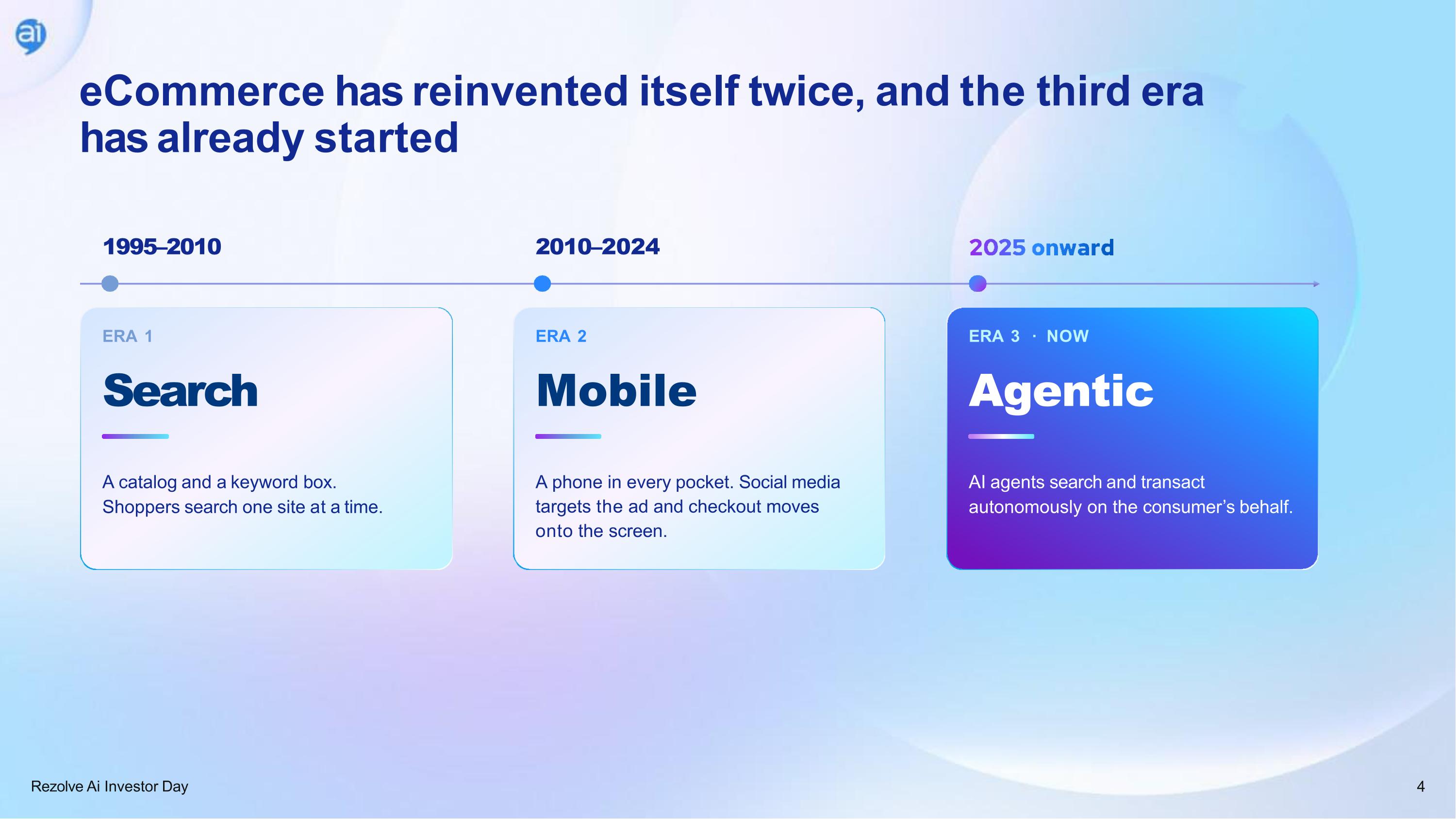
eCommerce has reinvented itself twice, and the third era has already started 1995–2010 2010–2024 ERA 1 Search A catalog and a keyword box. Shoppers search one site at a time. ERA 2 Mobile A phone in every pocket. Social media targets the ad and checkout moves onto the screen. ERA 3 · NOW Agentic AI agents search and transact autonomously on the consumer’s behalf. Rezolve Ai Investor Day
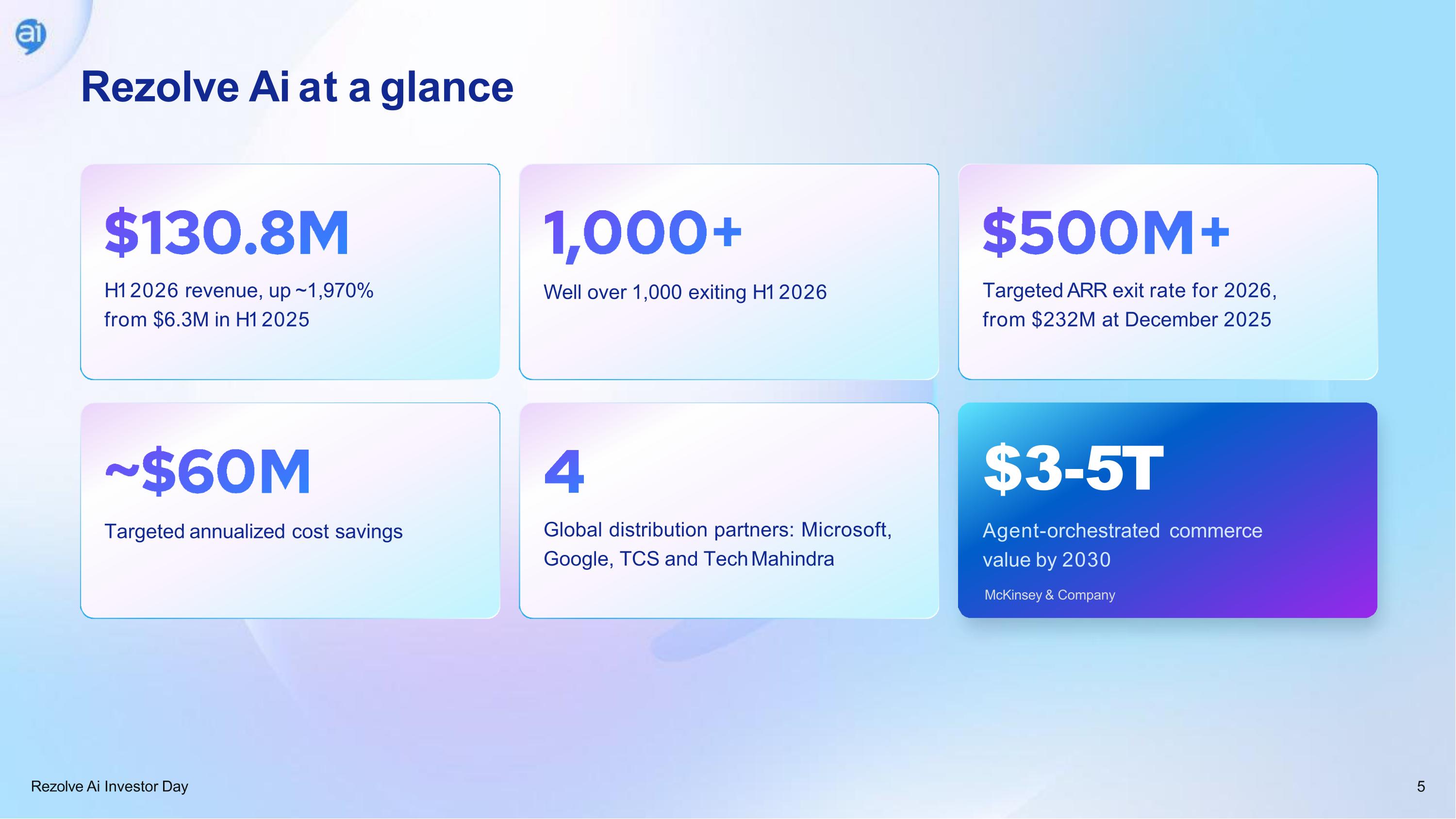
Rezolve Ai at a glance H1 2026 revenue, up ~1,970% from $6.3M in H1 2025 Targeted ARR exit rate for 2026, from $232M at December 2025 Well over 1,000 exiting H1 2026 Global distribution partners: Microsoft, Google, TCS and Tech Mahindra Targeted annualized cost savings $3-5T Agent-orchestrated commerce value by 2030 McKinsey & Company Rezolve Ai Investor Day
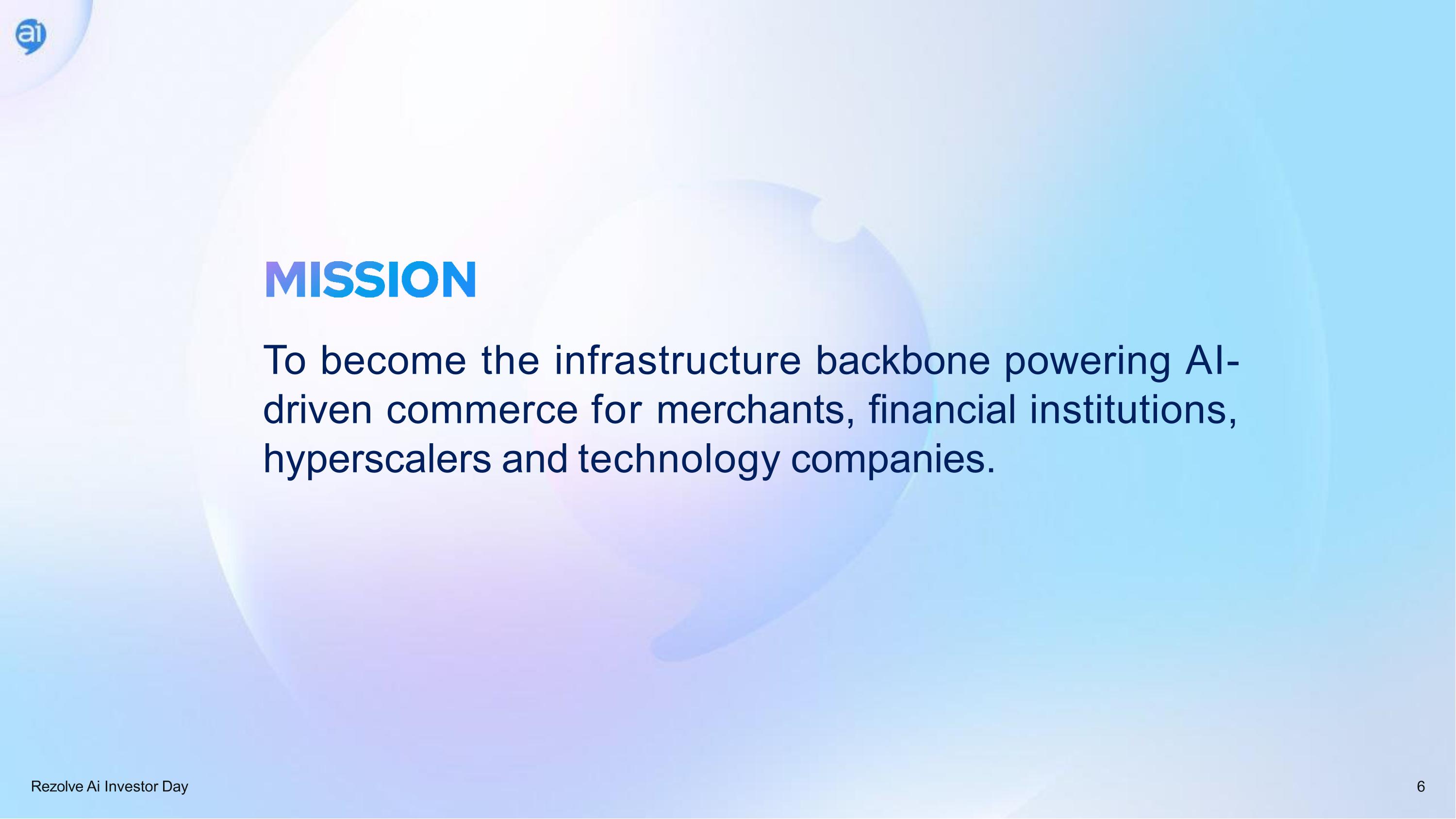
To become the infrastructure backbone powering AI-driven commerce for merchants, financial institutions, hyperscalers and technology companies. Rezolve Ai Investor Day
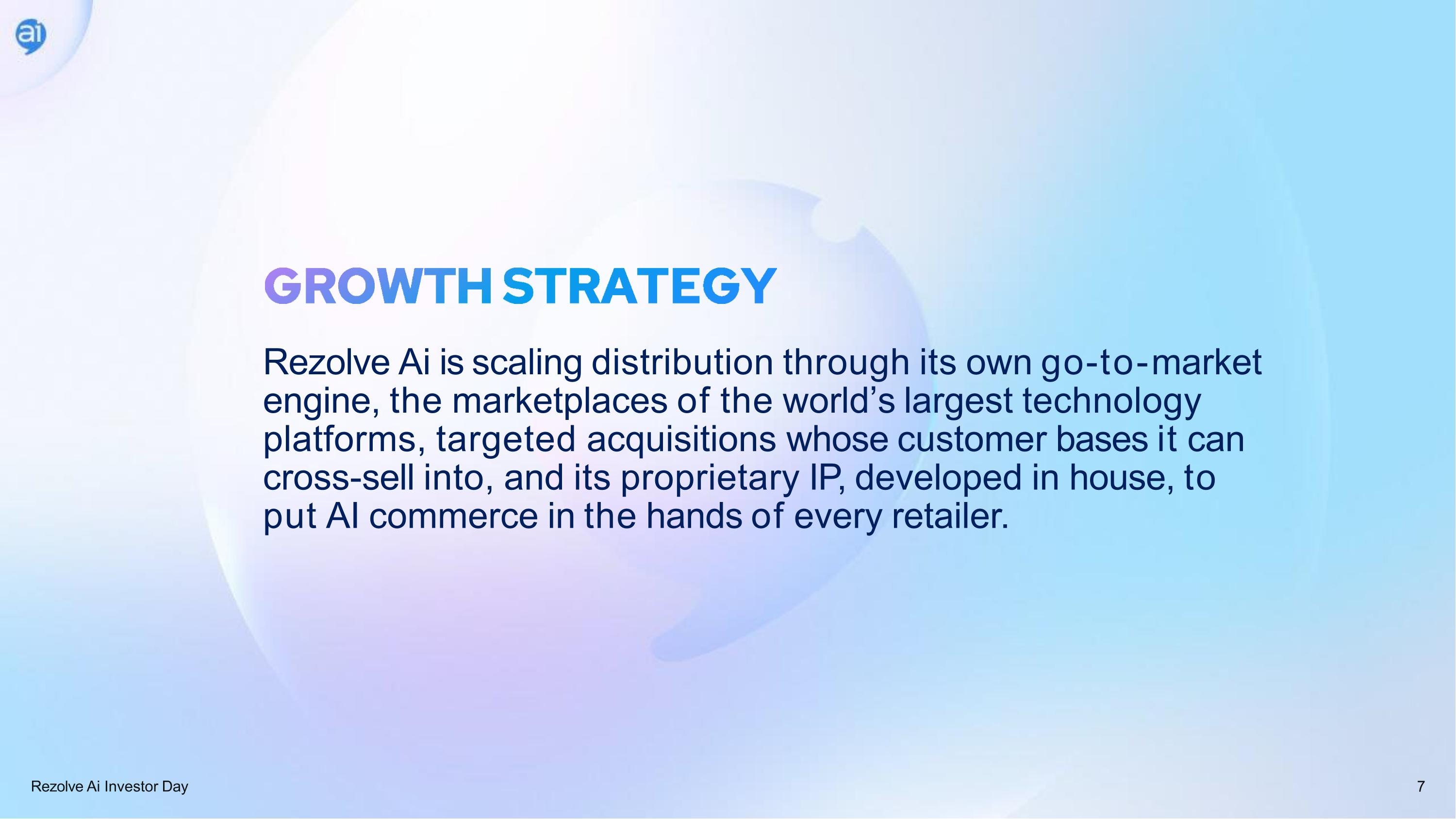
Rezolve Ai is scaling distribution through its own go-to-market engine, the marketplaces of the world’s largest technology platforms, targeted acquisitions whose customer bases it can cross-sell into, and its proprietary IP, developed in house, to put AI commerce in the hands of every retailer. Rezolve Ai Investor Day
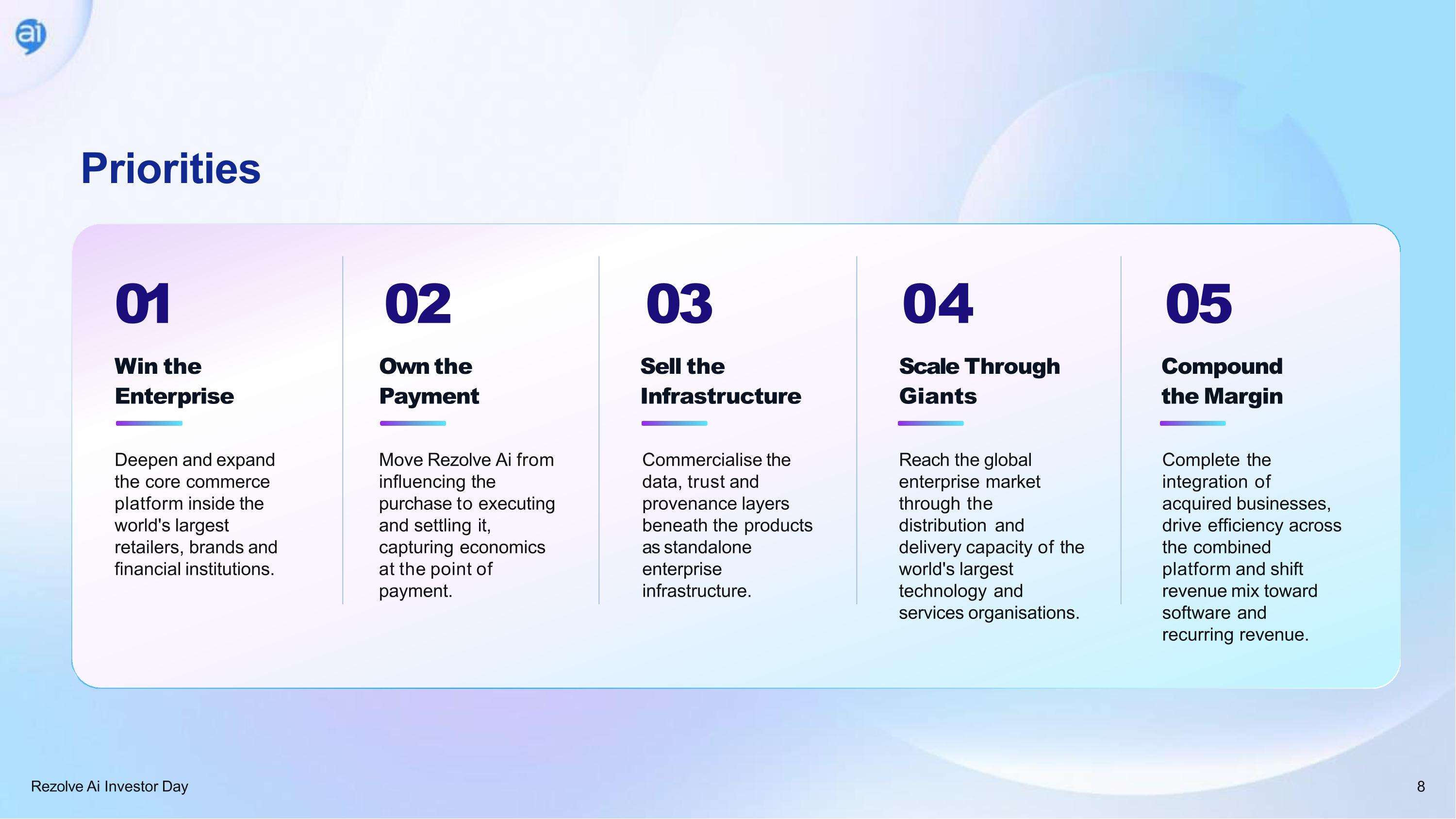
Priorities Deepen and expand the core commerce platform inside the world's largest retailers, brands and financial institutions. Move Rezolve Ai from influencing the purchase to executing and settling it, capturing economics at the point of payment. Commercialise the data, trust and provenance layers beneath the products as standalone enterprise infrastructure. Reach the global enterprise market through the distribution and delivery capacity of the world's largest technology and services organisations. Complete the integration of acquired businesses, drive efficiency across the combined platform and shift revenue mix toward software and recurring revenue. 01 Win the Enterprise Rezolve Ai Investor Day 02 Own the Payment 03 Sell the Infrastructure 04 Scale Through Giants 05 Compound the Margin
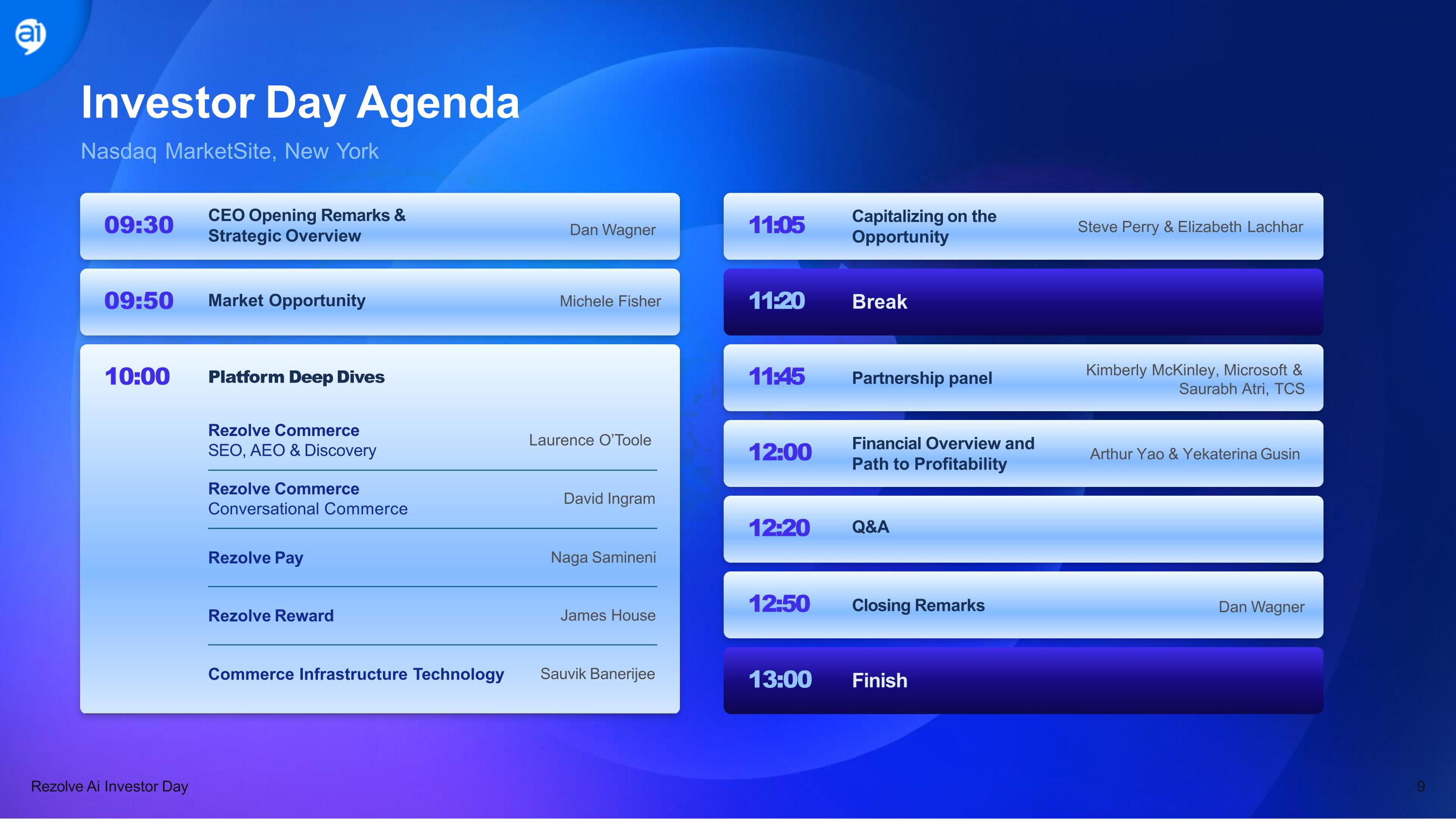
Investor Day Agenda Nasdaq MarketSite, New York 09:30 Dan Wagner 09:50 Market Opportunity Michele Fisher 10:00 Platform Deep Dives Rezolve Commerce SEO, AEO & Discovery Laurence O’Toole Rezolve Commerce Conversational Commerce David Ingram Rezolve Reward James House Rezolve Pay Naga Samineni Commerce Infrastructure Technology Sauvik Banerijee 11:05 Capitalizing on the Opportunity Steve Perry & Elizabeth Lachhar 11:20 Break 11:45 Partnership panel Kimberly McKinley, Microsoft & Saurabh Atri, TCS 12:00 Arthur Yao & Yekaterina Gusin 12:20 Q&A 12:50 Dan Wagner 13:00 Rezolve Ai Investor Day Finish CEO Opening Remarks & Strategic Overview Financial Overview and Path to Profitability Closing Remarks

10 10 Rezolve Ai Investor Day
Rezolve Ai Investor Day Michele Fisher Chief Marketing Officer, Rezolve Ai Market Opportunity 11
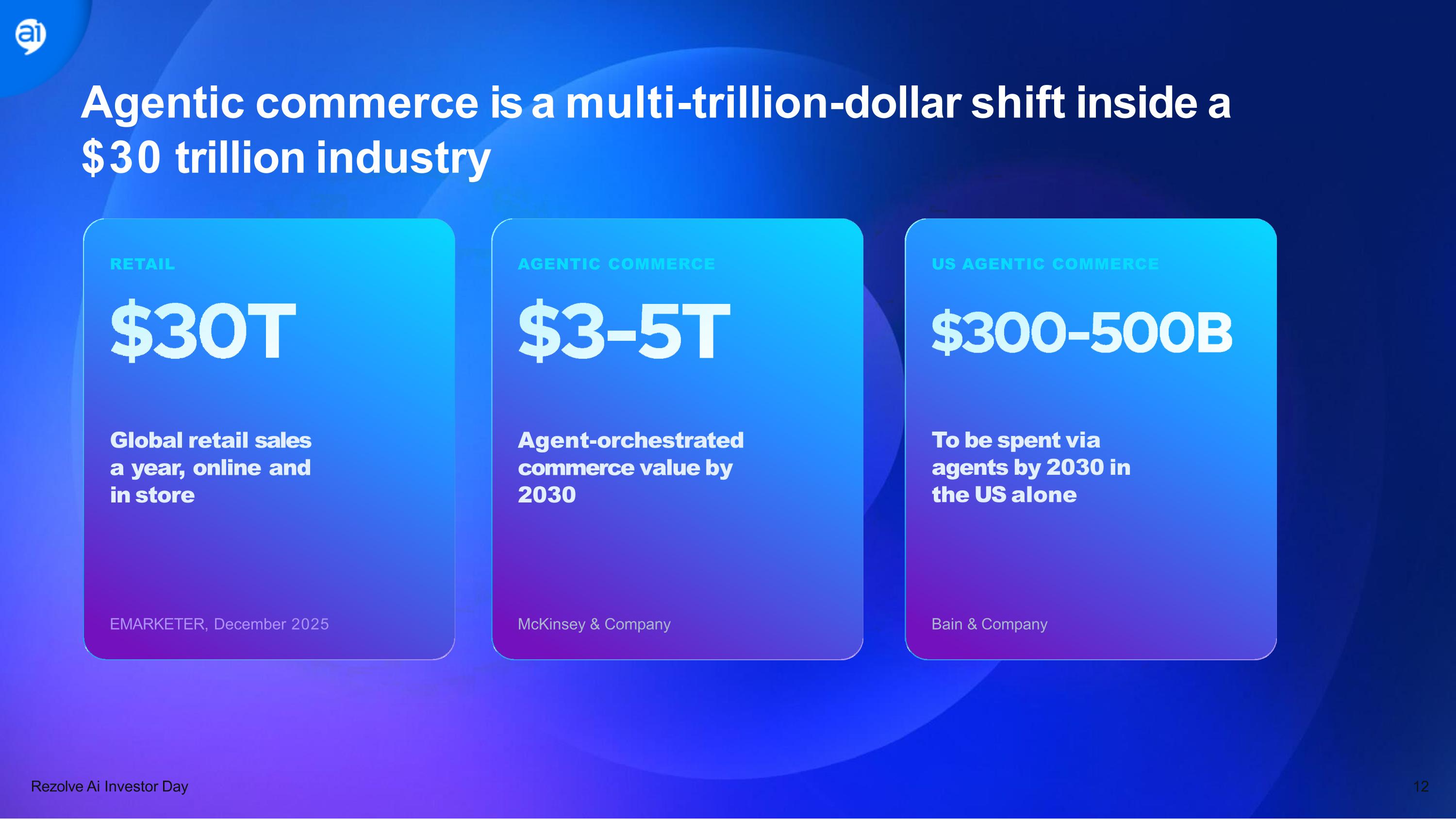
Agentic commerce is a multi-trillion-dollar shift inside a $30 trillion industry RETAIL Global retail sales a year, online and in store EMARKETER, December 2025 AGENTIC COMMERCE Agent-orchestrated commerce value by 2030 McKinsey & Company US AGENTIC COMMERCE To be spent via agents by 2030 in the US alone Rezolve Ai Investor Day 12 Bain & Company
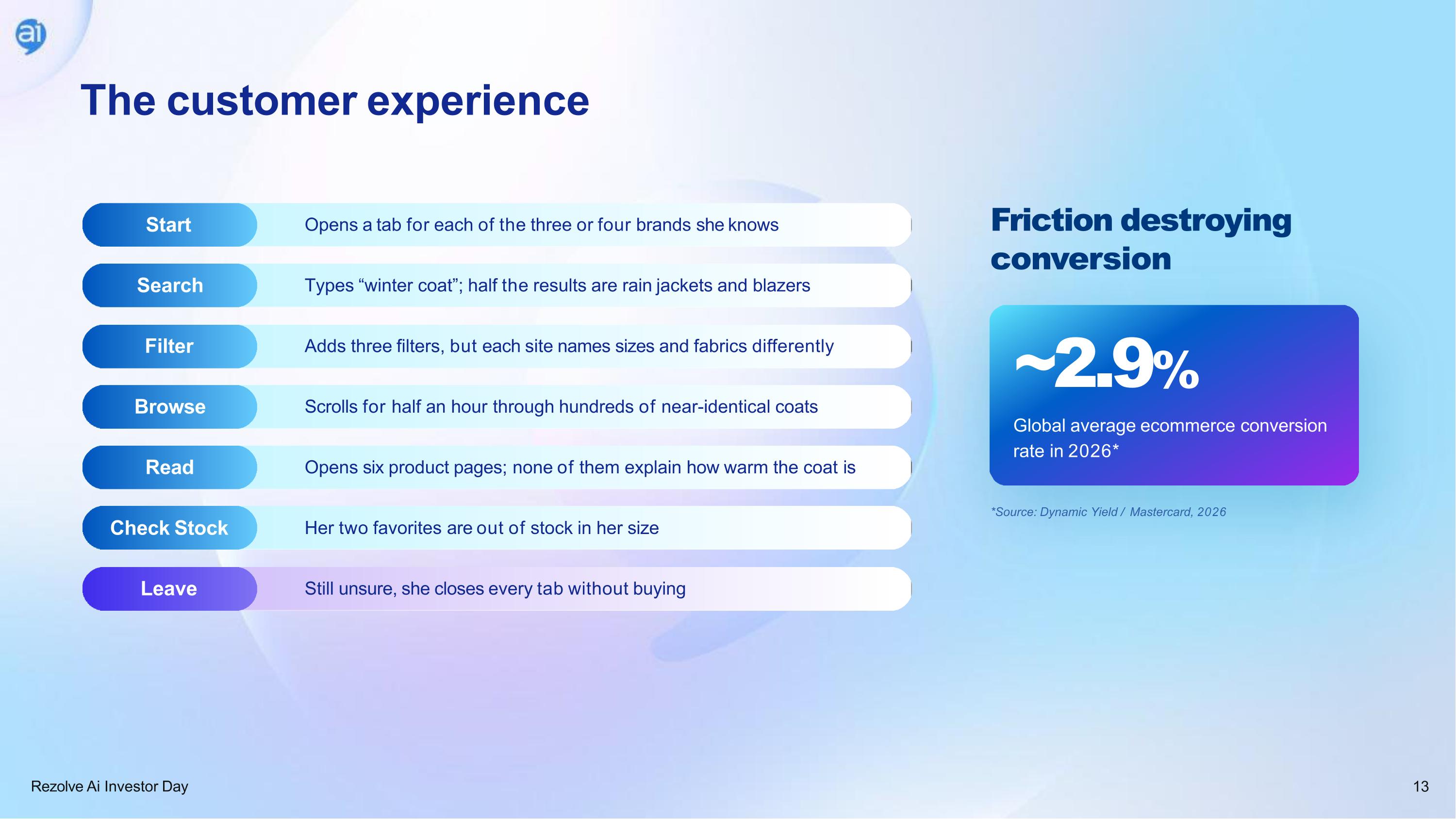
The customer experience Start Opens a tab for each of the three or four brands she knows Search Types “winter coat”; half the results are rain jackets and blazers Filter Adds three filters, but each site names sizes and fabrics differently Browse Scrolls for half an hour through hundreds of near-identical coats Read Opens six product pages; none of them explain how warm the coat is Check Stock Her two favorites are out of stock in her size Leave Still unsure, she closes every tab without buying Friction destroying conversion ~2.9% Global average ecommerce conversion rate in 2026* Rezolve Ai Investor Day 13 *Source: Dynamic Yield / Mastercard, 2026
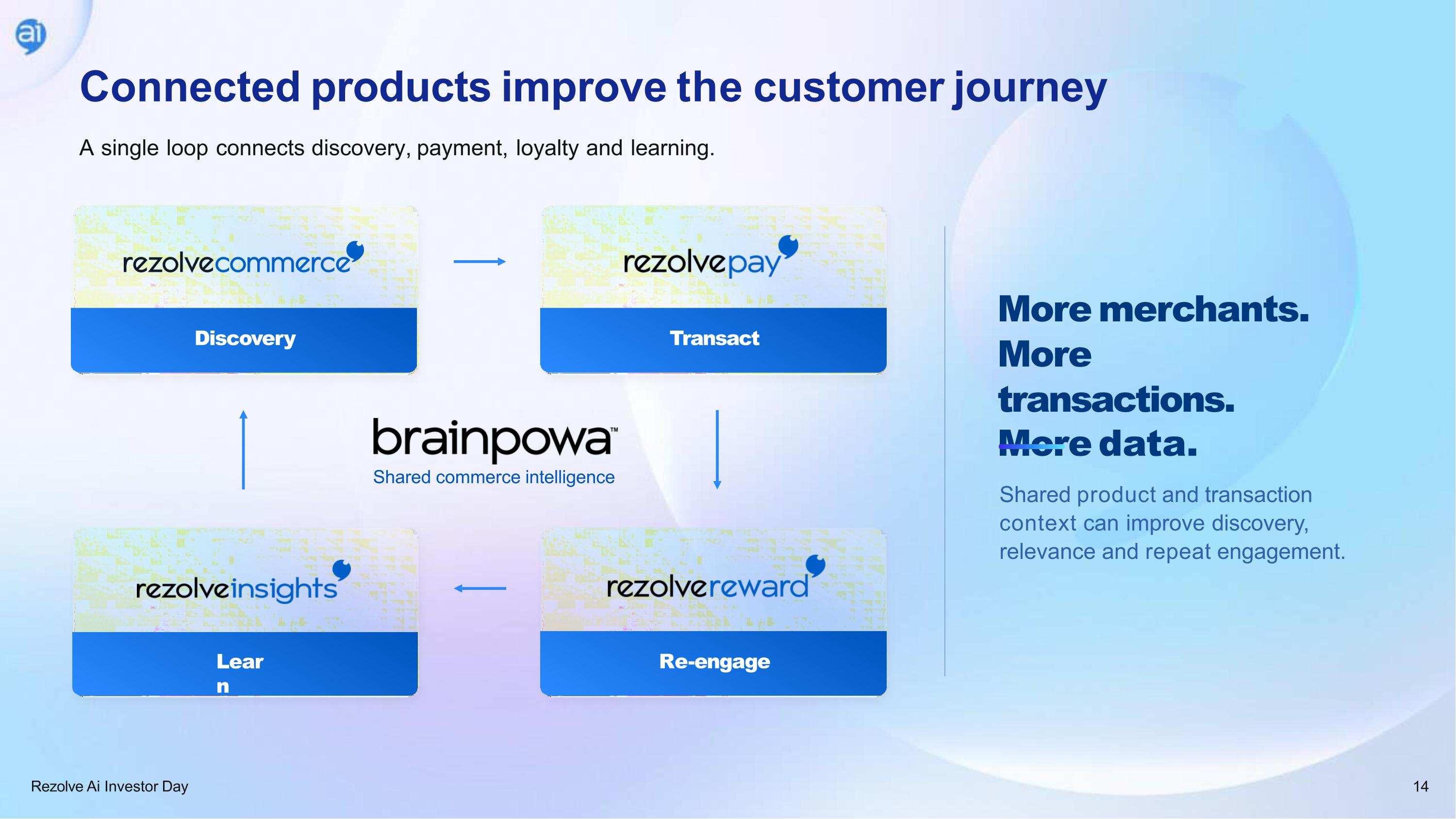
Connected products improve the customer journey A single loop connects discovery, payment, loyalty and learning. Discovery Transact Re-engage Learn Shared commerce intelligence More merchants. More transactions. More data. Shared product and transaction context can improve discovery, relevance and repeat engagement. Rezolve Ai Investor Day 14
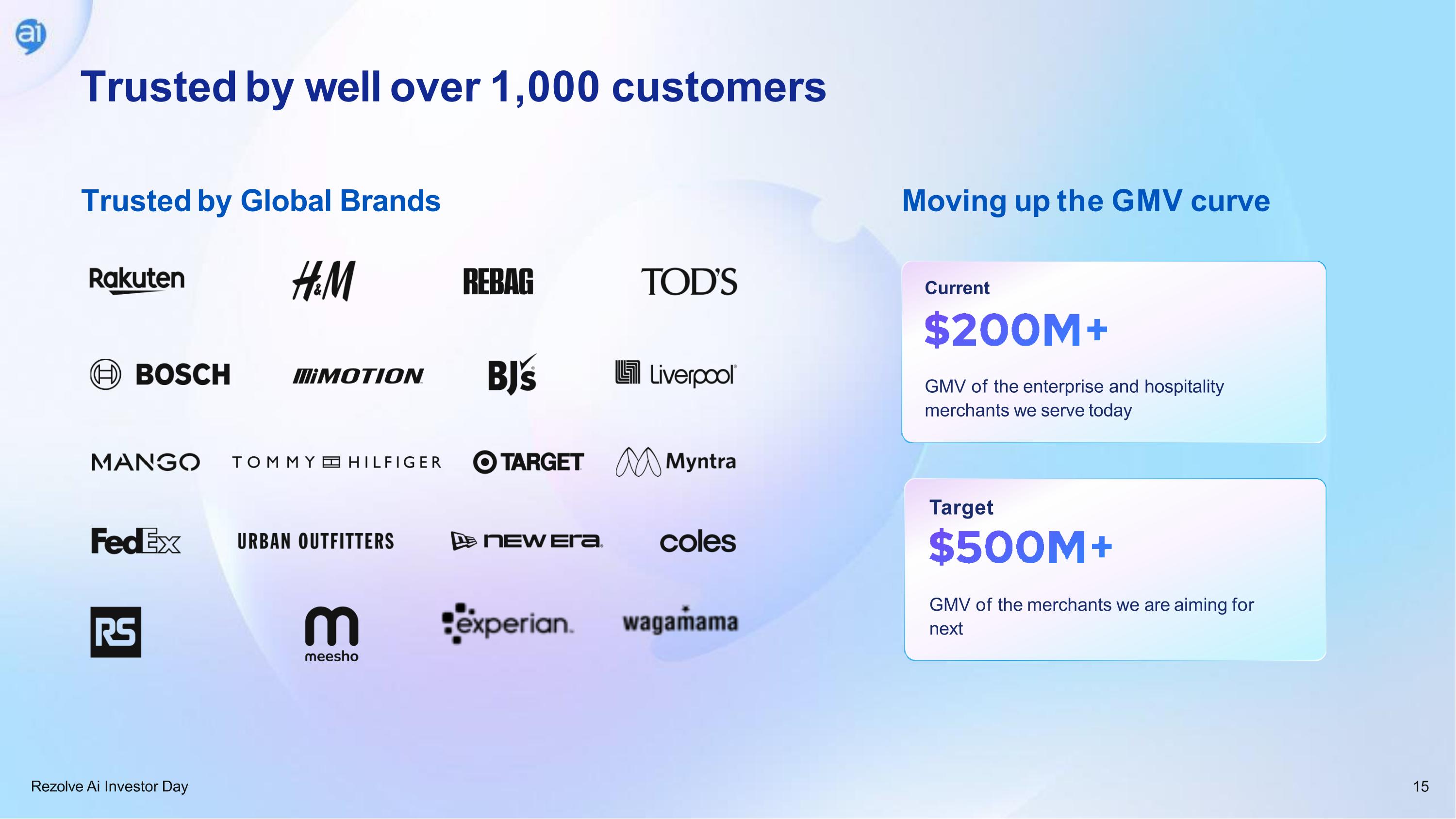
Trusted by well over 1,000 customers Trusted by Global Brands Moving up the GMV curve GMV of the enterprise and hospitality merchants we serve today Current GMV of the merchants we are aiming for next Target Rezolve Ai Investor Day 15
Rezolve Ai Investor Day Laurence O’Toole VP SEO, AEO & Discovery, Rezolve Ai SEO, AEO & Discovery 16
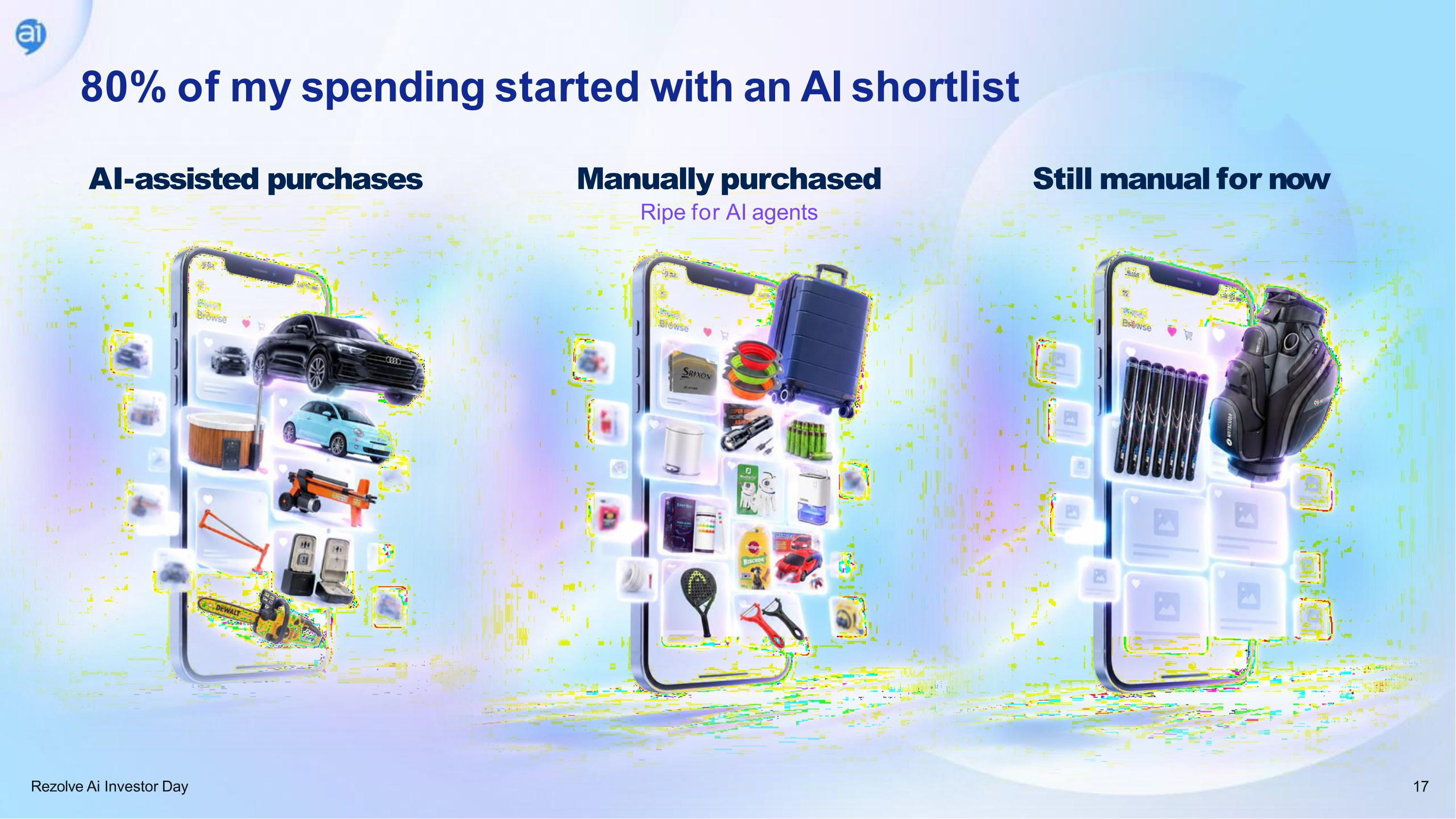
80% of my spending started with an AI shortlist Rezolve Ai Investor Day 17 AI-assisted purchases Manually purchased Ripe for AI agents Still manual for now
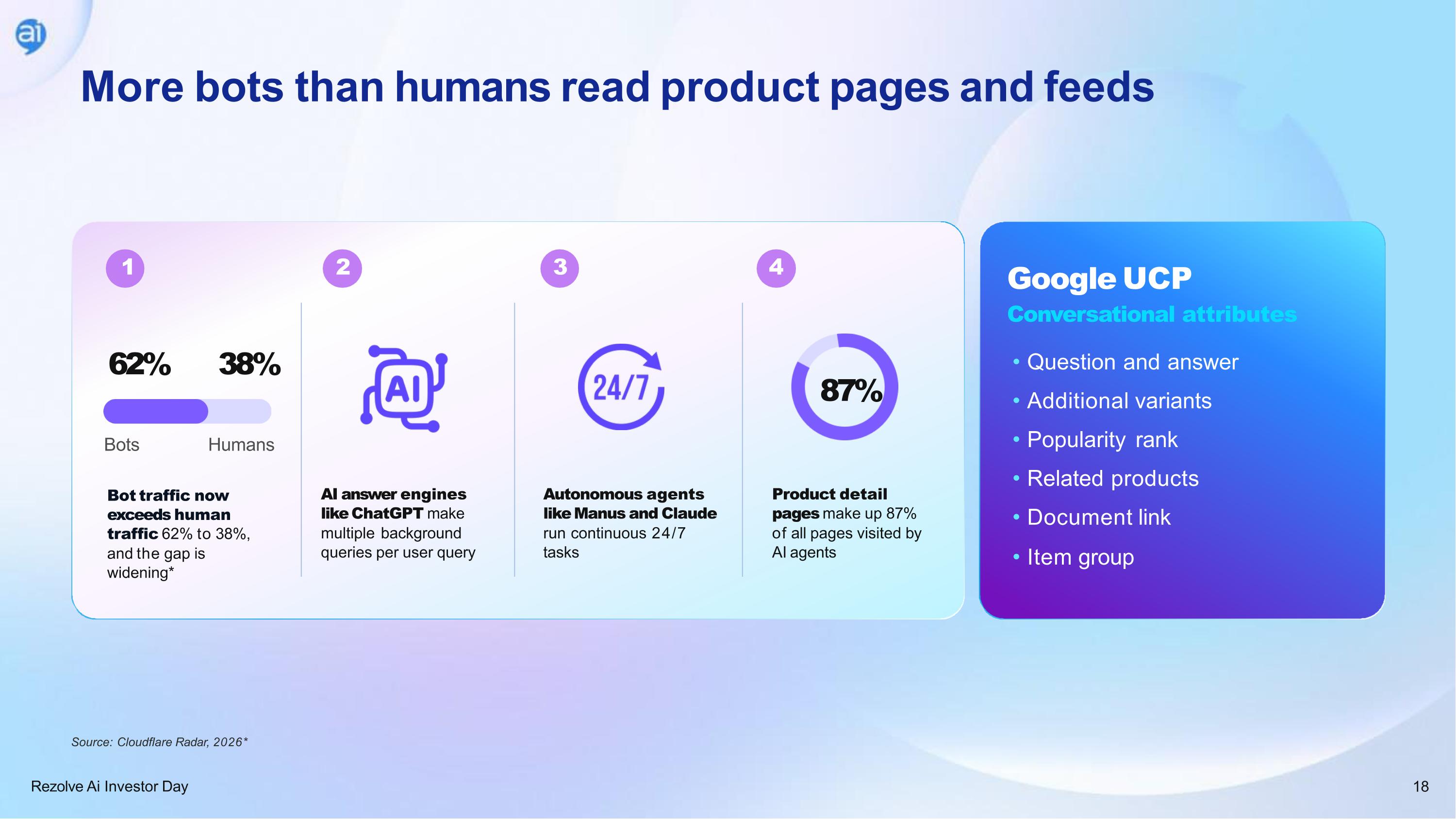
More bots than humans read product pages and feeds Google UCP Conversational attributes Question and answer Additional variants Popularity rank Related products Document link Item group 62% 38% Bots Humans Bot traffic now exceeds human traffic 62% to 38%, and the gap is widening* 1 2 3 AI answer engines like ChatGPT make multiple background queries per user query 4 Autonomous agents like Manus and Claude run continuous 24/7 tasks Rezolve Ai Investor Day 18 87% Product detail pages make up 87% of all pages visited by AI agents Source: Cloudflare Radar, 2026*
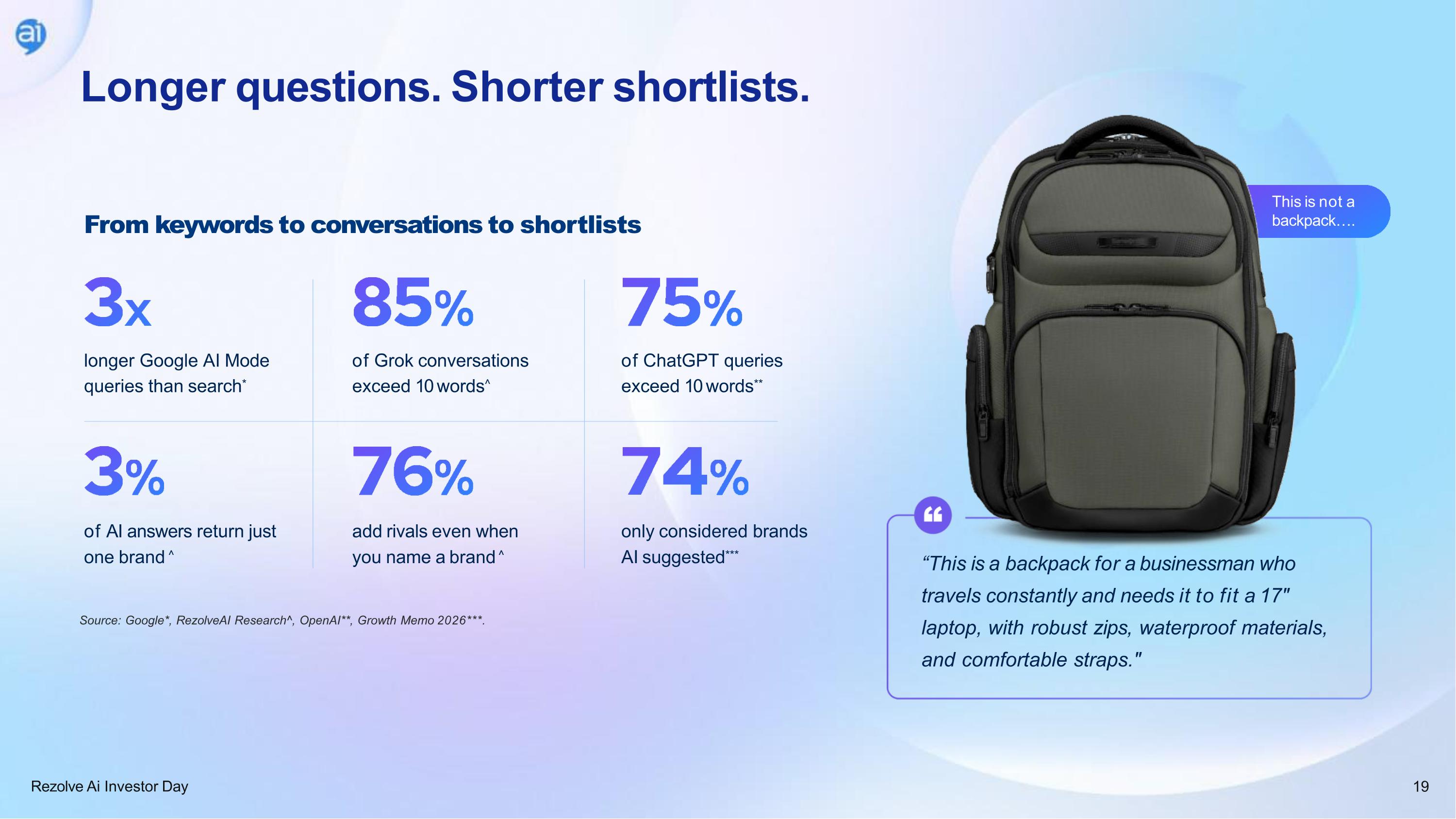
“This is a backpack for a businessman who travels constantly and needs it to fit a 17" laptop, with robust zips, waterproof materials, and comfortable straps." From keywords to conversations to shortlists longer Google AI Mode queries than search* of Grok conversations exceed 10 words^ of ChatGPT queries exceed 10 words** of AI answers return just one brand ^ add rivals even when you name a brand ^ only considered brands AI suggested*** Longer questions. Shorter shortlists. Source: Google*, RezolveAI Research^, OpenAI**, Growth Memo 2026***. This is not a backpack…. Rezolve Ai Investor Day 19
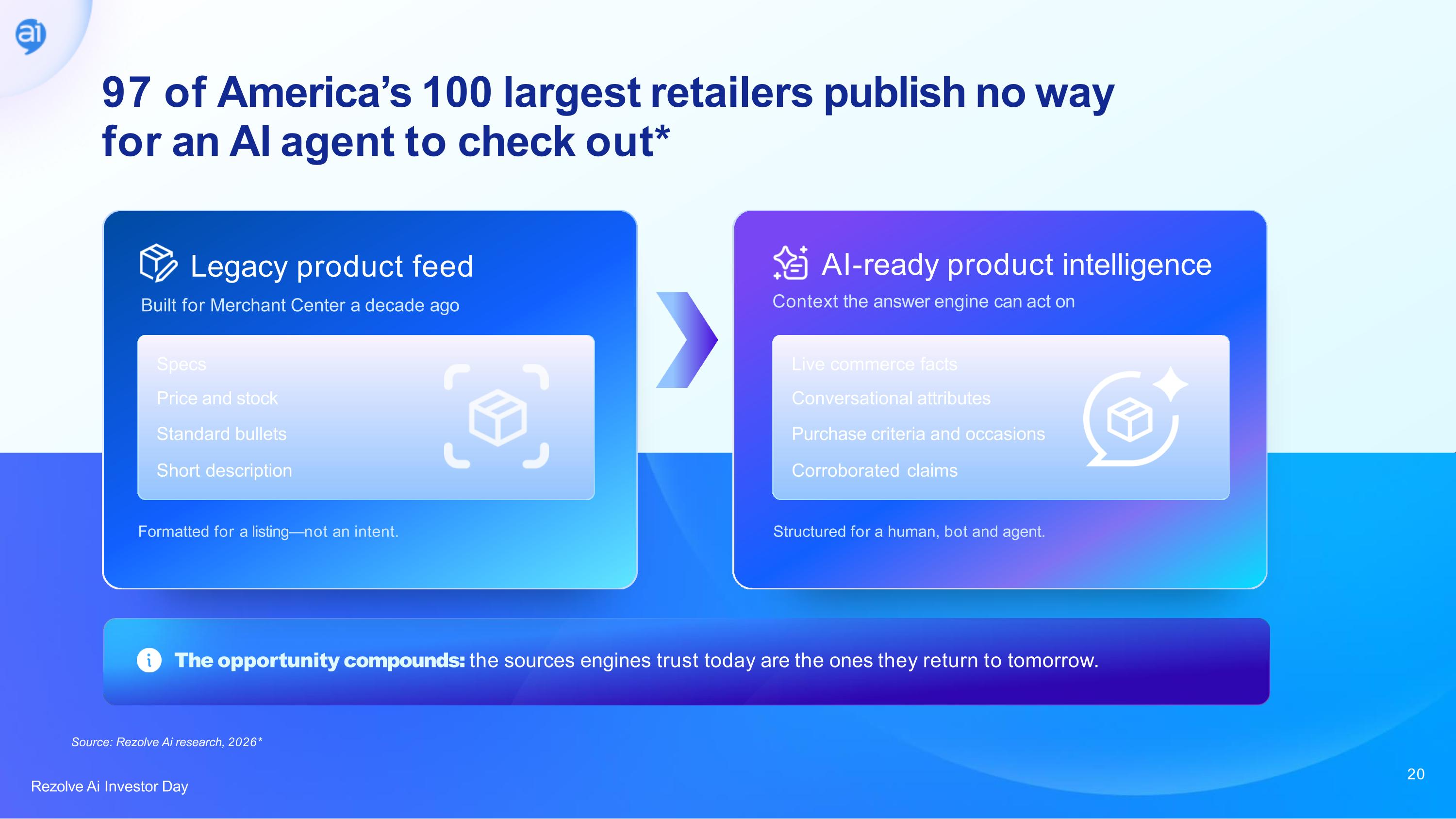
Live commerce facts Conversational attributes Purchase criteria and occasions Corroborated claims Structured for a human, bot and agent. Specs Price and stock Standard bullets Short description Legacy product feed Built for Merchant Center a decade ago Formatted for a listing—not an intent. The opportunity compounds: the sources engines trust today are the ones they return to tomorrow. 97 of America’s 100 largest retailers publish no way for an AI agent to check out* AI-ready product intelligence Context the answer engine can act on Source: Rezolve Ai research, 2026* Rezolve Ai Investor Day
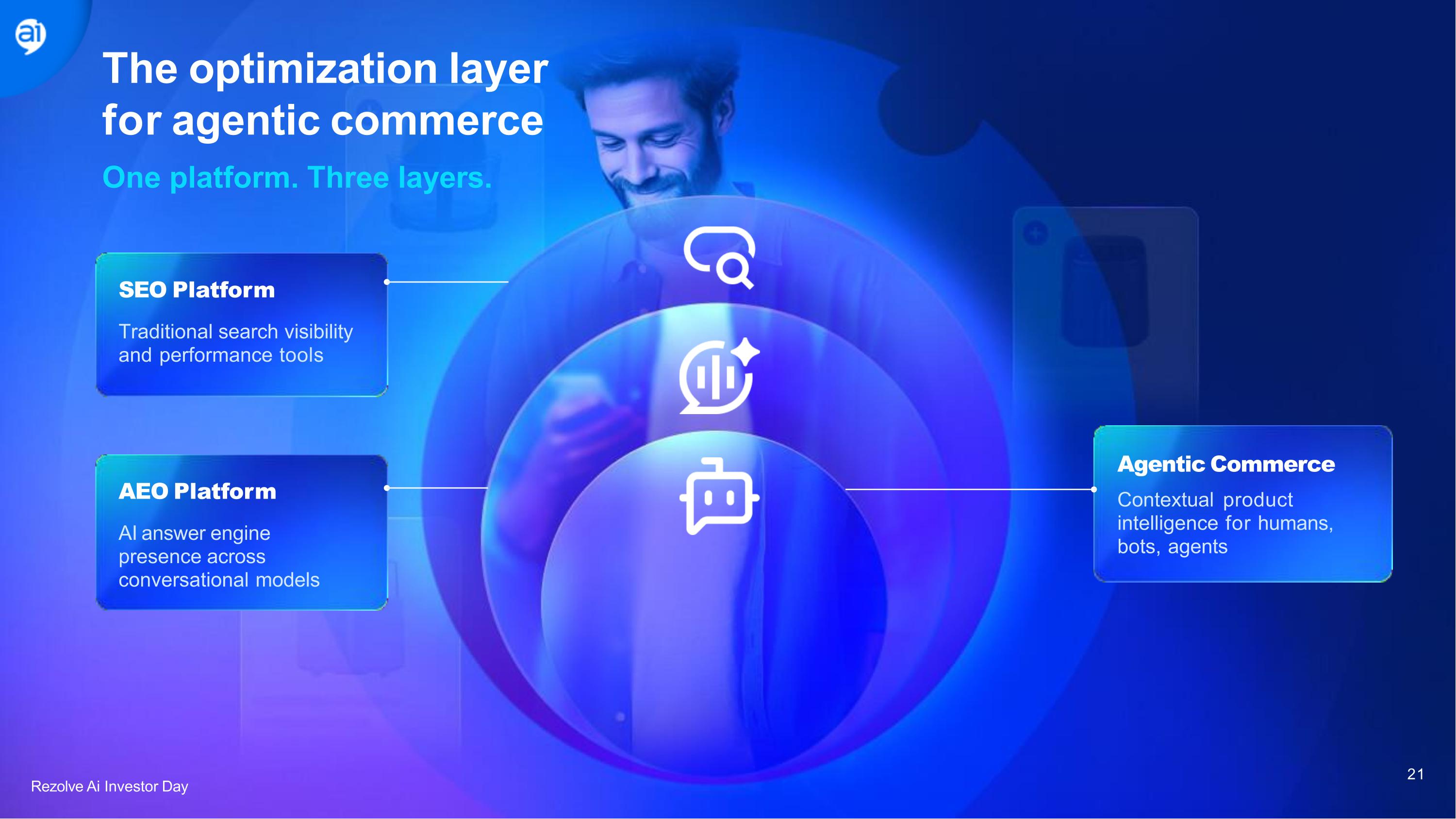
The optimization layer for agentic commerce One platform. Three layers. Agentic Commerce Contextual product intelligence for humans, bots, agents SEO Platform Traditional search visibility and performance tools AEO Platform AI answer engine presence across conversational models Rezolve Ai Investor Day

Rezolve Ai Investor Day 22

23 Rezolve Ai Investor Day
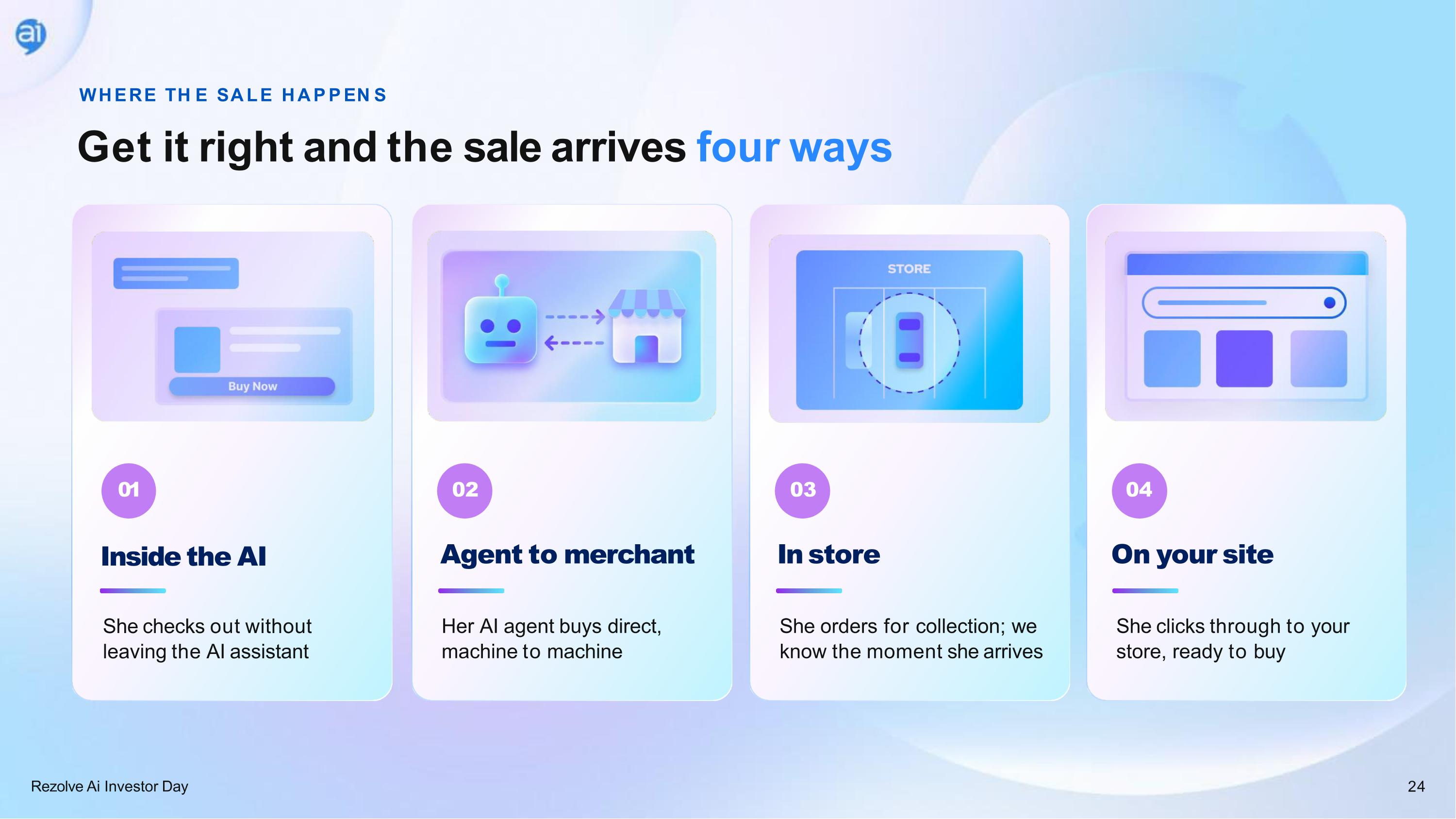
Inside the AI She checks out without leaving the AI assistant Agent to merchant Her AI agent buys direct, machine to machine Get it right and the sale arrives four ways W H E R E TH E S A L E H A P P EN S 02 01 She orders for collection; we know the moment she arrives 03 She clicks through to your store, ready to buy 04 In store On your site Rezolve Ai Investor Day 24
David Ingram Chief Experience Officer Conversational Commerce Rezolve Ai Investor Day 25

Agentic Commerce Rezolve Ai Investor Day
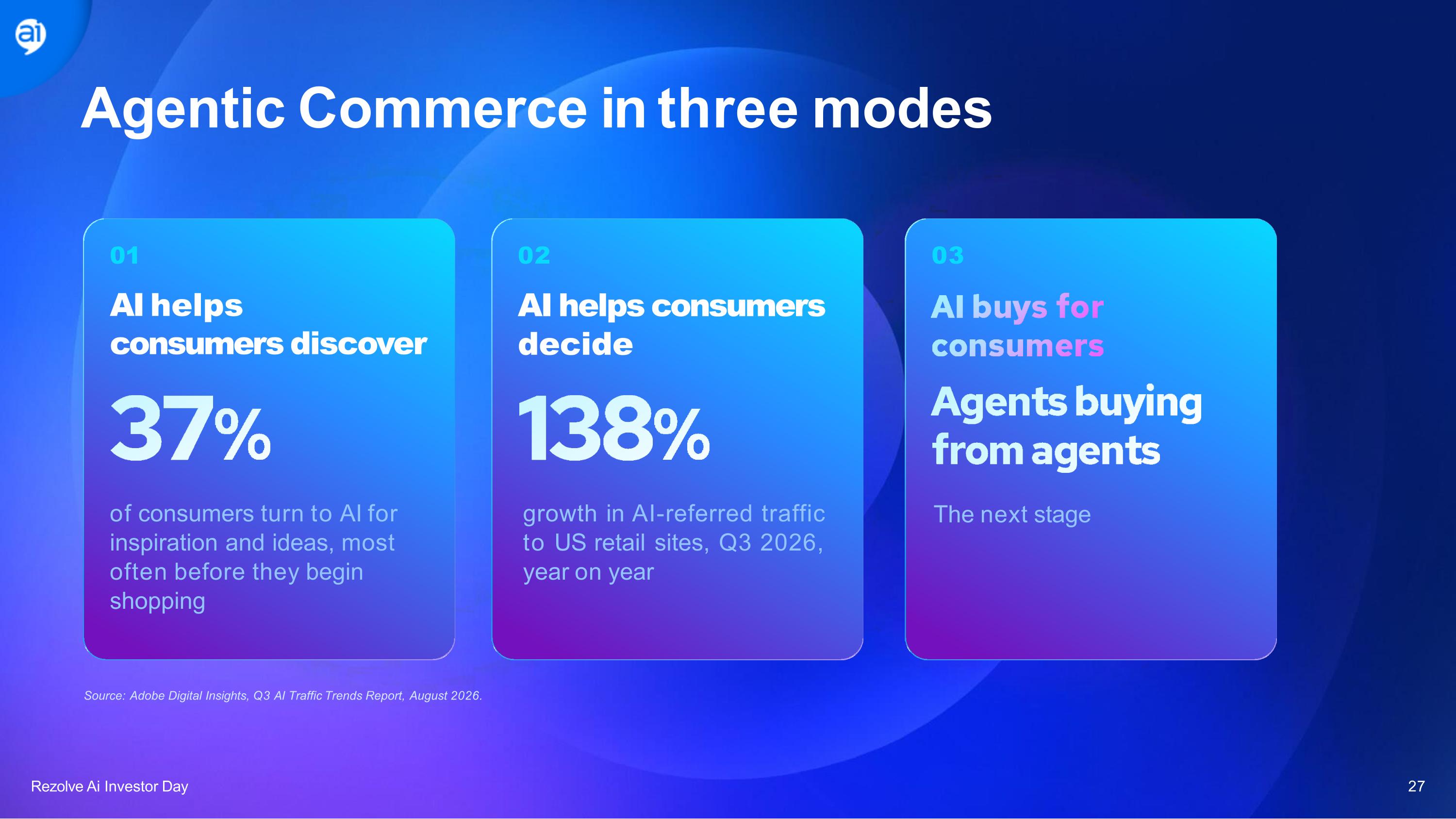
Agentic Commerce in three modes 01 AI helps consumers discover of consumers turn to AI for inspiration and ideas, most often before they begin shopping 02 AI helps consumers decide 03 growth in AI-referred traffic to US retail sites, Q3 2026, year on year Rezolve Ai Investor Day The next stage Source: Adobe Digital Insights, Q3 AI Traffic Trends Report, August 2026.
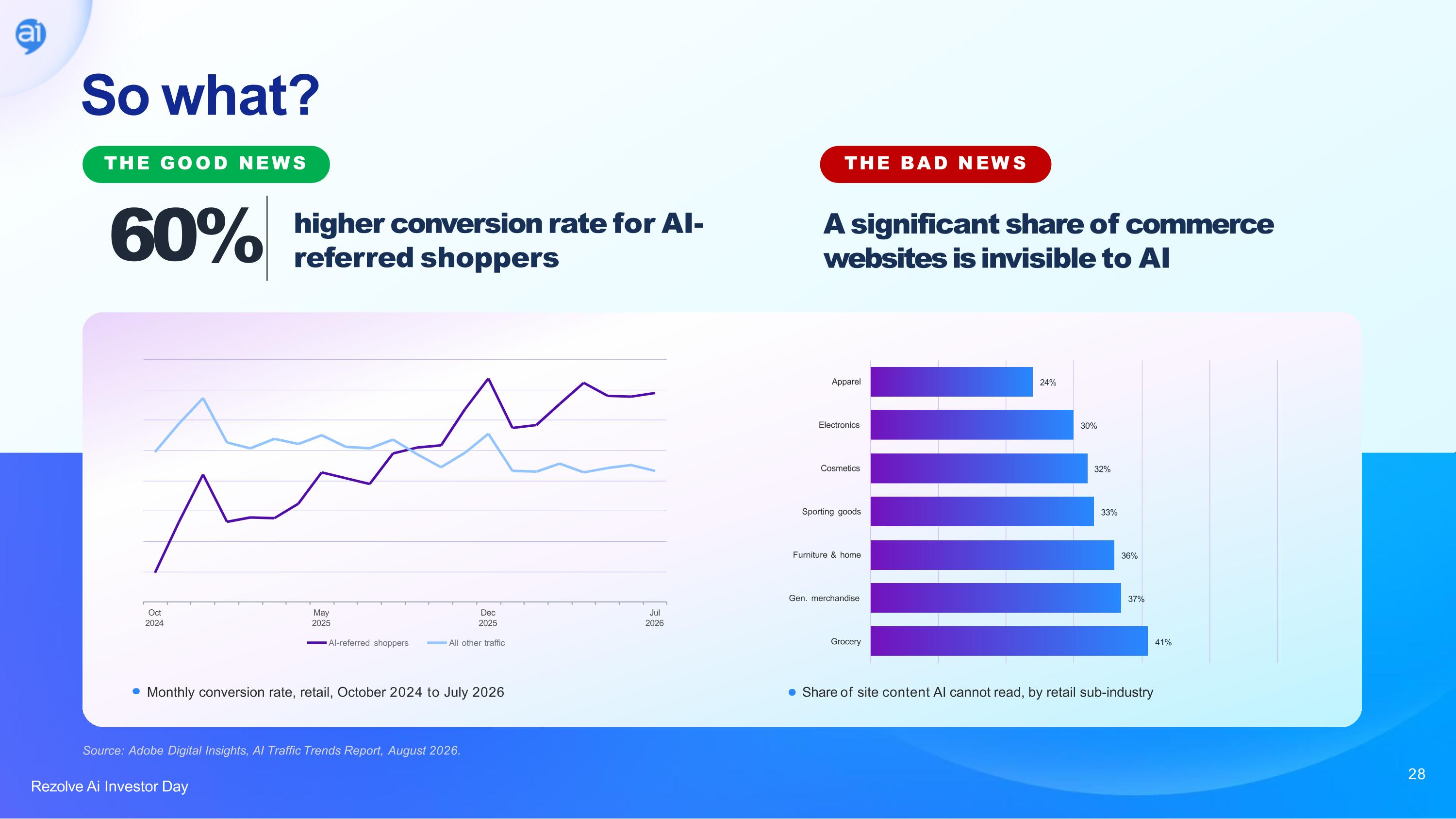
Oct 2024 May 2025 Dec 2025 Jul 2026 AI-referred shoppers All other traffic 41% 37% 36% 33% 32% 30% 24% Grocery Gen. merchandise Furniture & home Sporting goods Cosmetics Electronics Apparel Monthly conversion rate, retail, October 2024 to July 2026 Source: Adobe Digital Insights, AI Traffic Trends Report, August 2026. Share of site content AI cannot read, by retail sub-industry 60% higher conversion rate for AI-referred shoppers A significant share of commerce websites is invisible to AI So what? T H E G O O D N E W S T H E B A D N E W S 28 Rezolve Ai Investor Day
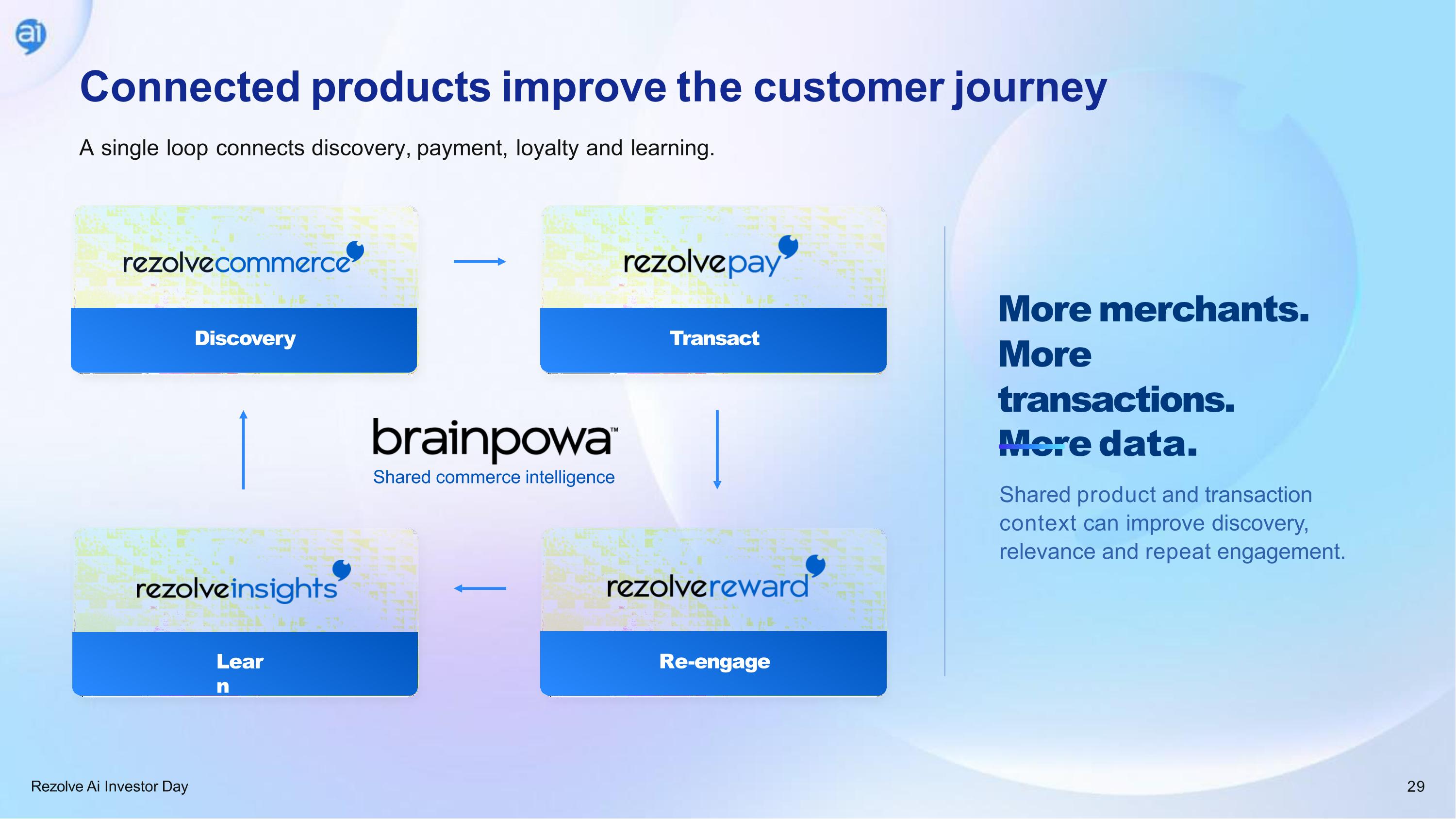
Connected products improve the customer journey A single loop connects discovery, payment, loyalty and learning. Discovery Transact Re-engage Learn Shared commerce intelligence More merchants. More transactions. More data. Shared product and transaction context can improve discovery, relevance and repeat engagement. Rezolve Ai Investor Day

Rezolve Ai Investor Day
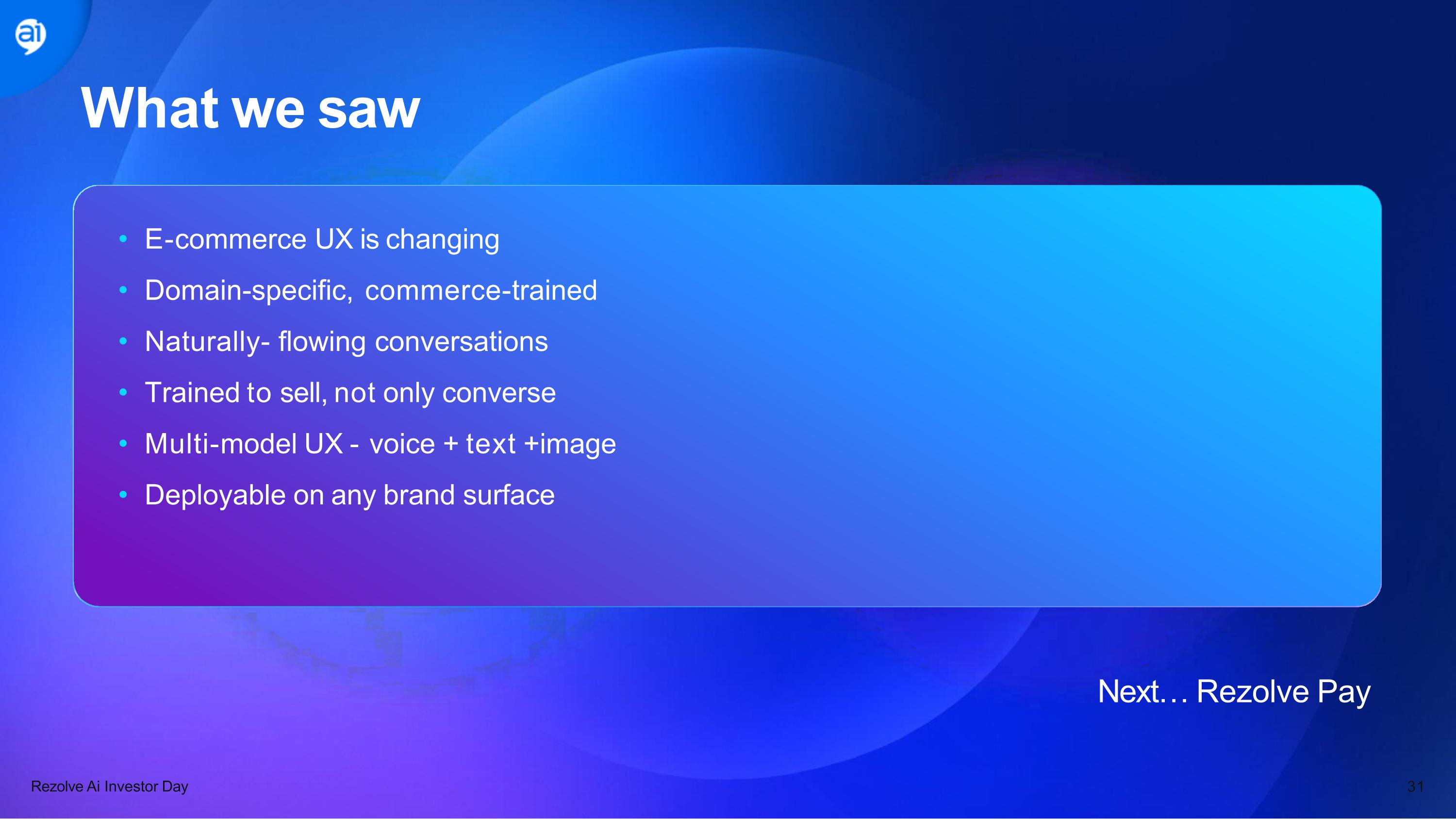
What we saw E-commerce UX is changing Domain-specific, commerce-trained Naturally- flowing conversations Trained to sell, not only converse Multi-model UX - voice + text +image Deployable on any brand surface Rezolve Ai Investor Day Next… Rezolve Pay
Rezolve Ai Investor Day Naga Samineni CEO, RezolvePay RezolvePay 32
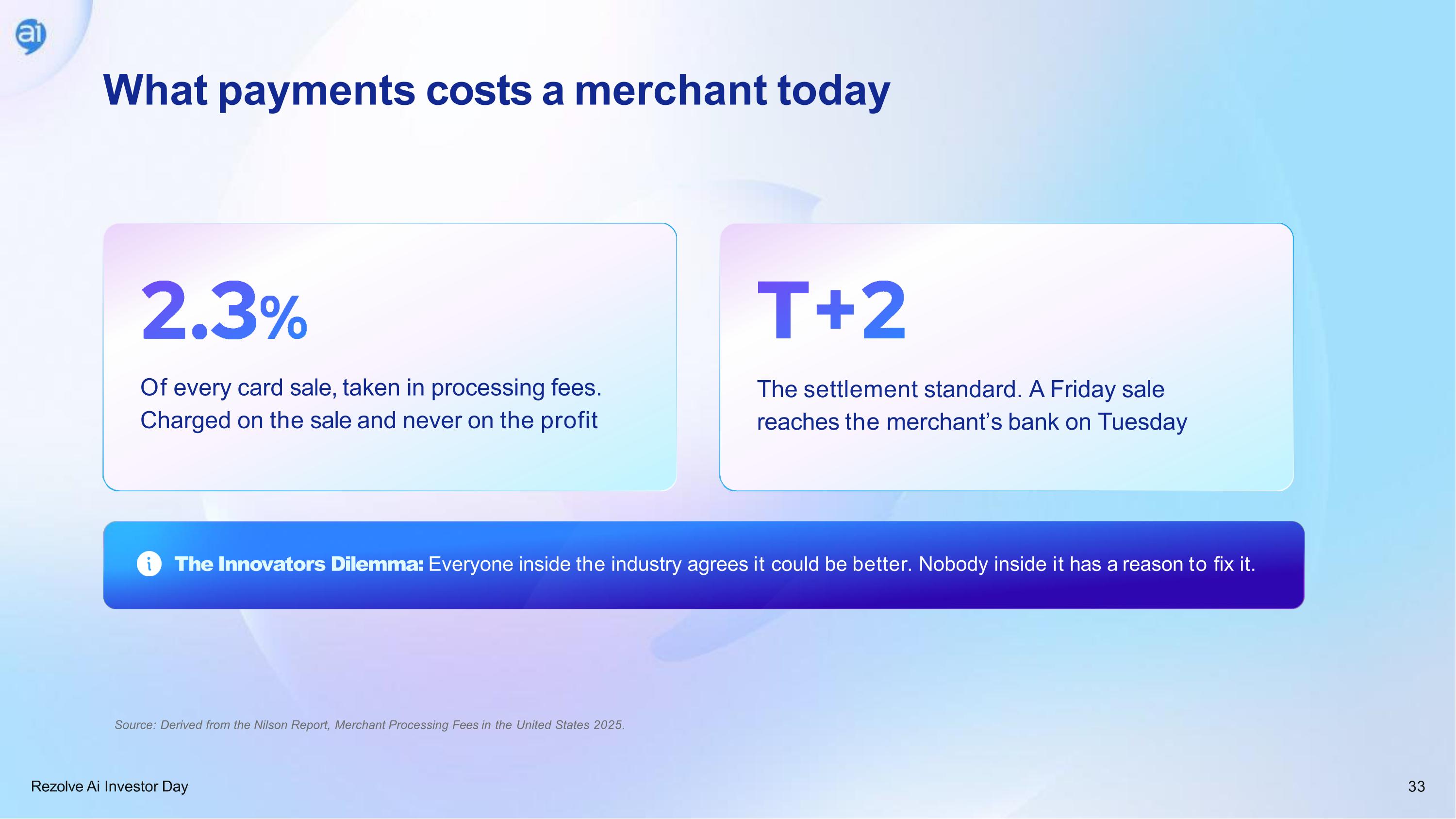
What payments costs a merchant today Of every card sale, taken in processing fees. Charged on the sale and never on the profit The settlement standard. A Friday sale reaches the merchant’s bank on Tuesday Source: Derived from the Nilson Report, Merchant Processing Fees in the United States 2025. The Innovators Dilemma: Everyone inside the industry agrees it could be better. Nobody inside it has a reason to fix it. Rezolve Ai Investor Day
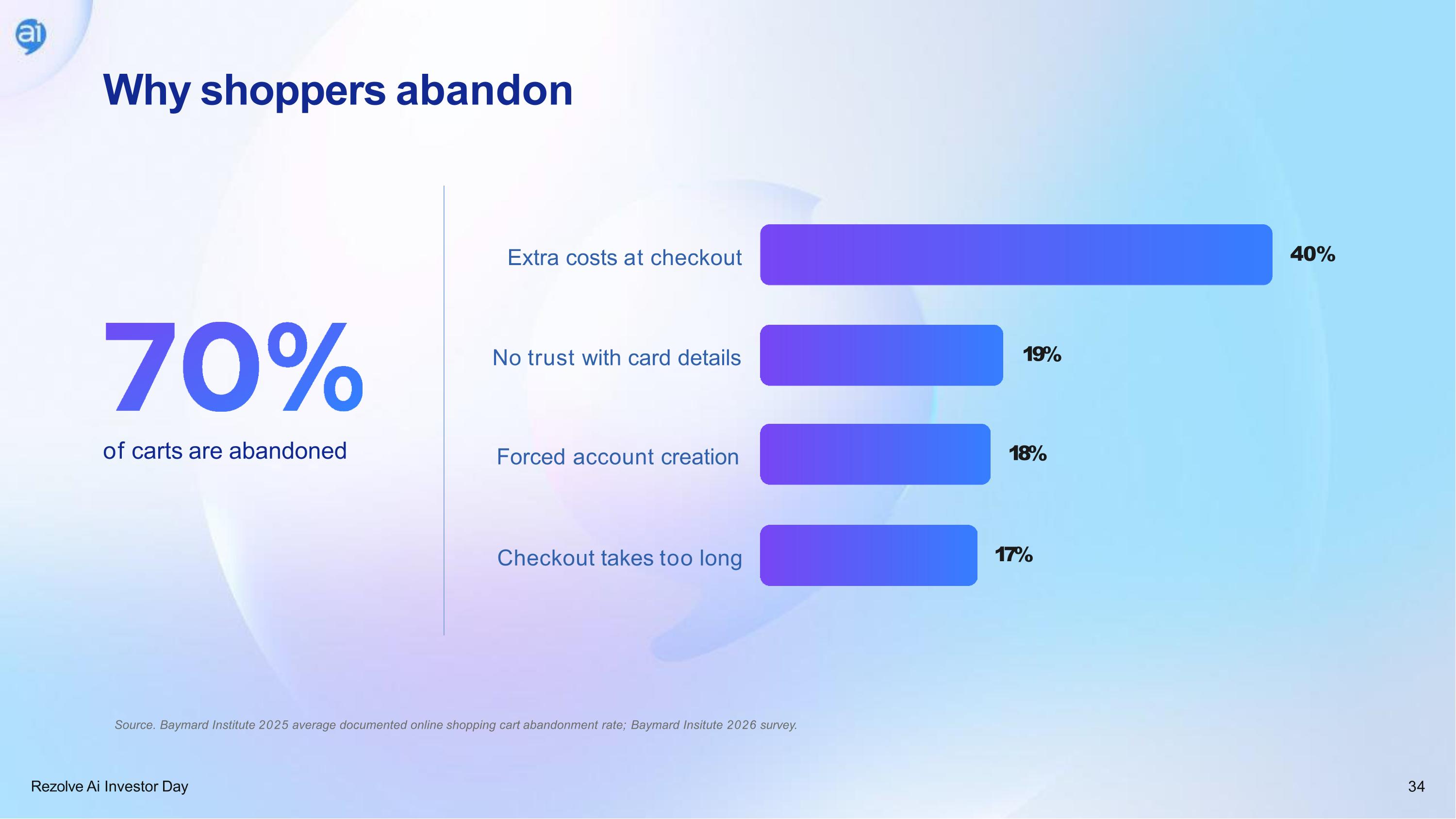
Why shoppers abandon of carts are abandoned Source. Baymard Institute 2025 average documented online shopping cart abandonment rate; Baymard Insitute 2026 survey. 40% 19% 18% 17% Extra costs at checkout Rezolve Ai Investor Day No trust with card details Forced account creation Checkout takes too long
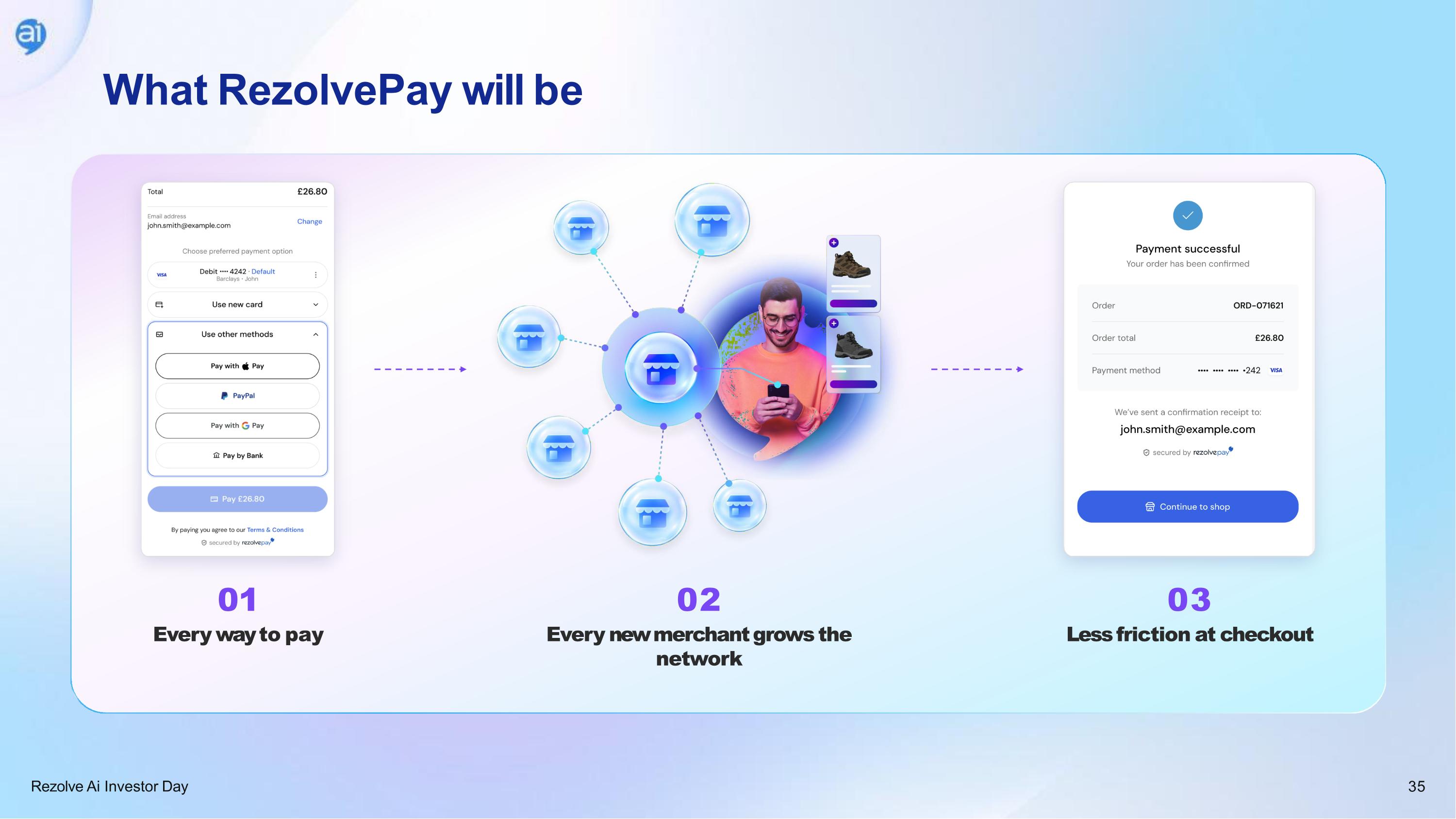
What RezolvePay will be 01 Every way to pay Rezolve Ai Investor Day 02 Every new merchant grows the network 03 Less friction at checkout
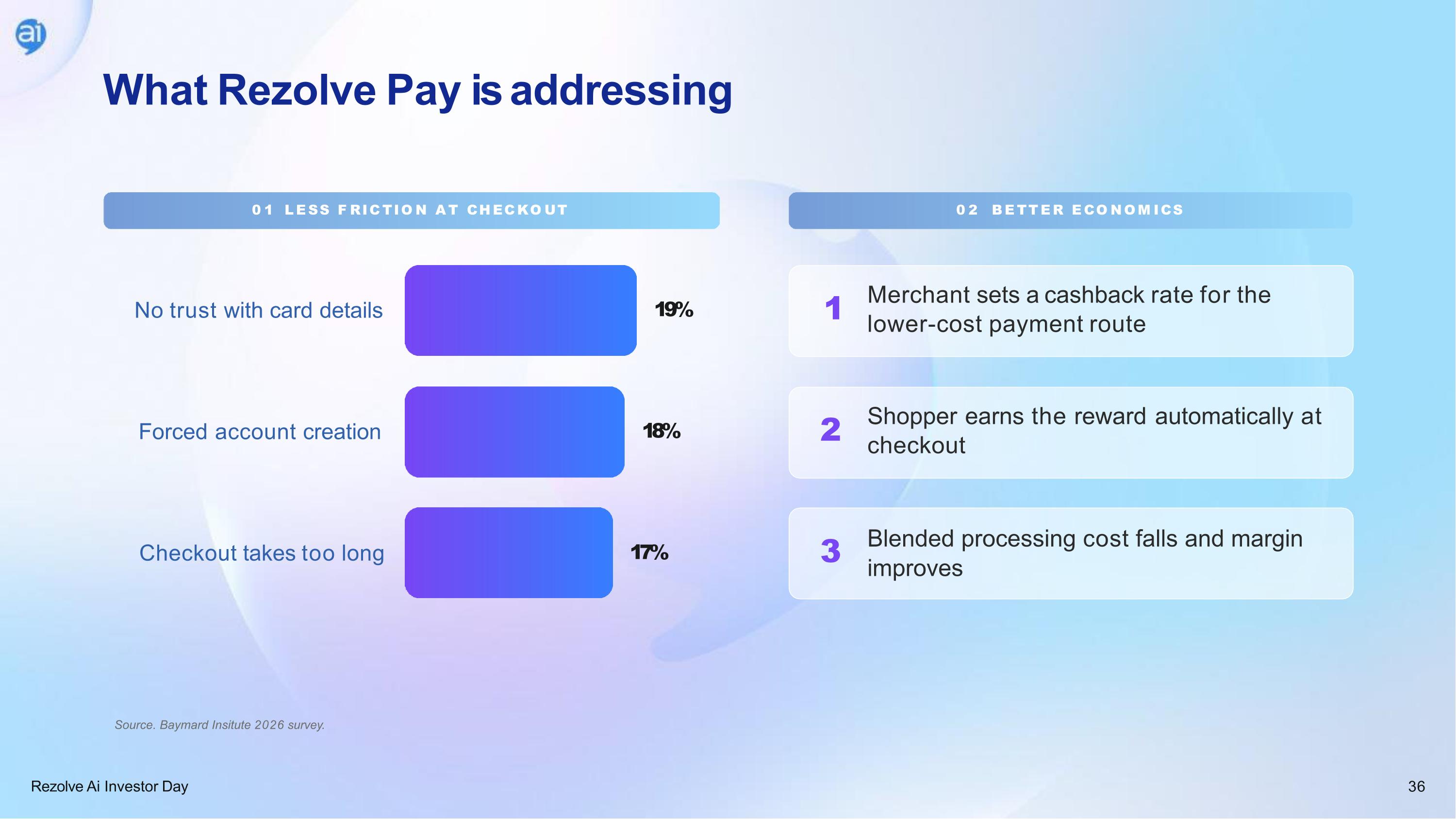
What Rezolve Pay is addressing Source. Baymard Insitute 2026 survey. 19% 18% 17% No trust with card details Forced account creation Checkout takes too long 0 1 L E S S F R I C T I O N A T C H E C K O U T 0 2 B E T T E R E C O N O M I C S 1 Rezolve Ai Investor Day Merchant sets a cashback rate for the lower-cost payment route 2 Shopper earns the reward automatically at checkout 3 Blended processing cost falls and margin improves
Rezolve Ai Investor Day Rezolve Reward 37 James House CEO, Reward
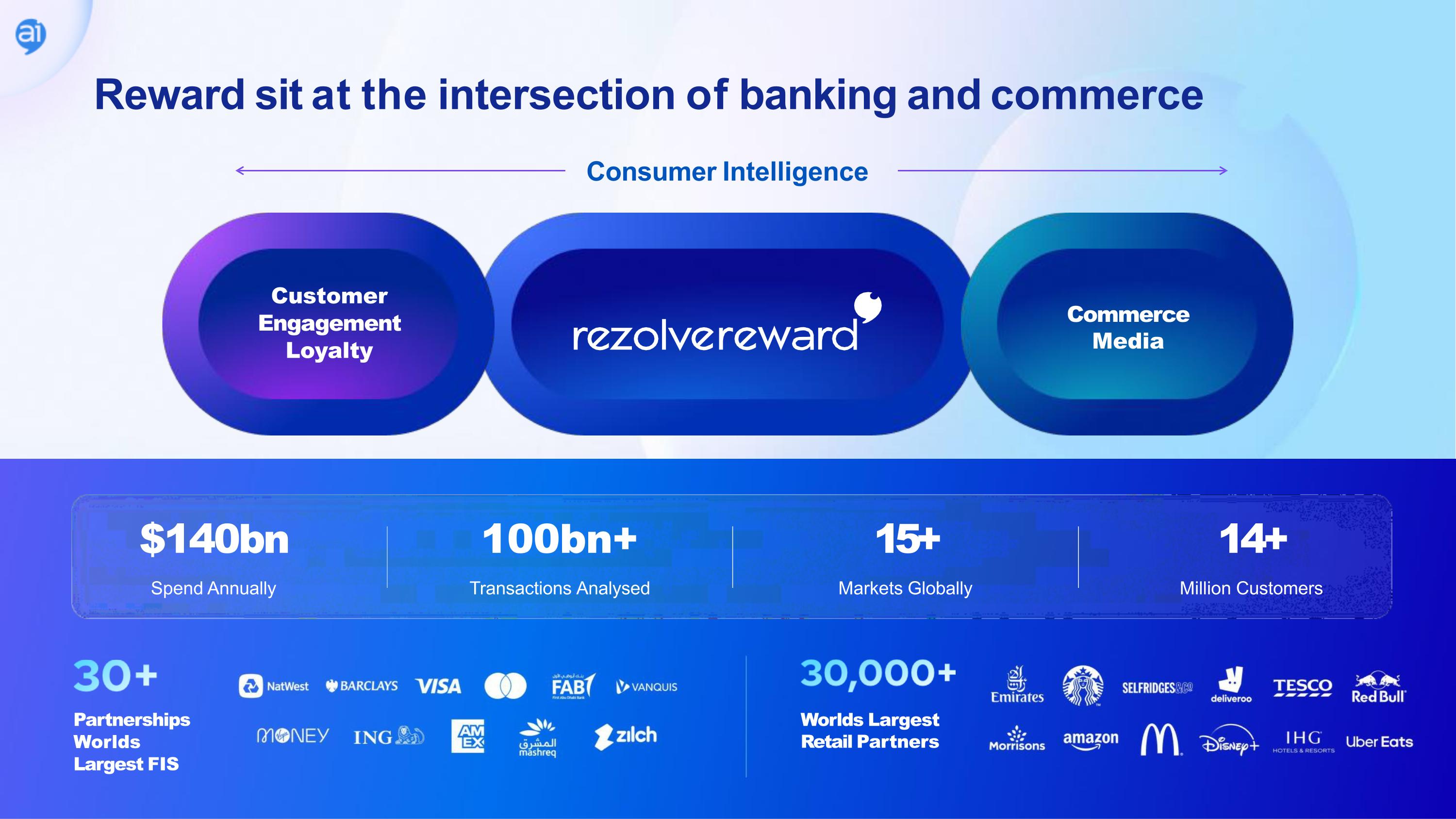
Presentation Name 38 Reward sit at the intersection of banking and commerce Commerce Media Customer Engagement Loyalty Consumer Intelligence $140bn Spend Annually 100bn+ Transactions Analysed 15+ Markets Globally 14+ Million Customers Partnerships Worlds Largest FIS Worlds Largest Retail Partners
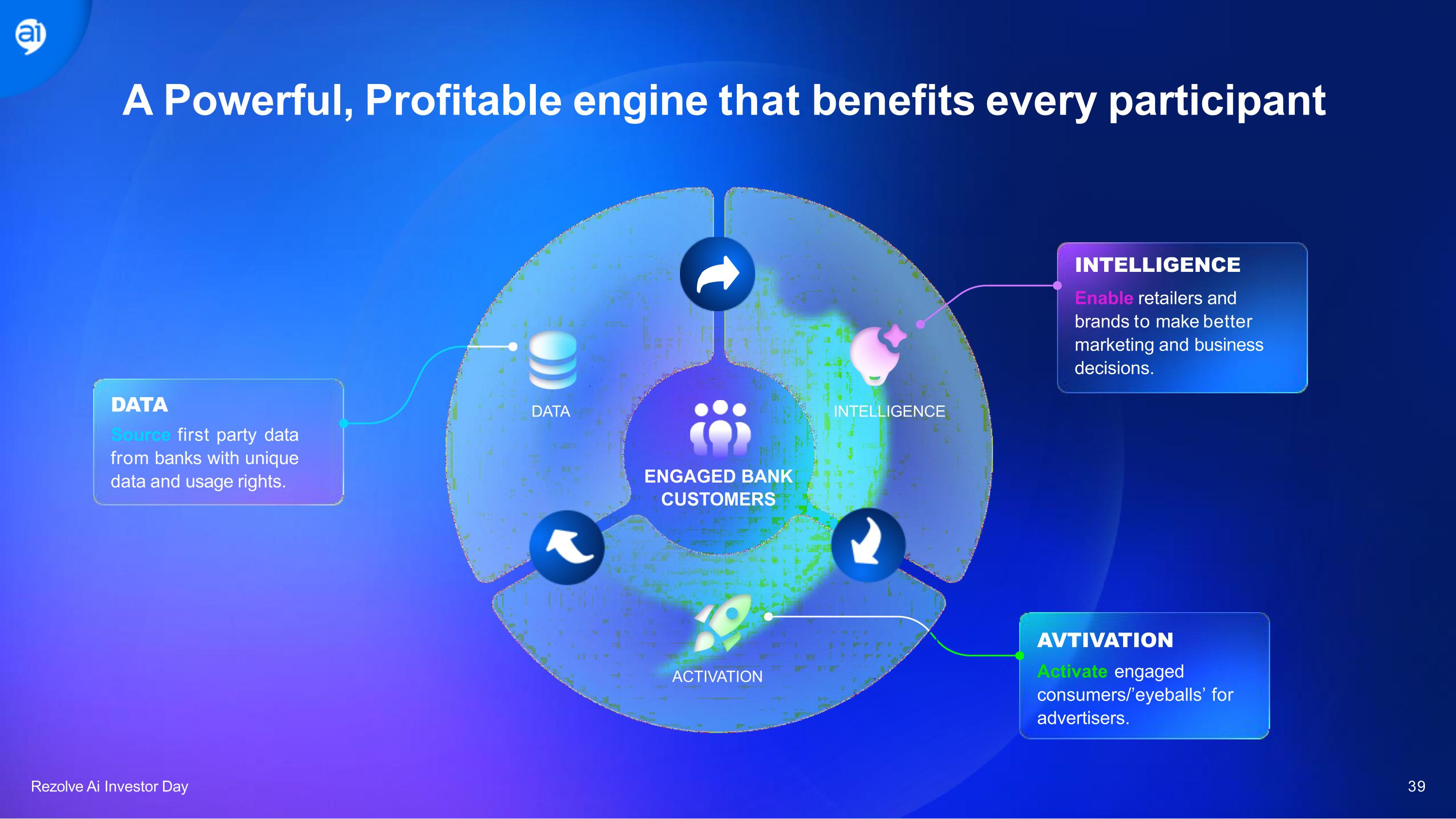
A Powerful, Profitable engine that benefits every participant INTELLIGENCE Enable retailers and brands to make better marketing and business decisions. AVTIVATION Activate engaged consumers/’eyeballs’ for advertisers. DATA Source first party data from banks with unique data and usage rights. DATA ACTIVATION INTELLIGENCE ENGAGED BANK CUSTOMERS Rezolve Ai Investor Day 39
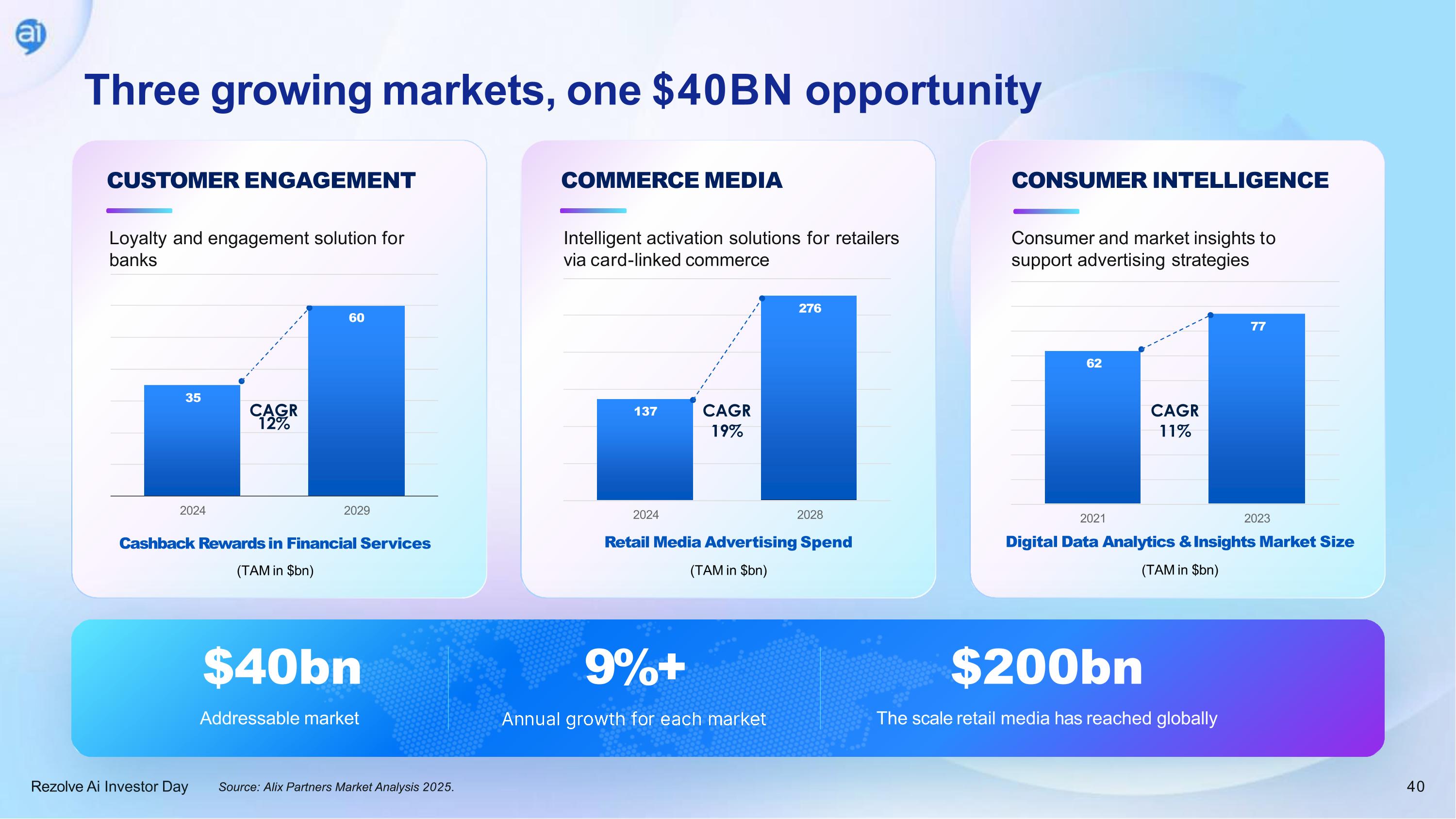
Rezolve Ai Investor Day 40 Three growing markets, one $40BN opportunity CUSTOMER ENGAGEMENT Loyalty and engagement solution for banks CONSUMER INTELLIGENCE Consumer and market insights to support advertising strategies COMMERCE MEDIA Intelligent activation solutions for retailers via card-linked commerce 60 35 CAGR 12% 2024 2029 Cashback Rewards in Financial Services (TAM in $bn) 137 276 CAGR 19% 2024 2028 Retail Media Advertising Spend (TAM in $bn) 62 77 CAGR 11% 2021 2023 Digital Data Analytics & Insights Market Size (TAM in $bn) $40bn Addressable market 9%+ $200bn The scale retail media has reached globally Source: Alix Partners Market Analysis 2025.

Rezolve Ai Investor Day

Rezolve Ai Investor Day
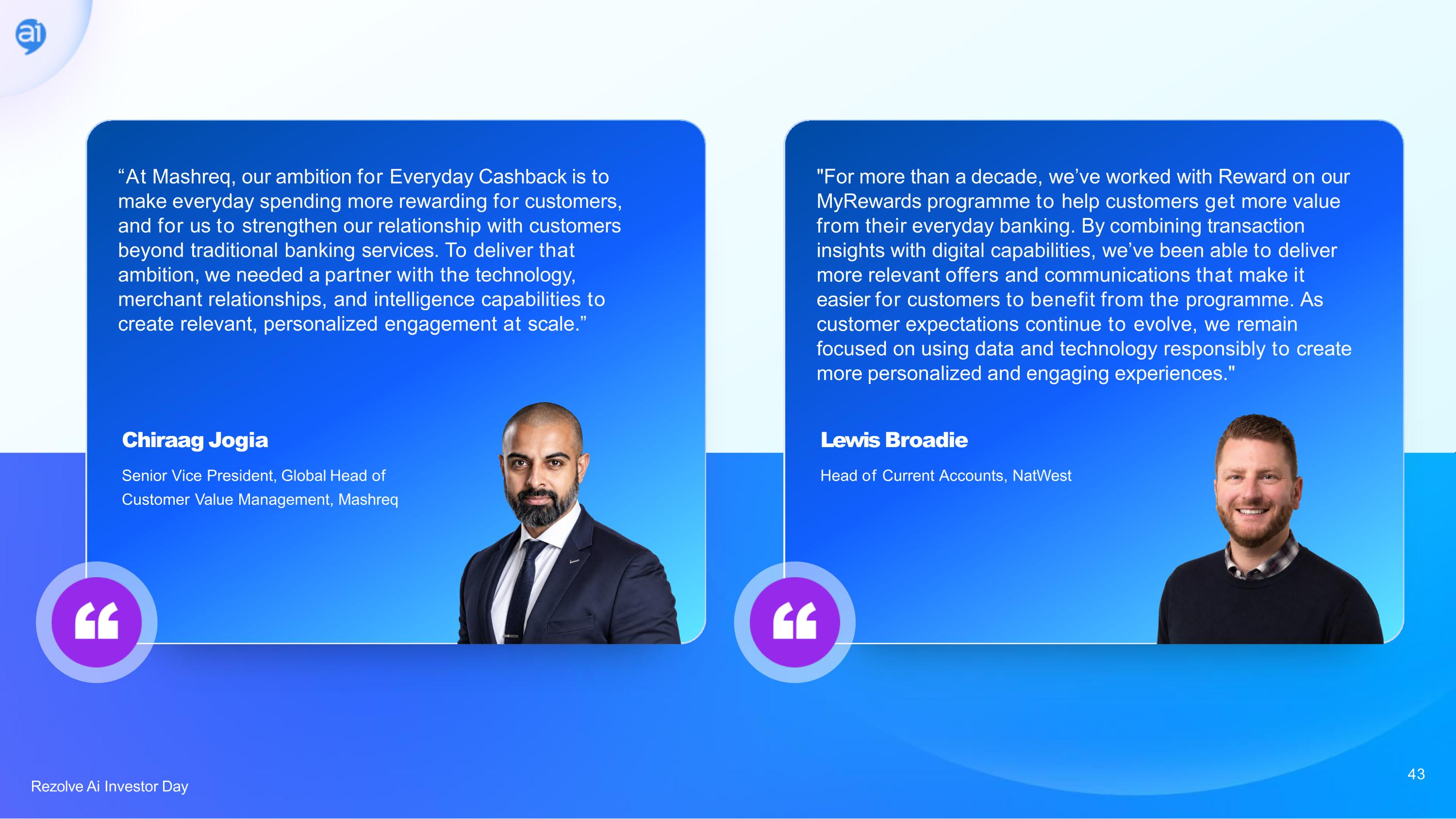
“At Mashreq, our ambition for Everyday Cashback is to make everyday spending more rewarding for customers, and for us to strengthen our relationship with customers beyond traditional banking services. To deliver that ambition, we needed a partner with the technology, merchant relationships, and intelligence capabilities to create relevant, personalized engagement at scale.” Chiraag Jogia Senior Vice President, Global Head of Customer Value Management, Mashreq "For more than a decade, we’ve worked with Reward on our MyRewards programme to help customers get more value from their everyday banking. By combining transaction insights with digital capabilities, we’ve been able to deliver more relevant offers and communications that make it easier for customers to benefit from the programme. As customer expectations continue to evolve, we remain focused on using data and technology responsibly to create more personalized and engaging experiences." Lewis Broadie Head of Current Accounts, NatWest 43 Rezolve Ai Investor Day
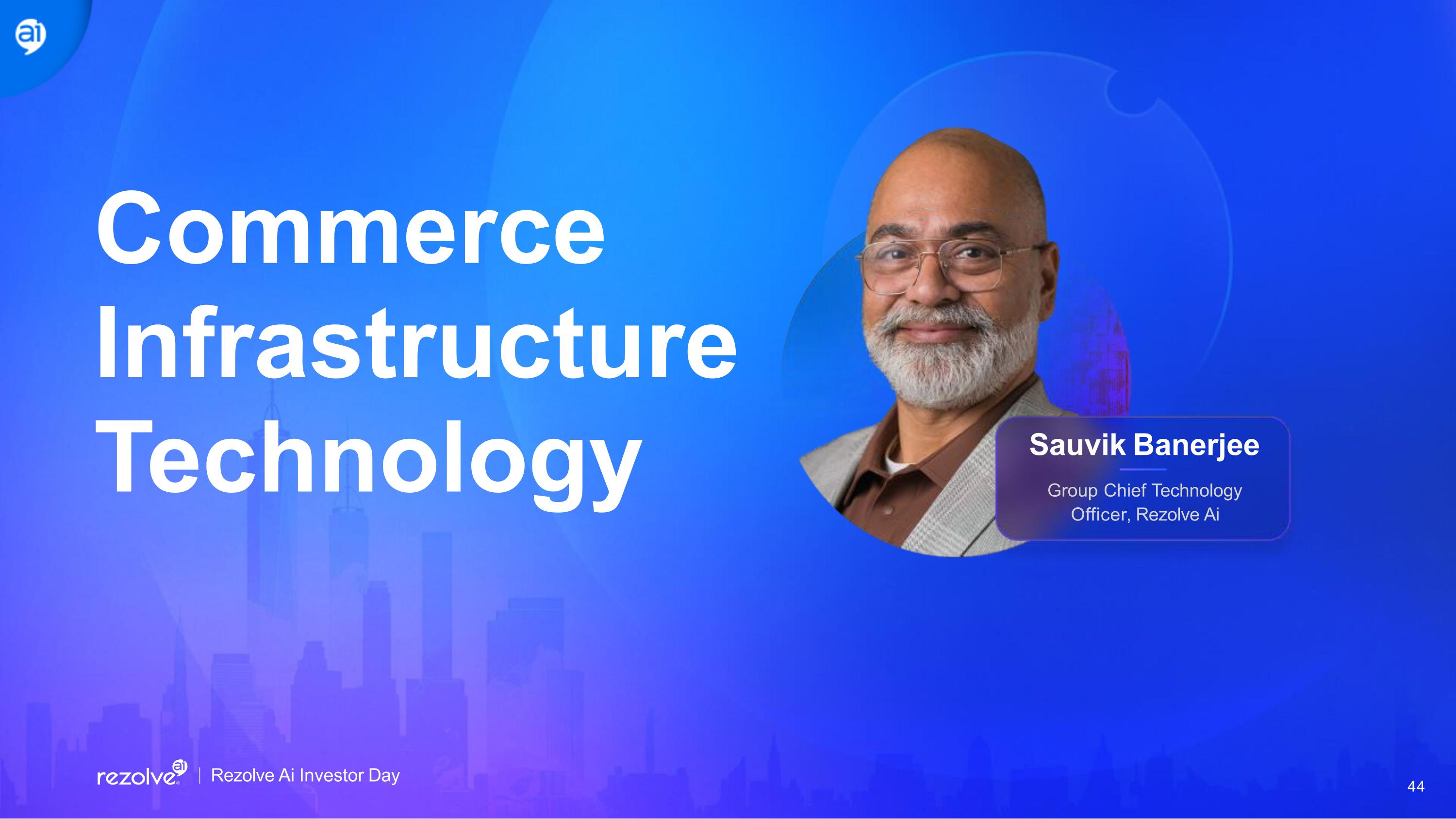
Sauvik Banerjee Group Chief Technology Officer, Rezolve Ai Rezolve Ai Investor Day 44 Commerce Infrastructure Technology
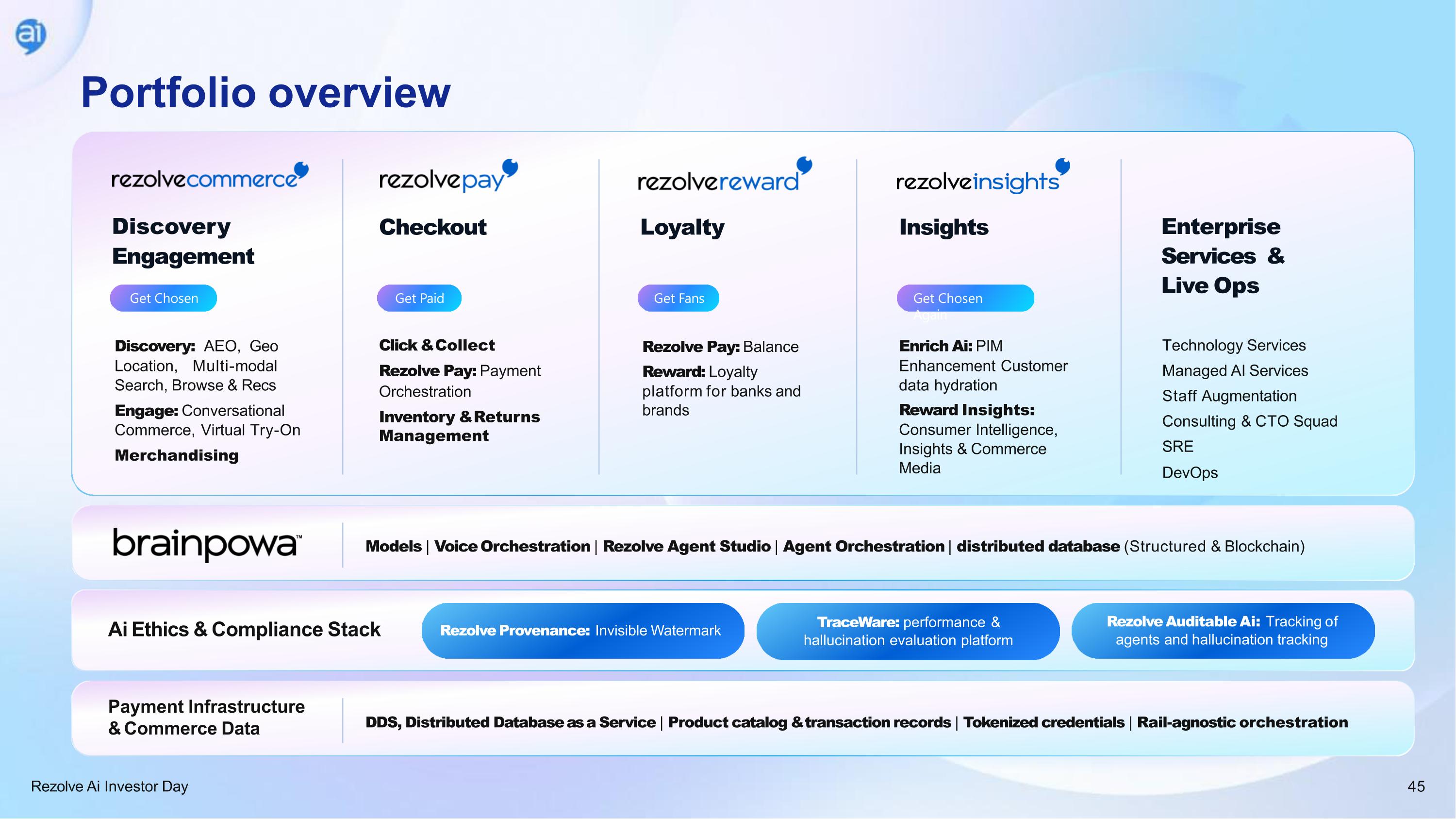
Portfolio overview Checkout Loyalty Insights Enterprise Services & Live Ops Discovery: AEO, Geo Location, Multi-modal Search, Browse & Recs Engage: Conversational Commerce, Virtual Try-On Merchandising Click & Collect Rezolve Pay: Payment Orchestration Inventory & Returns Management Rezolve Pay: Balance Reward: Loyalty platform for banks and brands Enrich Ai: PIM Enhancement Customer data hydration Reward Insights: Consumer Intelligence, Insights & Commerce Media Technology Services Managed AI Services Staff Augmentation Consulting & CTO Squad SRE DevOps Discovery Engagement Get Chosen Get Paid Get Fans Get Chosen Again Models | Voice Orchestration | Rezolve Agent Studio | Agent Orchestration | distributed database (Structured & Blockchain) Ai Ethics & Compliance Stack Rezolve Provenance: Invisible Watermark TraceWare: performance & hallucination evaluation platform Rezolve Auditable Ai: Tracking of agents and hallucination tracking Payment Infrastructure & Commerce Data DDS, Distributed Database as a Service | Product catalog & transaction records | Tokenized credentials | Rail-agnostic orchestration Rezolve Ai Investor Day
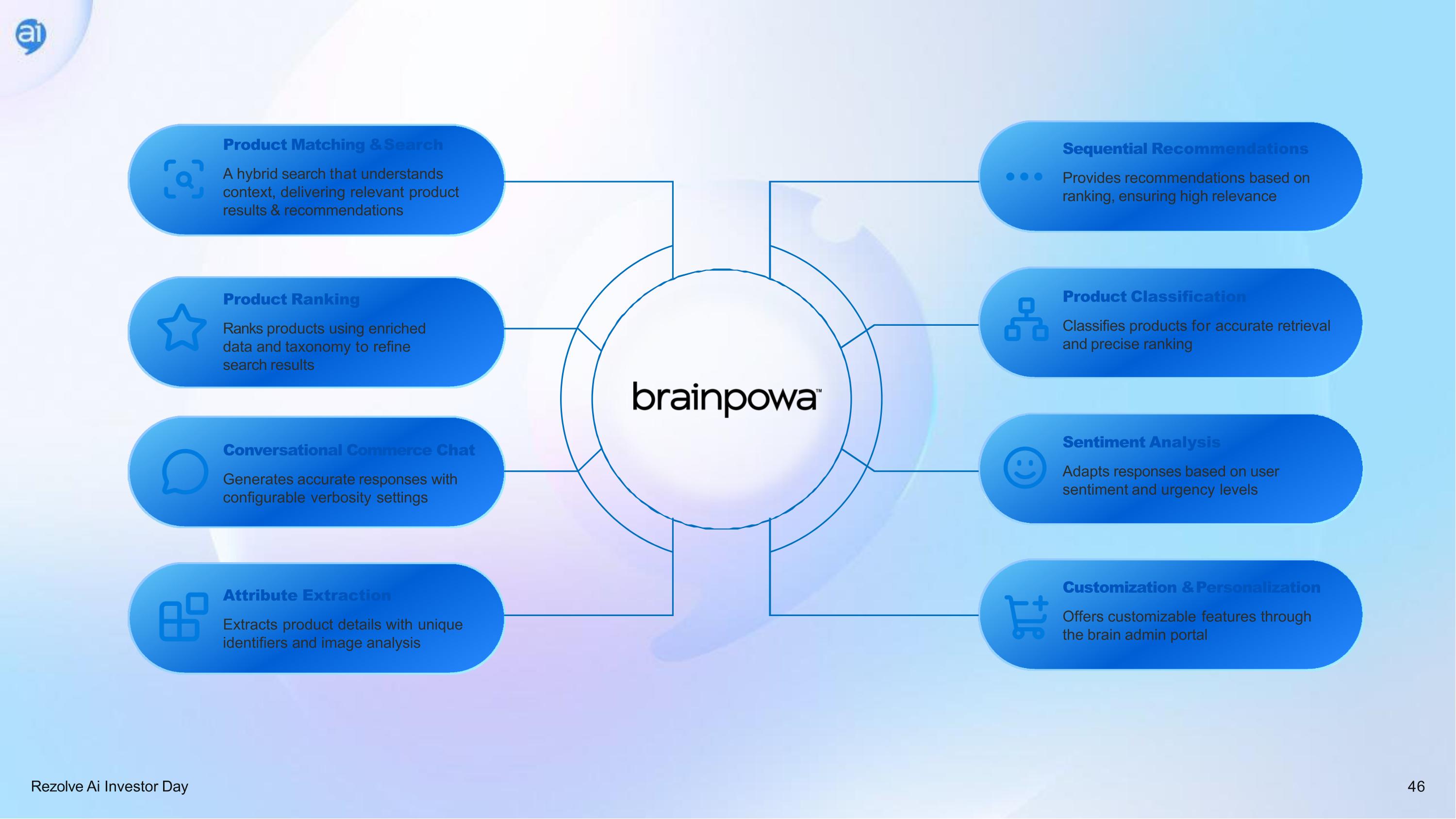
Product Matching & Search A hybrid search that understands context, delivering relevant product results & recommendations Product Ranking Ranks products using enriched data and taxonomy to refine search results Sequential Recommendations Provides recommendations based on ranking, ensuring high relevance Attribute Extraction Extracts product details with unique identifiers and image analysis Customization & Personalization Offers customizable features through the brain admin portal Product Classification Classifies products for accurate retrieval and precise ranking Sentiment Analysis Adapts responses based on user sentiment and urgency levels Conversational Commerce Chat Generates accurate responses with configurable verbosity settings Rezolve Ai Investor Day
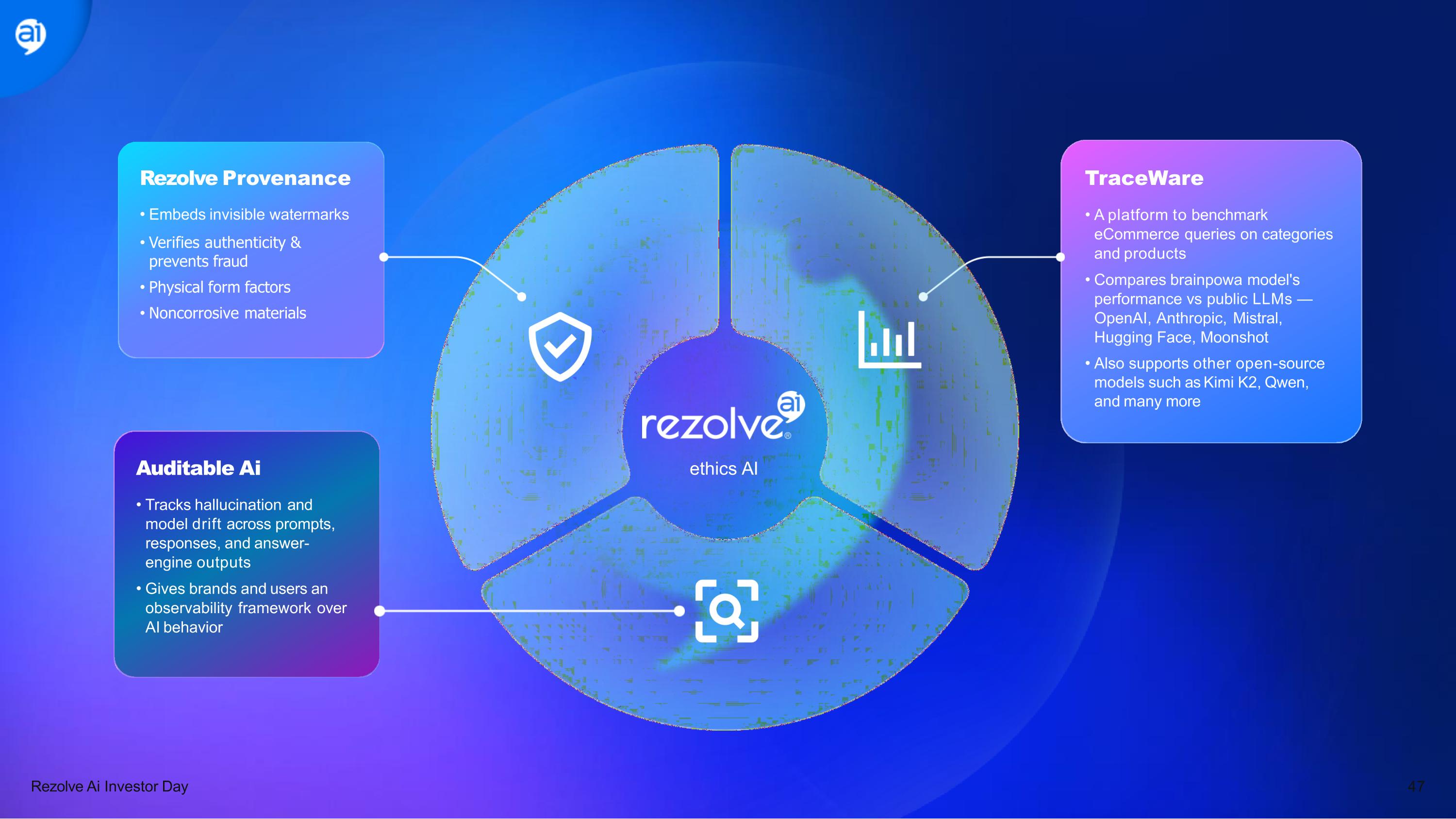
TraceWare A platform to benchmark eCommerce queries on categories and products Compares brainpowa model's performance vs public LLMs — OpenAI, Anthropic, Mistral, Hugging Face, Moonshot Also supports other open-source models such as Kimi K2, Qwen, and many more Rezolve Provenance Embeds invisible watermarks Verifies authenticity & prevents fraud Physical form factors Noncorrosive materials ethics AI Auditable Ai Tracks hallucination and model drift across prompts, responses, and answer- engine outputs Gives brands and users an observability framework over AI behavior Rezolve Ai Investor Day
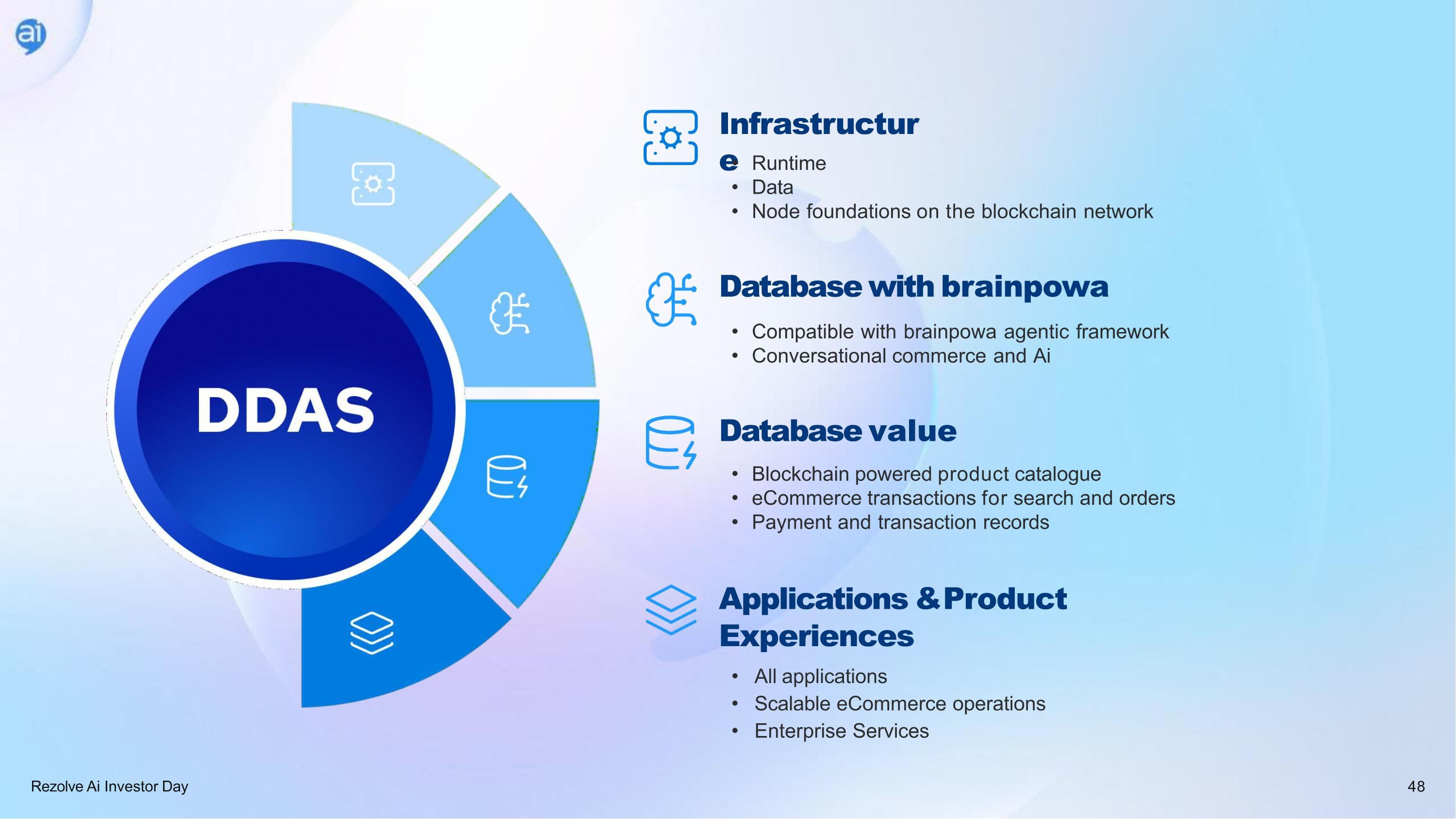
Infrastructure Runtime Data Node foundations on the blockchain network Database with brainpowa Compatible with brainpowa agentic framework Conversational commerce and Ai Database value Blockchain powered product catalogue eCommerce transactions for search and orders Payment and transaction records Applications & Product Experiences All applications Scalable eCommerce operations Enterprise Services Rezolve Ai Investor Day
Elizabeth Lachhar EVP Americas, Rezolve Ai Dr. Steve Perry Non-Executive Director, Rezolve Ai Rezolve Ai Investor Day Capitalizing on the Opportunity
Partnership Panel Saurabh Atri Head of Retail Growth & Transformation, East Region, Tata Consultancy Services Kimberly McKinley Senior Director, Microsoft Frontier Company Howe Gu Group SVP, Customer & Partners, Rezolve Ai Rezolve Ai Investor Day
Yekaterina Gusin Deputy Chief Financial Officer, Rezolve Ai Arthur Yao Chief Financial Officer, Rezolve Ai Rezolve Ai Investor Day Financial Overview
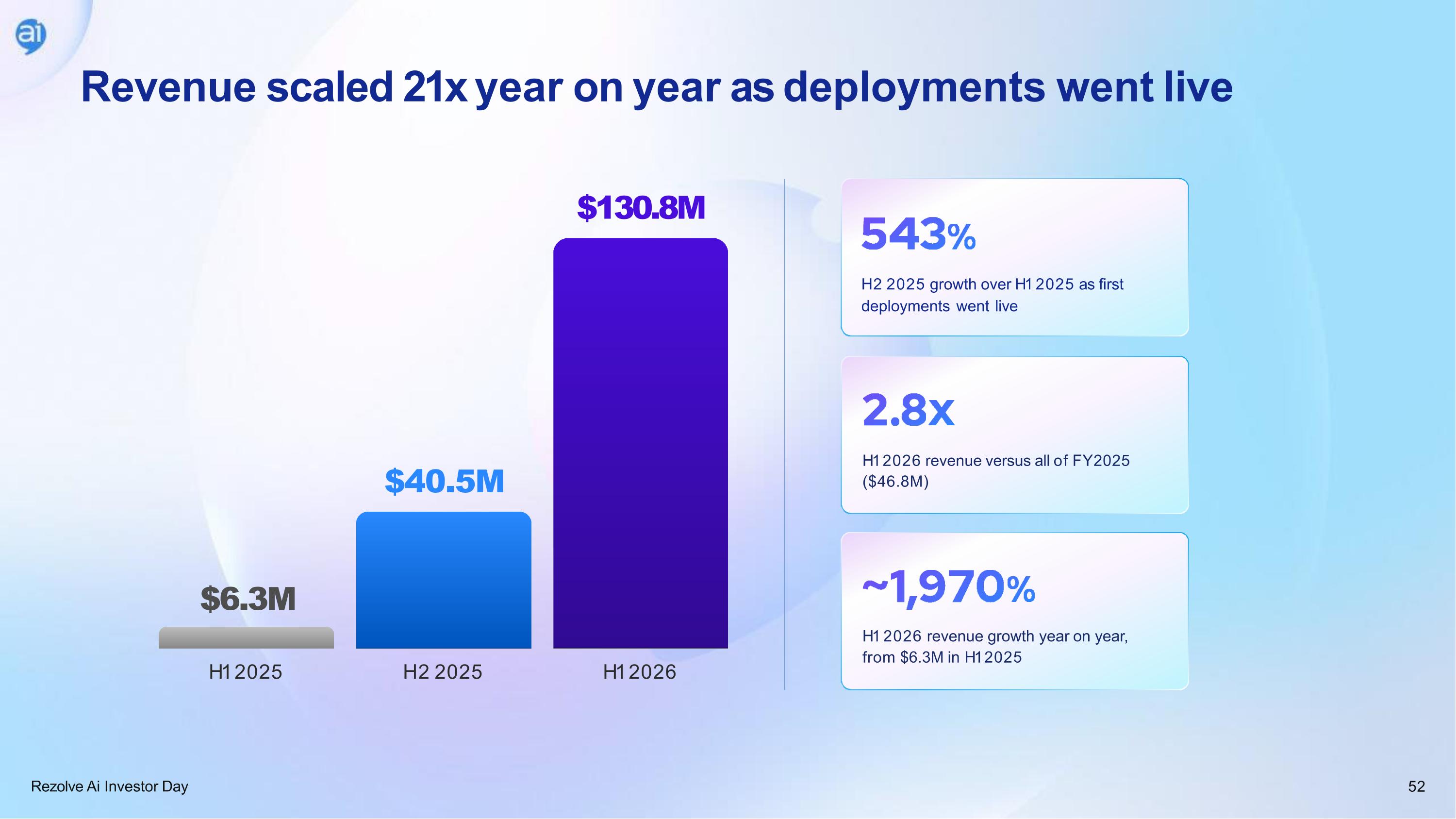
Revenue scaled 21x year on year as deployments went live $6.3M $40.5M $130.8M H1 2025 H2 2025 H1 2026 H2 2025 growth over H1 2025 as first deployments went live H1 2026 revenue versus all of FY2025 ($46.8M) H1 2026 revenue growth year on year, from $6.3M in H1 2025 Rezolve Ai Investor Day
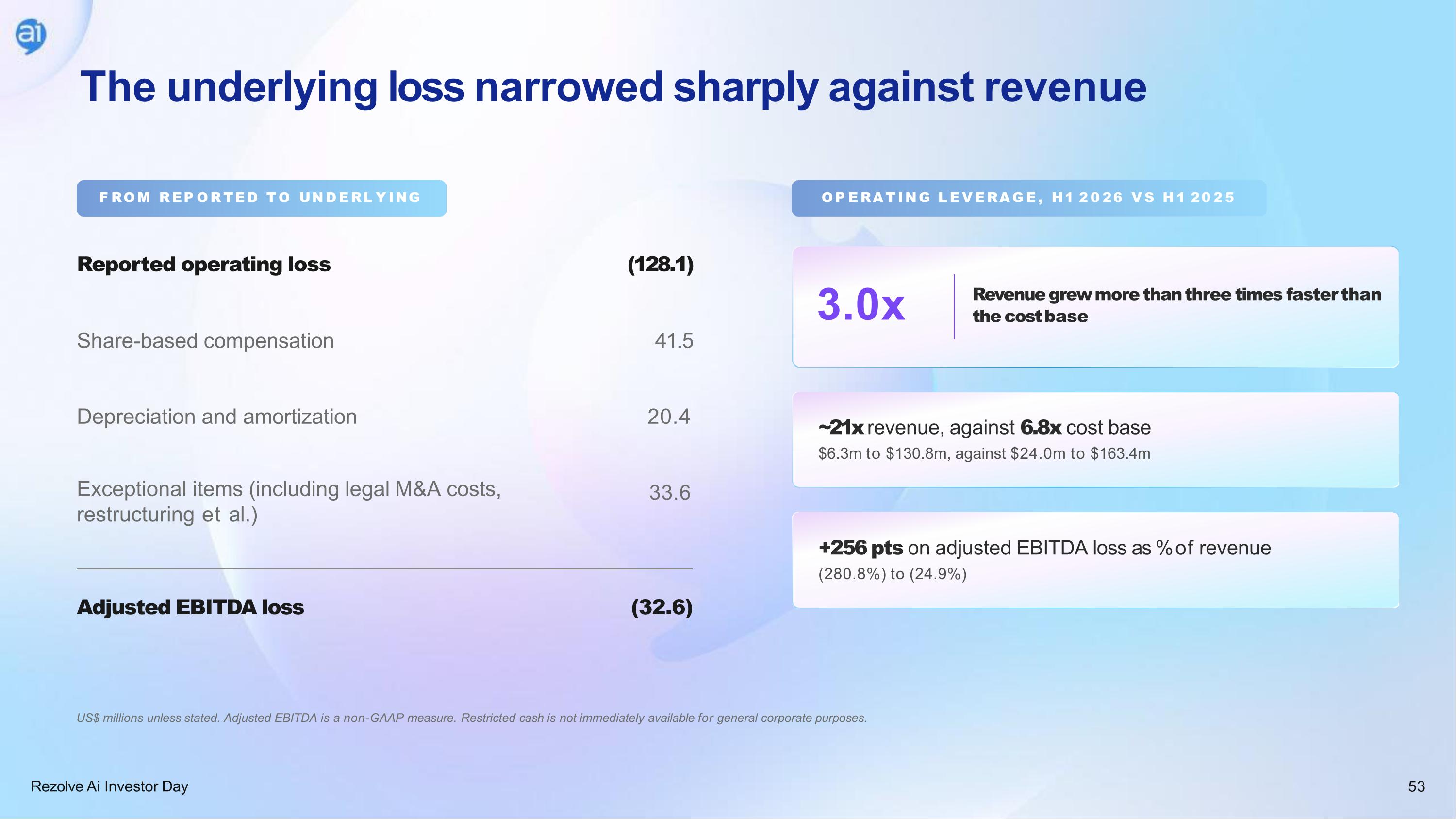
The underlying loss narrowed sharply against revenue Reported operating loss (128.1) Share-based compensation 41.5 Depreciation and amortization 20.4 Exceptional items (including legal M&A costs, restructuring et al.) 33.6 Adjusted EBITDA loss (32.6) F R O M R E P O R T E D T O U N D E R L Y I N G O P E R A T I N G L E V E R A G E , H 1 2 0 2 6 V S H 1 2 0 2 5 US$ millions unless stated. Adjusted EBITDA is a non-GAAP measure. Restricted cash is not immediately available for general corporate purposes. Revenue grew more than three times faster than the cost base ~21x revenue, against 6.8x cost base $6.3m to $130.8m, against $24.0m to $163.4m +256 pts on adjusted EBITDA loss as % of revenue (280.8%) to (24.9%) 3.0x Rezolve Ai Investor Day
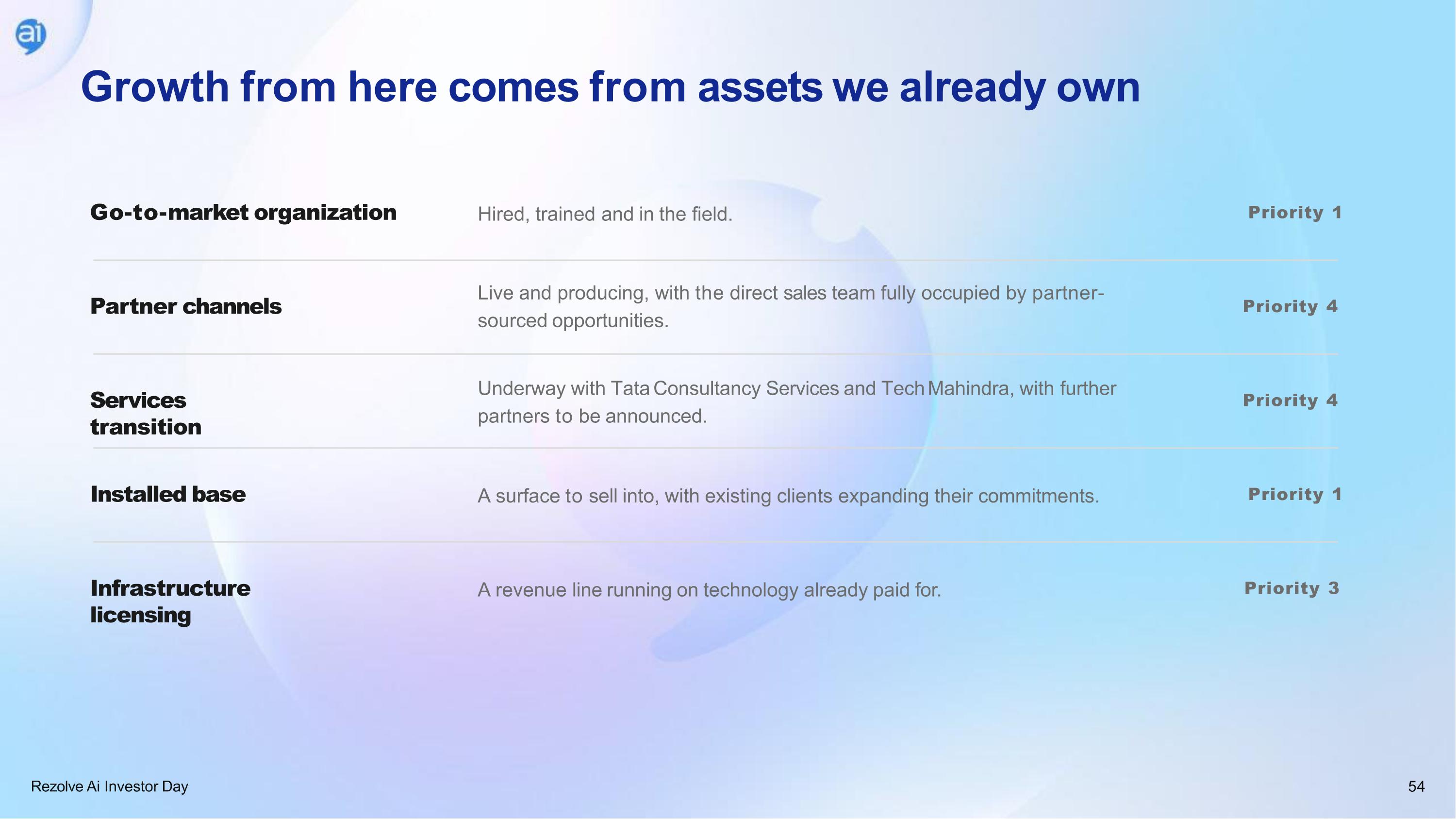
Growth from here comes from assets we already own Go-to-market organization Hired, trained and in the field. Partner channels Live and producing, with the direct sales team fully occupied by partner-sourced opportunities. Priority 4 Services transition Underway with Tata Consultancy Services and Tech Mahindra, with further partners to be announced. Priority 4 Installed base A surface to sell into, with existing clients expanding their commitments. Priority 1 Infrastructure licensing Rezolve Ai Investor Day A revenue line running on technology already paid for. Priority 3 Priority 1
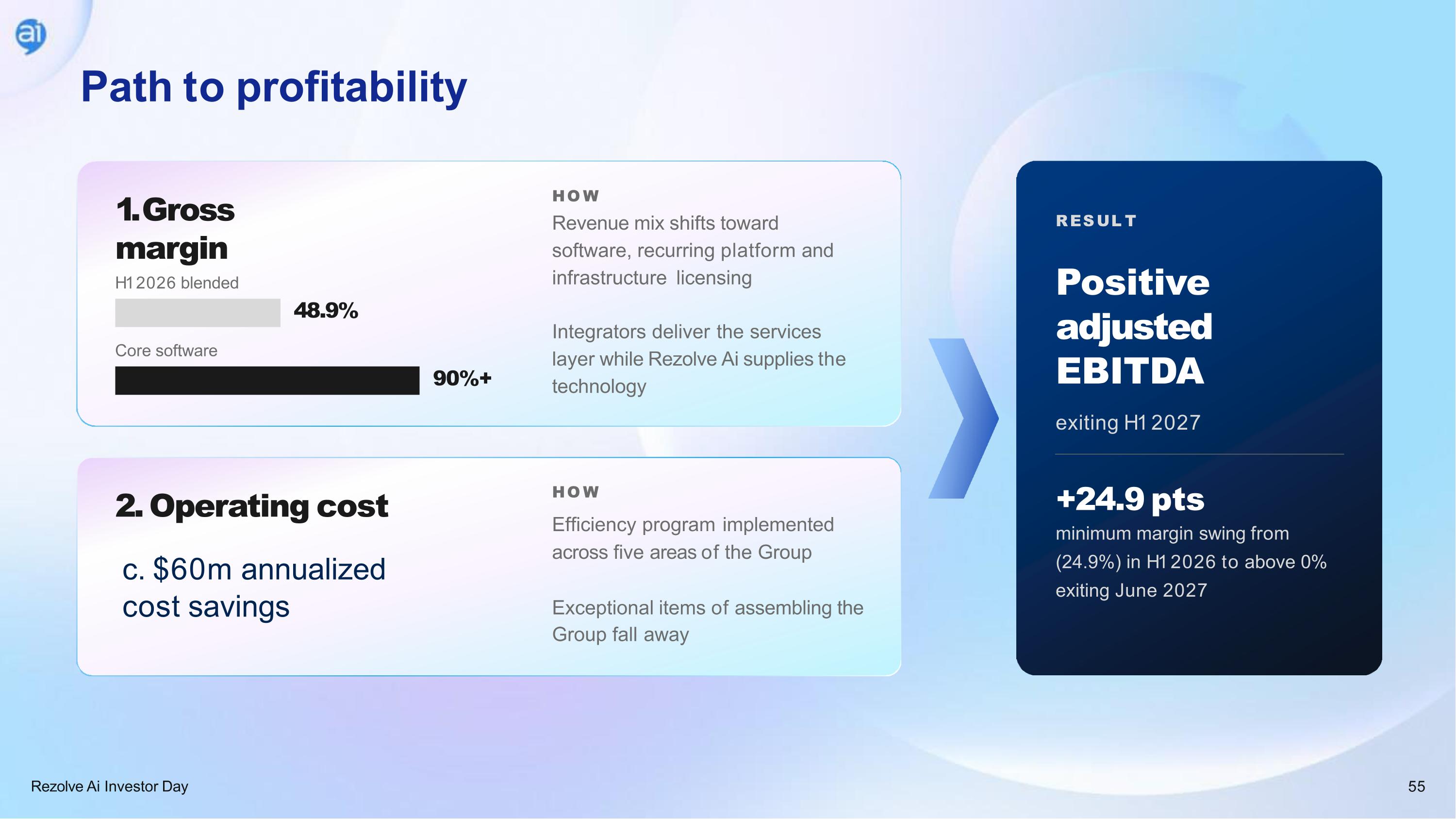
Path to profitability 1. Gross margin H1 2026 blended 48.9% Core software 90%+ H O W Revenue mix shifts toward software, recurring platform and infrastructure licensing Integrators deliver the services layer while Rezolve Ai supplies the technology H O W Efficiency program implemented across five areas of the Group Exceptional items of assembling the Group fall away 2. Operating cost c. $60m annualized cost savings R E S U L T Positive adjusted EBITDA exiting H1 2027 +24.9 pts minimum margin swing from (24.9%) in H1 2026 to above 0% exiting June 2027 Rezolve Ai Investor Day
Dan Wagner Founder, Chairman & CEO, Rezolve Ai Rezolve Ai Investor Day 56 Closing Remarks
Rezolve Ai Investor Day
